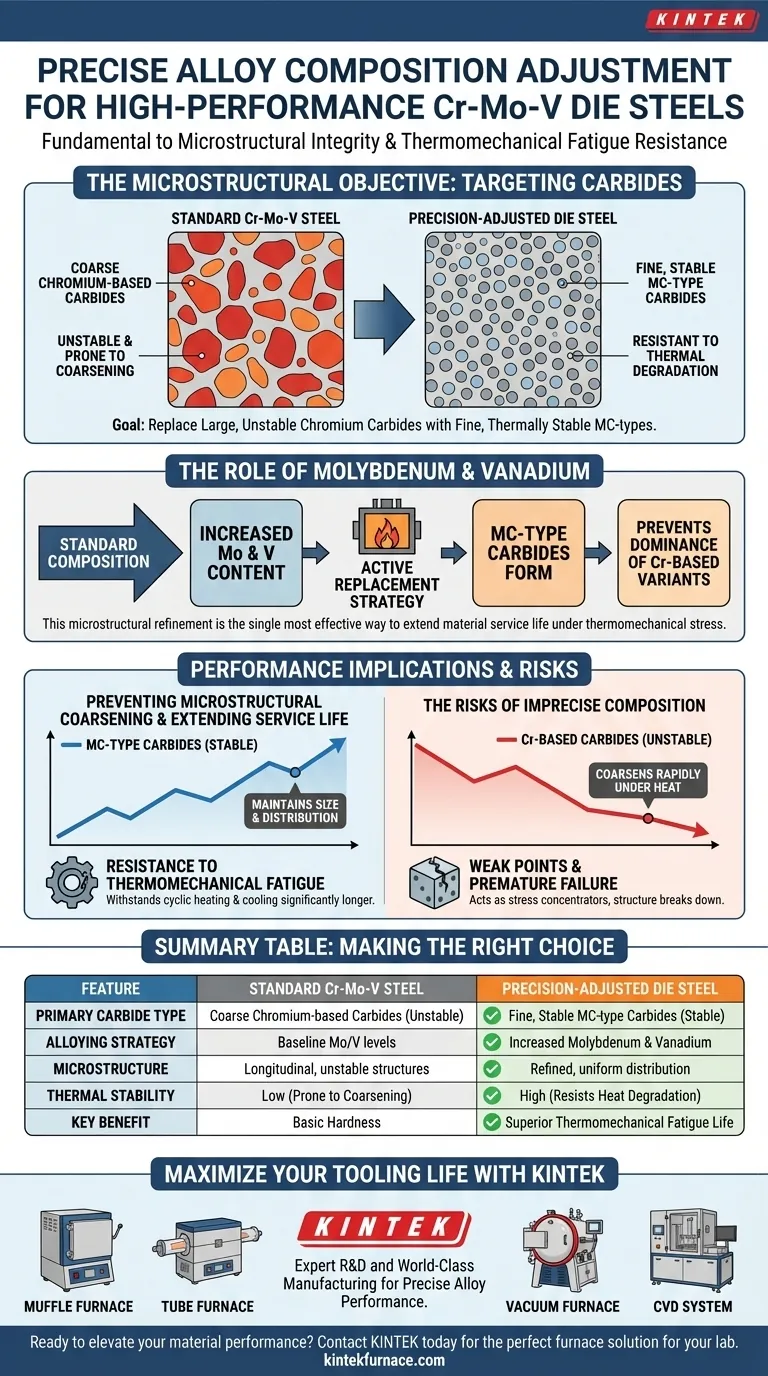
Precise alloy composition adjustment is fundamental to controlling the microstructural integrity of high-performance Cr-Mo-V die steels. It is strictly necessary to modify the type and distribution of carbides, specifically by increasing molybdenum and vanadium content to foster thermally stable MC-type carbides. This process eliminates coarse chromium-based carbides, significantly enhancing the material's resistance to thermomechanical fatigue.
The central goal of composition adjustment is to replace large, unstable chromium carbides with fine, thermally stable MC-type carbides. This microstructural refinement is the single most effective way to extend the material's service life under thermomechanical stress.
The Microstructural Objective
To understand the necessity of this process, one must look beyond the elemental list and examine how these elements interact at a microscopic level.
Targeting Carbide Types
The primary objective of adjusting the alloy composition is to fundamentally alter the carbide precipitation. Standard die steels often contain chromium-based longitudinal carbides.
These chromium structures are detrimental because they are coarse and unstable. Precision adjustment is required to shift the balance away from these structures and toward more desirable formations.
The Role of Molybdenum and Vanadium
The mechanism for this shift lies in the accurate increase of specific alloying elements. By boosting the content of molybdenum and vanadium, metallurgists force the steel to form MC-type carbides.
This is not a passive change; it is an active replacement strategy. The presence of adequate Molybdenum and Vanadium prevents the dominance of the chromium-based variants.
Performance Implications
The reason for chasing this specific microstructure is directly tied to the operational lifespan of the tool.
Preventing Microstructural Coarsening
Chromium-based carbides are prone to coarsening over time, especially under heat. When carbides grow large and coarse, the material loses toughness and homogeneity.
In contrast, MC-type carbides are thermally stable. They maintain their size and distribution even under the high temperatures inherent in die casting and forging operations.
Extending Service Life
The ultimate output of this chemical precision is resistance to thermomechanical fatigue.
Die steels are subjected to cyclic heating and cooling, which creates immense stress. By replacing unstable carbides with stable MC-types, the material can withstand these cycles significantly longer without degrading.
The Risks of Imprecise Composition
While the benefits of adjustment are clear, failing to achieve the precise balance creates specific vulnerabilities.
The Persistence of Weak Points
If the molybdenum and vanadium levels are not adjusted high enough, the formation of MC-type carbides will be insufficient.
This leaves the coarse chromium-based longitudinal carbides in place. These structures act as stress concentrators and weak points within the steel matrix.
Vulnerability to Thermal Environment
Without the thermal stability provided by MC-carbides, the steel remains prone to rapid degradation.
In a thermomechanical fatigue environment, a lack of precision leads to premature tool failure as the unstable carbides coarsen and the material structure breaks down.
Making the Right Choice for Your Goal
When selecting or specifying high-performance die steels, your focus should be on the intended operating environment and the required longevity of the tool.
- If your primary focus is Maximum Fatigue Life: Ensure the alloy composition has been optimized with elevated Molybdenum and Vanadium levels to maximize MC-type carbide formation.
- If your primary focus is Microstructural Stability: Verify that the processing method explicitly targets the reduction of coarse chromium-based longitudinal carbides.
True performance in die steels is not just about hardness; it is about the thermal stability of the carbide network.
Summary Table:
| Feature | Standard Cr-Mo-V Steel | Precision-Adjusted Die Steel |
|---|---|---|
| Primary Carbide Type | Coarse Chromium-based Carbides | Fine, Stable MC-type Carbides |
| Alloying Strategy | Baseline Mo/V levels | Increased Molybdenum & Vanadium |
| Microstructure | Longitudinal, unstable structures | Refined, uniform distribution |
| Thermal Stability | Low (prone to coarsening) | High (resists heat degradation) |
| Key Benefit | Basic hardness | Superior Thermomechanical Fatigue Life |
Maximize Your Tooling Life with KINTEK
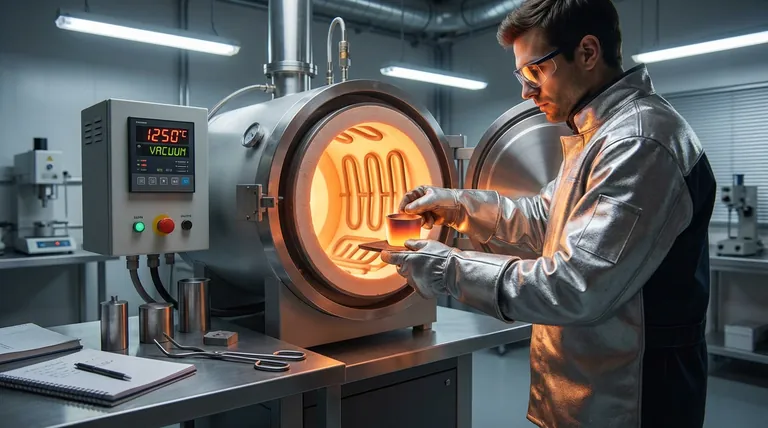
Precise alloy performance requires exact thermal processing. At KINTEK, we understand that achieving the perfect MC-type carbide distribution in Cr-Mo-V die steels depends on superior temperature control and vacuum integrity.
Backed by expert R&D and world-class manufacturing, KINTEK offers a comprehensive range of Muffle, Tube, Rotary, Vacuum, and CVD systems. Whether you are refining high-performance die steels or developing specialized alloys, our lab high-temp furnaces are fully customizable to meet your unique metallurgical needs.
Ready to elevate your material performance? Contact KINTEK today to consult with our experts on the perfect furnace solution for your lab.
Visual Guide
References
- Yasha Yuan, Jingpei Xie. Strain-Controlled Thermal–Mechanical Fatigue Behavior and Microstructural Evolution Mechanism of the Novel Cr-Mo-V Hot-Work Die Steel. DOI: 10.3390/ma18020334
This article is also based on technical information from Kintek Furnace Knowledge Base .
Related Products
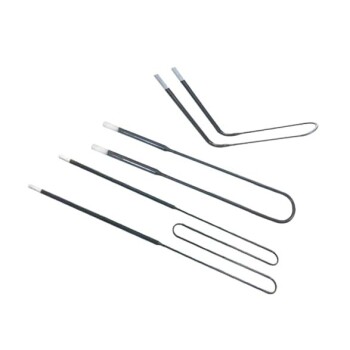
- Molybdenum Disilicide MoSi2 Thermal Heating Elements for Electric Furnace
- Multi Heating Zones CVD Tube Furnace Machine for Chemical Vapor Deposition Equipment
- 915MHz MPCVD Diamond Machine Microwave Plasma Chemical Vapor Deposition System Reactor
- High Temperature Muffle Oven Furnace for Laboratory Debinding and Pre Sintering
- Molybdenum Vacuum Heat Treat Furnace
People Also Ask
- What are the typical application temperatures for molybdenum disilicide (MoSi2) heating elements? Master High-Temp Performance
- What is the primary use of molybdenum disilicide? Ideal for High-Temp Heating Elements
- What are the characteristics of molybdenum disilicide heating elements? Unlock High-Temp Performance
- What are the properties of molybdenum disilicide (MoSi2) that make it suitable for high-temperature applications? Discover Its High-Temp Resilience
- What are the applications of molybdenum disilicide heating elements? Achieve Extreme Heat Stability for Industrial Processes