
Using a vacuum drying oven is the superior method for preparing ZIF67/MXene composites because it lowers the ambient pressure, allowing solvents to evaporate rapidly at significantly reduced temperatures. This process eliminates the need for high heat, protecting the composite from the thermal degradation, oxidation, and structural collapse that typically occur in traditional ovens.
Core Takeaway The primary value of vacuum drying is the preservation of electrochemical performance. By removing solvents at low temperatures in an oxygen-free environment, you maintain the composite's delicate porous architecture and chemical stability—both of which are critical for efficient ion transport in electrocatalytic applications.
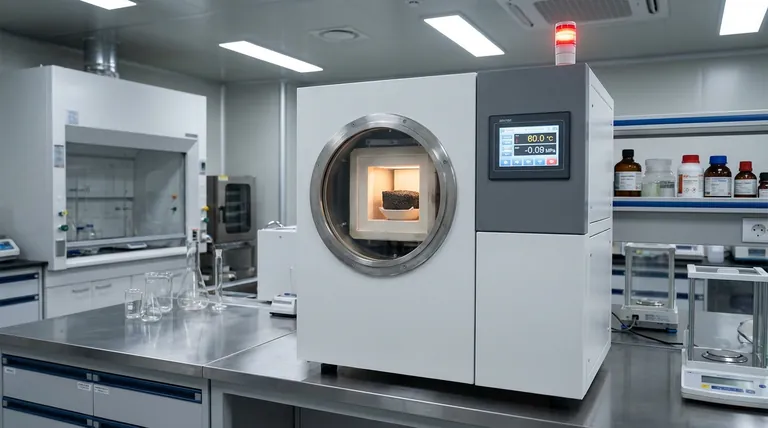
Preserving Material Integrity Through Physics
The Thermodynamics of Low-Temperature Drying
The fundamental advantage of a vacuum oven is the manipulation of boiling points. By reducing the pressure inside the chamber, solvents like ethanol or methanol volatilize at much lower temperatures (typically 50°C to 70°C) than they would at standard atmospheric pressure.
This allows you to dehydrate the material thoroughly without subjecting the heat-sensitive ZIF67 framework or MXene sheets to destructive thermal stress.
Protection Against Chemical Oxidation
MXene is a two-dimensional material with high surface activity, making it highly susceptible to oxidation when exposed to heated air. A traditional oven acts as an oxidizing environment, which degrades the electrochemical activity of the material.
A vacuum oven operates in a negative pressure environment, effectively removing oxygen from the chamber. This preserves the surface functional groups of the MXene and ensures the chemical stability of the ZIF67/MXene composite is maintained throughout the drying phase.
Enhancing Electrochemical Performance
Maintaining Pore Architecture
For electrocatalytic applications, the internal structure of the material is just as important as its chemistry. In a traditional oven, the capillary forces exerted during high-temperature evaporation can cause pores to collapse.
Vacuum drying prevents this pore closure. It maintains a well-developed internal pore structure, which is essential for facilitating ion transport and maximizing the specific surface area of the final composite.
Preventing Agglomeration
Vacuum drying promotes a loose physical morphology in precursor materials. By avoiding the rapid, uneven heating of standard ovens, the vacuum method prevents material clumping or agglomeration.
This ensures the composite remains uniform, which significantly improves the consistency of subsequent processing steps such as grinding or pyrolysis.
Common Pitfalls to Avoid
Ignoring Temperature Precision
While vacuum ovens allow for lower temperatures, they do not make the material immune to heat. A common mistake is assuming the vacuum environment alone is sufficient protection. You must strictly adhere to the recommended range of 60°C to 80°C. Exceeding this—even under vacuum—can still lead to the thermal degradation of the ZIF67 framework.
Overlooking Solvent Dynamics
The vacuum environment accelerates evaporation, but it requires careful management of solvent release. Rapid volatilization is beneficial for drying speed, but without controlled pressure reduction, it can lead to uncontrolled "bumping" of the material. A gradual reduction in pressure is often necessary to maintain the structural uniformity of the composite.
Making the Right Choice for Your Goal
To maximize the performance of your ZIF67/MXene composite, align your drying strategy with your specific research objectives:
- If your primary focus is Structural Fidelity: Use vacuum drying to prevent pore closure, ensuring the high surface area required for maximum ion transport.
- If your primary focus is Chemical Stability: Rely on the vacuum environment to eliminate oxygen, protecting the highly reactive MXene nanosheets from oxidation during the drying process.
Summary: Vacuum drying is not just a faster alternative; it is a critical processing step that safeguards the micro-structural and chemical properties required for high-performance electrocatalytic materials.
Summary Table:
| Feature | Vacuum Drying Oven | Traditional Convection Oven |
|---|---|---|
| Drying Temperature | Low (50°C - 70°C) | High (Standard Boiling Points) |
| Atmosphere | Oxygen-free / Negative Pressure | Ambient Air (Oxidizing) |
| Pore Structure | Preserved & Well-developed | Risk of Thermal Collapse |
| Chemical Stability | High (Protects MXene surface) | Low (Susceptible to Oxidation) |
| Material Morphology | Loose & Uniform | High Risk of Agglomeration |
Maximize Your Research Precision with KINTEK
Don’t let thermal degradation or oxidation compromise your ZIF67/MXene composite performance. Backed by expert R&D and manufacturing, KINTEK offers specialized Vacuum, Muffle, Tube, and CVD systems tailored for the delicate requirements of advanced materials science. Our high-temperature lab furnaces are fully customizable to ensure your unique drying and pyrolysis needs are met with unmatched precision.
Ready to elevate your material integrity?
Contact KINTEK today to discuss your custom furnace solution.
References
- Komal Farooq, Yongde Xia. MXene boosted MOF-derived cobalt sulfide/carbon nanocomposites as efficient bifunctional electrocatalysts for OER and HER. DOI: 10.1039/d4na00290c
This article is also based on technical information from Kintek Furnace Knowledge Base .
Related Products
- Vacuum Heat Treat Sintering and Brazing Furnace
- Vacuum Heat Treat Sintering Furnace Molybdenum Wire Vacuum Sintering Furnace
- Dental Porcelain Zirconia Sintering Ceramic Vacuum Press Furnace
- Molybdenum Vacuum Heat Treat Furnace
- Vacuum Hot Press Furnace Machine Heated Vacuum Press
People Also Ask
- How does vacuum heat treating affect the grain structure of metal alloys? Achieve Precise Microstructure Control
- What are the benefits of using vacuum heat treating furnaces for metal alloys? Achieve Superior Metal Properties and Performance
- What is one of the most important uses of vacuum heat treating furnaces in aerospace? Achieve Superior Strength in Aircraft Alloys
- What is the temperature of a vacuum furnace brazing? Optimize Your Joint Strength and Cleanliness
- What are the steps involved in a typical vacuum brazing treatment? Master the Process for Strong, Clean Joints












