
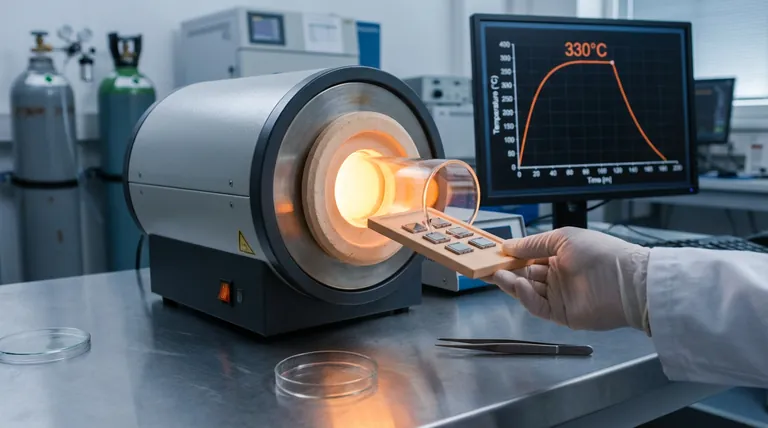
The Annealing Furnace acts as the definitive stabilization step in the fabrication of high-performance gas sensors. By subjecting sensor samples—specifically those utilizing materials like Indium-doped Tin Oxide (In-doped SnO2)—to precise thermal treatment around 330 °C, the furnace fundamentally alters the material's microstructure to ensure functionality.
The primary value of annealing lies in its ability to eliminate internal material stress and refine crystal quality, converting a raw fabrication into a stable device with high sensitivity and long-term reliability.
Optimizing Material Structure
Eliminating Residual Stress
During the initial deposition of thin films, materials often develop significant internal tension. The annealing furnace applies controlled heat to relax these structures.
By maintaining temperatures around 330 °C, the process effectively removes residual internal stresses. This prevents mechanical failures such as cracking or delamination in the delicate sensing layers.
Enhancing Crystal Quality
Beyond stress relief, thermal treatment is essential for ordering the atomic structure of the sensor. The heat provided by the furnace promotes better crystallization within the sensing layer.
For materials like In-doped SnO2, this results in a higher quality crystal lattice. A superior crystal structure is the foundation for consistent electron flow and surface interaction.
Improving Operational Performance
Stabilizing Electrical Properties
A sensor with a disordered internal structure will exhibit erratic electrical behavior. Annealing standardizes these properties, creating a predictable baseline for the device.
By stabilizing the electrical characteristics, the furnace ensures that the sensor's readings are a result of gas interaction, not internal structural changes.
Maximizing Sensitivity and Longevity
The ultimate goal of post-processing is to enhance how the sensor reacts to its target environment. The primary reference highlights that this process significantly boosts sensitivity to gases such as ethanol vapor.
Furthermore, this treatment directly correlates to the device's lifespan. By fixing the microstructure early, the annealing process ensures the sensor maintains its performance stability over a long period.
Understanding the Process Constraints
The Importance of Temperature Precision
While annealing is beneficial, it requires strict adherence to specific temperature profiles. The reference specifies 330 °C for specific Indium-doped samples to achieve optimal results.
Deviating significantly from the target temperature can fail to relieve stress or, conversely, damage the thin film.
Material-Specific Requirements
It is critical to note that the parameters for annealing are dictated by the material composition.
The benefits described—stress elimination and crystal enhancement—are universal goals, but the specific execution depends on the doping agents and oxides used in your specific sensor design.
Making the Right Choice for Your Goal
To maximize the effectiveness of your sensor fabrication process, consider your specific performance metrics:
- If your primary focus is High Sensitivity: Ensure your annealing profile is optimized to maximize crystal quality, which directly increases the sensor's responsiveness to gases like ethanol.
- If your primary focus is Long-Term Reliability: Prioritize the completeness of the stress-relief phase to prevent physical degradation and drift over the device's life.
By strictly controlling the thermal history of your device, you transition from a theoretical prototype to a commercially viable product.
Summary Table:
| Impact Category | Key Benefit | Technical Effect |
|---|---|---|
| Microstructure | Stress Relief | Eliminates internal tension to prevent cracking or delamination. |
| Crystal Quality | Lattice Ordering | Enhances crystallization for consistent electron flow and surface interaction. |
| Performance | High Sensitivity | Significantly boosts reaction rates to target gases like ethanol. |
| Reliability | Long-term Stability | Fixes electrical properties to ensure predictable, drift-free operation. |
Elevate Your Sensor Performance with KINTEK Precision
Transition from a prototype to a high-performance commercial product with KINTEK’s industry-leading thermal solutions. Backed by expert R&D and manufacturing, KINTEK offers a comprehensive range of Muffle, Tube, Rotary, Vacuum, and CVD systems, all designed to deliver the precise 330 °C thermal profiles required for advanced gas sensor annealing.
Whether you need to optimize crystal quality or ensure the long-term reliability of your sensing layers, our customizable lab high-temp furnaces provide the uniform heating and stability your research demands.
Ready to refine your fabrication process? Contact KINTEK today to find the perfect furnace for your unique needs!
References
- Birhanu Alemayehu, Guru Subramanyam. Indium-Doped SnO2 Based Surface Acoustic Wave Gas Sensor with Ba0.6Sr0.4TiO3 Film. DOI: 10.3390/cryst14040366
This article is also based on technical information from Kintek Furnace Knowledge Base .
Related Products
- Controlled Inert Nitrogen Hydrogen Atmosphere Furnace
- High Temperature Muffle Oven Furnace for Laboratory Debinding and Pre Sintering
- Laboratory Muffle Oven Furnace with Bottom Lifting
- Small Vacuum Heat Treat and Tungsten Wire Sintering Furnace
- Vacuum Heat Treat Sintering Furnace with Pressure for Vacuum Sintering
People Also Ask
- How does hydrogen furnace annealing assist in preparing mechanically alloyed powders for compaction?
- How does atmospheric annealing in a controlled hydrogen furnace affect the cold compaction behavior of metal powders?
- What are the characteristics and uses of hydrogen atmospheres in furnaces? Unlock Clean Metal Processing
- What are the characteristics and uses of hydrogen atmosphere in furnaces? Achieve Superior Surface Purity and Bonding
- What controlled-atmosphere furnace conditions are required for sintering powder metallurgy copper alloy compacts? Ideal Setup



















