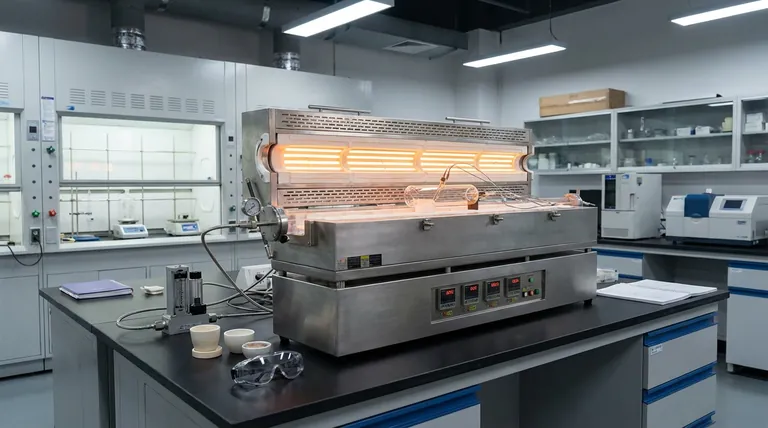
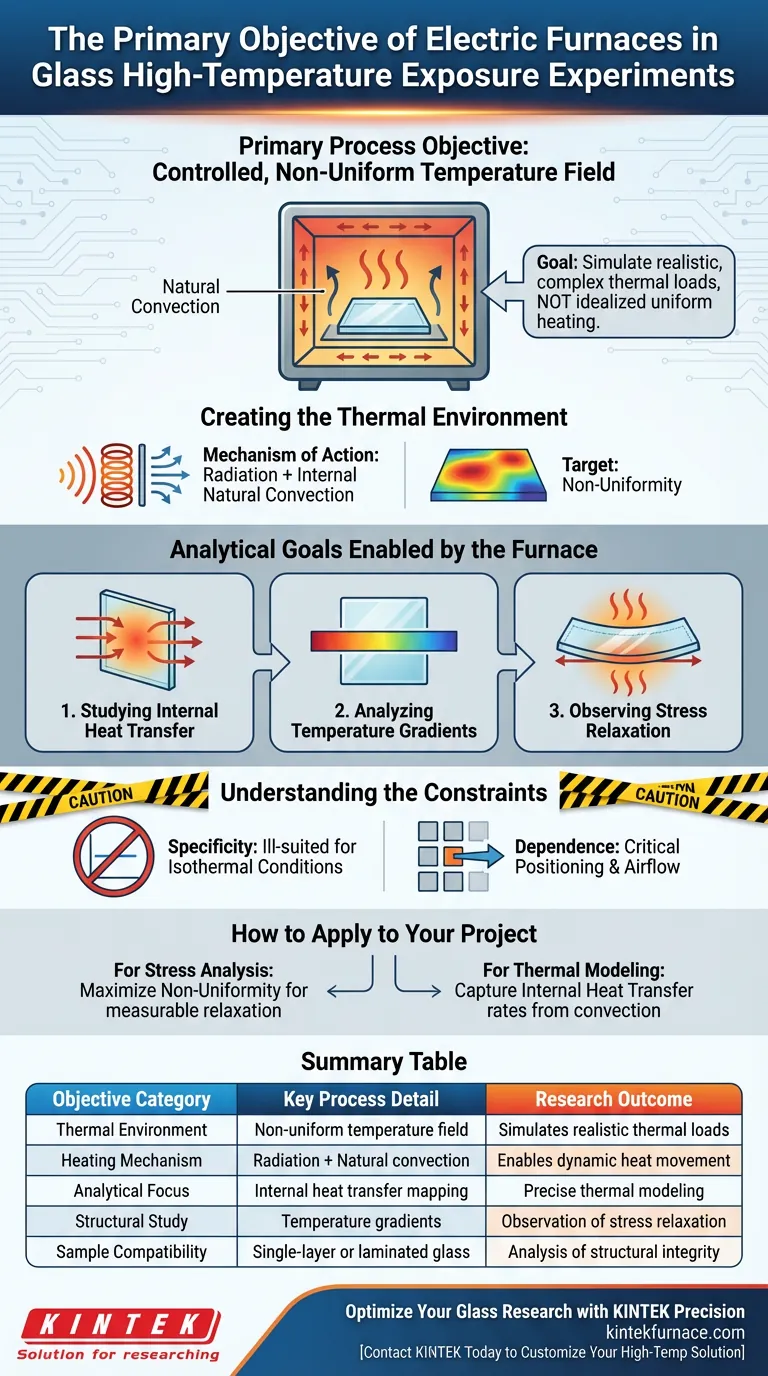
The primary process objective of using an electric furnace in these experiments is to simulate a controlled high-temperature environment that exposes glass samples to a specific, non-uniform temperature field. By utilizing electric heating elements and facilitating internal natural convection, the furnace creates the distinct thermal conditions necessary to test single-layer or laminated glass.
While generating heat is the function, the specific objective is to create a controlled, non-uniform temperature distribution. This environment is essential for isolating and analyzing internal heat transfer, temperature gradients, and stress relaxation within the glass.
Creating the Thermal Environment
The Mechanism of Action
The electric furnace operates by generating heat radiation directly from its heating elements.
Simultaneously, it facilitates internal natural convection within the chamber. This dual approach ensures the glass is exposed to a dynamic thermal load rather than static conduction.
Target: Non-Uniformity
Unlike processes that require perfectly even heating, the objective here is to provide a non-uniform temperature field.
This specific distribution is applied to the glass samples (whether single-layer or laminated) to mimic realistic, complex exposure scenarios rather than idealized conditions.
Analytical Goals Enabled by the Furnace
Studying Internal Heat Transfer
The controlled environment allows researchers to map how heat moves through the glass structure.
By manipulating the furnace output, you can observe the rate and direction of internal heat transfer under varying high-temperature conditions.
Analyzing Temperature Gradients
The non-uniform field creates distinct temperature gradients across the sample's surface and thickness.
These gradients are critical data points, as uniform heating often fails to reveal how glass responds to localized thermal variances.
Observing Stress Relaxation
The ultimate physical phenomenon being studied is stress relaxation.
The furnace provides the precise thermal context needed to observe how the glass structure mechanically relaxes or deforms in response to the induced temperature gradients.
Understanding the Constraints
Specificity of Application
This setup is engineered specifically for studying gradients and stress in a non-uniform field.
It is likely ill-suited for experiments requiring isothermal (perfectly uniform) conditions, as the natural convection and radiation serve to create variation rather than eliminate it.
Dependence on Convection
The process relies heavily on internal natural convection.
This means the positioning of the sample relative to the heating elements and airflow is a critical variable that must remain consistent to ensure reproducible data.
How to Apply This to Your Project
When designing your high-temperature exposure experiment, align your furnace settings with your specific analytical goals:
- If your primary focus is Stress Analysis: Ensure the furnace is calibrated to maximize the non-uniformity of the temperature field to induce measurable stress relaxation.
- If your primary focus is Thermal Modeling: Focus on capturing data regarding the internal heat transfer rates driven by the natural convection within the chamber.
Use the electric furnace not just to heat the glass, but to create the precise thermal imbalances that reveal its structural limits.
Summary Table:
| Objective Category | Key Process Detail | Research Outcome |
|---|---|---|
| Thermal Environment | Non-uniform temperature field | Simulates realistic thermal loads |
| Heating Mechanism | Radiation + Natural convection | Enables dynamic heat movement |
| Analytical Focus | Internal heat transfer mapping | Precise thermal modeling |
| Structural Study | Temperature gradients | Observation of stress relaxation |
| Sample Compatibility | Single-layer or laminated glass | Analysis of structural integrity |
Optimize Your Glass Research with KINTEK Precision
Are you looking to master complex thermal gradients in your materials research? KINTEK provides industry-leading Muffle, Tube, Rotary, Vacuum, and CVD systems designed for the most demanding high-temperature applications. Whether you are analyzing stress relaxation or internal heat transfer, our customizable laboratory furnaces offer the stability and control necessary for reproducible scientific data.
Backed by expert R&D and world-class manufacturing, KINTEK empowers researchers to push the limits of glass and ceramic science.
Contact KINTEK Today to Customize Your High-Temp Solution
Visual Guide
References
- Maximilian Möckel, Michael Engelmann. Temperature distribution and stress relaxation in glass under high temperature exposition. DOI: 10.1007/s40940-025-00296-1
This article is also based on technical information from Kintek Furnace Knowledge Base .
Related Products
- Electric Rotary Kiln Small Rotary Furnace for Activated Carbon Regeneration
- Electric Rotary Kiln Continuous Working Small Rotary Furnace Kiln for Pyrolysis Plant Heating
- Electric Rotary Kiln Pyrolysis Furnace Plant Machine Small Rotary Kiln Calciner
- Silicon Carbide SiC Thermal Heating Elements for Electric Furnace
- Spark Plasma Sintering SPS Furnace
People Also Ask
- What are the main applications of a rotary kiln electric furnace? Achieve Uniform Heat Treatment for Powders
- What are the key components of a rotary kiln electric furnace? Unlock Efficient Thermal Processing
- What is the significance of the refractory lining in a rotary kiln electric furnace? Unlock Efficiency and Longevity
- What advantages do electric rotary kilns offer over fuel-based kilns? Boost Efficiency and Purity in Your Process
- What materials can be processed in an electric rotary kiln? Versatile Solutions for Advanced Materials