
A plasma surface metallurgy furnace achieves infiltration by utilizing high-energy argon plasma within a low-pressure vacuum environment to physically drive alloying elements into a substrate.
The process begins by bombarding a source material (such as chromium) to eject atoms, which then bombard the workpiece acting as a cathode. This dual-action process heats the workpiece and creates atomic vacancies, allowing the alloying elements to diffuse deeply and form a unified metallurgical bond.
The Core Insight: Unlike traditional coatings that sit on top of a surface, this process uses thermal energy and atomic defects to integrate the alloy into the material. The result is a diffusion layer with exceptional adhesion strength that creates a gradual transition between the surface and the core.
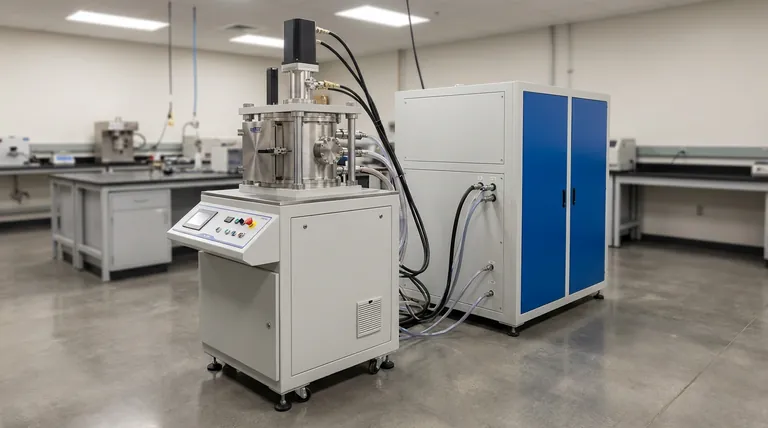
The Physical Mechanism of Infiltration
The transformation of the workpiece surface relies on a sequence of high-energy physical interactions.
The Vacuum and Plasma Environment
The process operates inside a low-pressure vacuum environment.
Argon gas is introduced and ionized to create plasma. An electric field is applied to control the movement of these ions, setting the stage for the transfer of material.
Sputtering the Source Material
The system directs the argon plasma to bombard the source material (often called the target), such as metal chromium.
This bombardment dislodges, or "sputters," atoms from the target. These source atoms are ejected into the vacuum chamber, ready to be deposited onto the workpiece.
Activation of the Workpiece
The workpiece itself is set up as the cathode within the electrical circuit.
The sputtered source atoms and plasma particles bombard the surface of the workpiece with high energy. This bombardment serves two critical functions simultaneously: it heats the workpiece and physically alters the surface structure.
Creating Defects to Enable Diffusion
The most critical aspect of this process is the creation of surface vacancy defects.
The high-energy bombardment knocks atoms out of their lattice positions on the workpiece surface. These "holes" or vacancies provide a pathway for the incoming alloying atoms to slip inside the crystal structure.
Formation of the Metallurgical Bond
Driven by the heat and the availability of lattice vacancies, the alloying elements diffuse into the substrate.
Rather than forming a distinct layer on top, the elements mix with the base material. This results in a high-strength metallurgical bond, where the surface composition is chemically altered to resist wear or corrosion.
Understanding the Trade-offs
While plasma surface metallurgy offers superior bonding, the mechanism introduces specific constraints that must be managed.
Thermal Implications
The process relies on heating the workpiece to promote diffusion.
Because the substrate must reach temperatures sufficient to allow atomic movement, this method may not be suitable for materials that are highly sensitive to heat or prone to thermal distortion.
Component Geometry
The mechanism depends on direct bombardment by ions and atoms.
Complex geometries with deep recesses or internal bores may prove difficult to treat uniformly, as the line-of-sight nature of sputtering can limit how effectively ions reach shadowed areas.
Making the Right Choice for Your Goal
When deciding if plasma surface metallurgy is the correct solution for your application, consider your performance requirements.
- If your primary focus is Adhesion Strength: This method is superior because it creates a diffusion bond that cannot peel or flake off like a traditional overlay coating.
- If your primary focus is Surface Chemistry: This allows you to modify standard steel to have properties similar to expensive alloys (like stainless steel) only where it matters—on the surface.
This technology bridges the gap between coating and bulk alloying, offering a way to engineer high-performance surfaces without the cost of solid alloy components.
Summary Table:
| Feature | Plasma Surface Metallurgy Mechanism |
|---|---|
| Environment | Low-pressure vacuum with ionized Argon plasma |
| Source Material | Sputtered target (e.g., Chromium) via ion bombardment |
| Workpiece Role | Acts as a cathode to attract ions and generate heat |
| Bonding Type | Unified metallurgical bond (Atomic diffusion) |
| Key Advantage | Superior adhesion strength compared to surface coatings |
Elevate Your Material Performance with KINTEK
Are you looking to achieve exceptional surface durability without the high cost of solid alloys? KINTEK provides industry-leading thermal processing solutions tailored to your exact specifications. Backed by expert R&D and manufacturing, we offer a comprehensive range of lab high-temp furnaces, including Muffle, Tube, Rotary, Vacuum, and CVD systems—all fully customizable to solve your most complex metallurgical challenges.
Ready to optimize your surface engineering? Contact us today to consult with our specialists and discover how our advanced furnace technology can bring precision and strength to your research or production.
References
- Changzeng Luo, Shengguan Qu. Impact Wear Behavior of the Valve Cone Surface after Plasma Alloying Treatment. DOI: 10.3390/app14114811
This article is also based on technical information from Kintek Furnace Knowledge Base .
Related Products
- Spark Plasma Sintering SPS Furnace
- Slide PECVD Tube Furnace with Liquid Gasifier PECVD Machine
- Inclined Rotary Plasma Enhanced Chemical Deposition PECVD Tube Furnace Machine
- Inclined Rotary Plasma Enhanced Chemical Deposition PECVD Tube Furnace Machine
- Magnesium Extraction and Purification Condensing Tube Furnace
People Also Ask
- Why is it necessary to maintain a high vacuum environment during the SPS of SiC? Key to High-Density Ceramics
- How does the heating mechanism of Spark Plasma Sintering (SPS) function? Enhance TiC/SiC Composite Fabrication
- What are the technical advantages of using an SPS sintering furnace? Elevate Al2O3-TiC Material Performance
- What are the steps in the discharge plasma sintering process? Master Fast, High-Density Material Consolidation
- What are the advantages of spark plasma sintering (SPS) over traditional forging? Precision Microstructural Control



















