
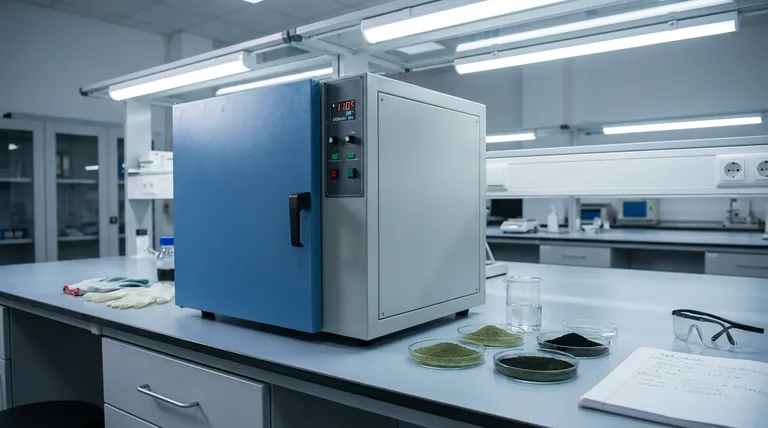
The critical function of a constant temperature drying oven in the preparation of chromium-doped nickel oxide nanoparticles (Cr/NiONPs) is to facilitate the controlled removal of physically adsorbed water and residual solvents. By treating the impregnated material at 110 °C overnight, the oven ensures the chromium precursor adheres firmly to the nickel oxide framework, stabilizing the material before it undergoes high-temperature processing.
This drying phase acts as a vital transition step, preventing structural fragmentation during subsequent calcination by eliminating moisture that would otherwise evaporate violently at higher temperatures.
The Mechanics of Precursor Stabilization
Controlled Solvent Removal
Following the impregnation step, the nanoparticles are saturated with solvents and physically adsorbed water. The drying oven provides a stable thermal environment, specifically at 110 °C for an overnight period. This duration and temperature are calibrated to remove these volatile components without inducing premature chemical reactions.
Anchoring the Dopant
The drying process is not merely about dehydration; it is essential for the physical structure of the composite. As the solvents evaporate slowly and steadily, the chromium precursor is allowed to settle and adhere firmly to the nickel oxide nanoparticle framework. This creates a uniform distribution of the dopant, which is crucial for the material's final properties.
Protecting Structural Integrity
Preventing Thermal Shock
If the impregnated material were moved directly to a high-temperature calcination furnace, any remaining moisture would flash into steam instantly. This rapid expansion creates internal pressure that can shatter the nanoparticle structure. The drying oven acts as a safety buffer, removing this moisture gently to prevent particle fragmentation.
Ensuring Experimental Reproducibility
Residual moisture can cause endothermic effects (absorbing heat) during later heating stages. This can interfere with the stability of combustion temperatures or calcination profiles. By ensuring the sample is completely dry, the oven guarantees that the subsequent thermal treatment focuses entirely on the chemical phase transformation, rather than waste energy on water evaporation.
Understanding the Trade-offs
The Risk of Incomplete Drying
If the drying time is shortened or the temperature is significantly lower than 110 °C, residual moisture may remain deep within the pore structure. This compromises the "pre-treatment" benefit, leading to the very structural collapse or agglomeration the process is meant to prevent.
The Consequence of Rapid Evaporation
While efficiency is often desired, speeding up this specific step by increasing the temperature well beyond 110 °C is counterproductive. Rapid evaporation can lead to "hard agglomeration," where particles fuse together into unusable clumps, or cause the migration of the active metal precursor to the surface, resulting in uneven doping.
Optimizing Your Synthesis Protocol
To ensure high-quality Cr/NiONP synthesis, align your process with your specific structural goals:
- If your primary focus is Structural Integrity: Ensure the drying phase runs the full overnight duration at 110 °C to completely eliminate the risk of fragmentation during calcination.
- If your primary focus is Doping Uniformity: Maintain strict temperature stability to prevent rapid solvent exit, which helps the chromium precursor remain evenly distributed across the nickel oxide carrier.
A patient, controlled drying phase is the unsung hero of nanoparticle synthesis, transforming a wet slurry into a robust framework ready for crystallization.
Summary Table:
| Drying Parameter | Requirement | Purpose in Cr/NiONP Synthesis |
|---|---|---|
| Temperature | 110 °C | Steady removal of moisture without premature chemical reaction |
| Duration | Overnight | Ensures deep dehydration of pore structures for structural integrity |
| Key Outcome | Precursor Anchoring | Ensures the chromium dopant adheres firmly to the NiO framework |
| Risk Mitigation | Anti-Fragmentation | Prevents violent steam expansion during the calcination phase |
Elevate Your Nanoparticle Synthesis with KINTEK
Precision is the foundation of high-performance materials. At KINTEK, we understand that the success of your Cr/NiONP preparation depends on flawless thermal control. Backed by expert R&D and world-class manufacturing, we provide a comprehensive range of Muffle, Tube, Rotary, Vacuum, and CVD systems, along with specialized constant temperature lab furnaces that are fully customizable to your unique synthesis protocols.
Don't let residual moisture or thermal shock compromise your research. Our high-temperature solutions ensure uniform heating and structural integrity for every sample. Contact us today to find the perfect thermal solution for your lab and see how our expertise can drive your innovation forward.
References
- Zahraa H. Athab, Nadhir Al‐Ansari. Comparison activity of pure and chromium-doped nickel oxide nanoparticles for the selective removal of dyes from water. DOI: 10.1038/s41598-024-53490-6
This article is also based on technical information from Kintek Furnace Knowledge Base .
Related Products
- 1700℃ High Temperature Muffle Oven Furnace for Laboratory
- 1200℃ Muffle Oven Furnace for Laboratory
- 1400℃ Muffle Oven Furnace for Laboratory
- 1800℃ High Temperature Muffle Oven Furnace for Laboratory
- High Temperature Muffle Oven Furnace for Laboratory Debinding and Pre Sintering
People Also Ask
- What is the primary function of a high-temperature laboratory muffle furnace in chemical synthesis? Achieve Precision.
- How does a high-temperature laboratory muffle furnace affect material properties? Transform Anodic Oxide Films Fast
- What role does a muffle furnace play in BCZY712 electrolyte powder production? Achieve Perfect Phase Purity
- What role does a muffle furnace play in sintering photocathodes? Enhance Electrode Conductivity & Catalytic Activity
- How does a muffle furnace impact Ni/MgAl2O4 catalysts? Optimize Stability and Catalytic Performance






