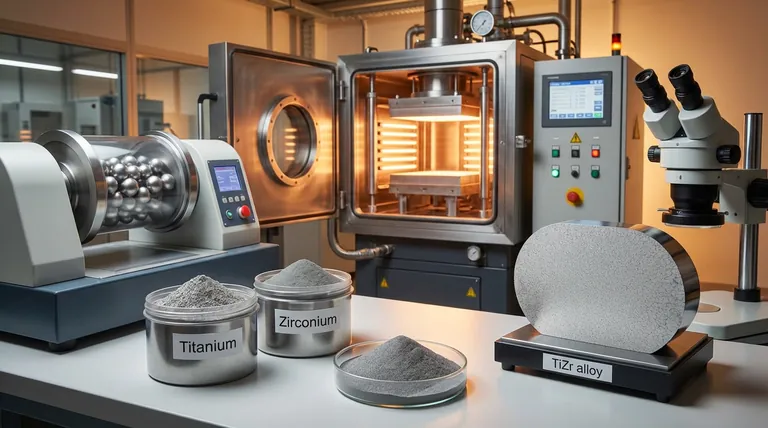
Powder metallurgy represents a superior method for producing Titanium (Ti) and Titanium-Zirconium (TiZr) alloys by enabling manufacturing in a solid state. By utilizing precise proportioning of pure metal powders and processing techniques like ball milling and vacuum hot pressing, this approach effectively eliminates the structural inconsistencies often caused by traditional melting methods.
The Core Takeaway The primary value of powder metallurgy is its ability to overcome component segregation. This results in Titanium-based materials with a highly uniform microstructure and precisely controlled chemical composition, which is essential for high-stakes biomedical applications.
Solving the Segregation Problem
Eliminating Component Separation
In traditional alloy production, melting materials can lead to component segregation, where elements separate due to density or melting point differences.
Powder metallurgy circumvents this by keeping the materials in a solid state. This ensures that the elements remain evenly distributed throughout the manufacturing process.
The Role of Ball Milling
To achieve this homogeneity, the process utilizes ball milling for mixing.
This mechanical process ensures that the pure metal powders are blended thoroughly before they are consolidated, setting the foundation for a consistent final product.
Achieving Structural Precision
Consolidating via Vacuum Hot Pressing
Once mixed, the powders are consolidated using vacuum hot pressing.
This technique applies heat and pressure simultaneously in a vacuum environment. It effectively binds the materials together without inducing the chemical variances associated with liquid-state processing.
Uniform Microstructure
The direct result of this controlled processing is a highly uniform microstructure.
Unlike cast alloys, which may have irregular grain structures, alloys produced via powder metallurgy exhibit consistent structural properties throughout the entire component.
Precise Chemical Control
Because the process begins with the precise proportioning of pure metal powders, the final chemical composition can be strictly controlled.
This allows manufacturers to dictate the exact ratio of Titanium to Zirconium, ensuring the material meets exact specifications.
Understanding the Trade-offs
Process Complexity vs. Material Quality
While powder metallurgy offers superior material properties, it requires a more rigorous processing chain than simple melting.
Techniques like ball milling and vacuum hot pressing are specialized processes. However, this added complexity is the necessary cost for eliminating component segregation and achieving the high standards required for sensitive applications.
Making the Right Choice for Your Goal
When deciding between powder metallurgy and traditional melting for Ti and TiZr alloys, consider your specific requirements:
- If your primary focus is structural uniformity: Prioritize powder metallurgy to eliminate the risk of component segregation found in melting methods.
- If your primary focus is biomedical safety: Utilize powder metallurgy to ensure the precise chemical composition and microstructure required for medical compatibility.
Powder metallurgy is the definitive choice when material consistency and chemical precision are non-negotiable.
Summary Table:
| Feature | Traditional Melting | Powder Metallurgy |
|---|---|---|
| Material State | Liquid (Melting) | Solid-State Processing |
| Composition Control | Risk of Segregation | Precise & Homogeneous |
| Microstructure | Often Irregular | Highly Uniform |
| Key Techniques | Casting/Forging | Ball Milling & Vacuum Hot Pressing |
| Ideal Application | Standard Industrial Use | High-Stakes Biomedical/Technical |
Elevate Your Material Standards with KINTEK
Don't compromise on the integrity of your Titanium and Titanium-Zirconium alloys. KINTEK’s advanced lab high-temp furnaces, including specialized Vacuum Hot Pressing systems, are engineered to help you eliminate component segregation and achieve perfect structural uniformity.
Backed by expert R&D and world-class manufacturing, we provide customizable Muffle, Tube, Rotary, Vacuum, and CVD systems tailored to your unique research and production needs.
Ready to achieve non-negotiable material consistency?
Contact KINTEK Today to consult with our experts on the ideal high-temperature solution for your lab.
Visual Guide

References
- El‐Sayed M. Sherif. A comparative study on the corrosion of pure titanium and titanium–12%zirconium alloy after different exposure periods of time in sodium chloride solution. DOI: 10.1063/5.0192701
This article is also based on technical information from Kintek Furnace Knowledge Base .
Related Products
- Magnesium Extraction and Purification Condensing Tube Furnace
- Multi Zone Laboratory Quartz Tube Furnace Tubular Furnace
- Multi Heating Zones CVD Tube Furnace Machine for Chemical Vapor Deposition Equipment
- 1400℃ High Temperature Laboratory Tube Furnace with Alumina Tube
- Vacuum Induction Melting Furnace
People Also Ask
- What are the advantages of using a condensing tube furnace for magnesium extraction? Achieve High Purity and Efficient Metal Recovery
- How do advanced control systems enhance the operation of a tube furnace? Boost Precision and Efficiency in Thermal Processing
- What factors should be considered when selecting between a tube furnace and a box furnace? Optimize Your Lab's Thermal Processing
- How does the atmosphere differ between tube furnaces and box furnaces? Optimize Your Heat Treatment Process
- What role does a tube furnace play in the surface modification of Ni-Mo catalysts? Master Phase & Surface Control