
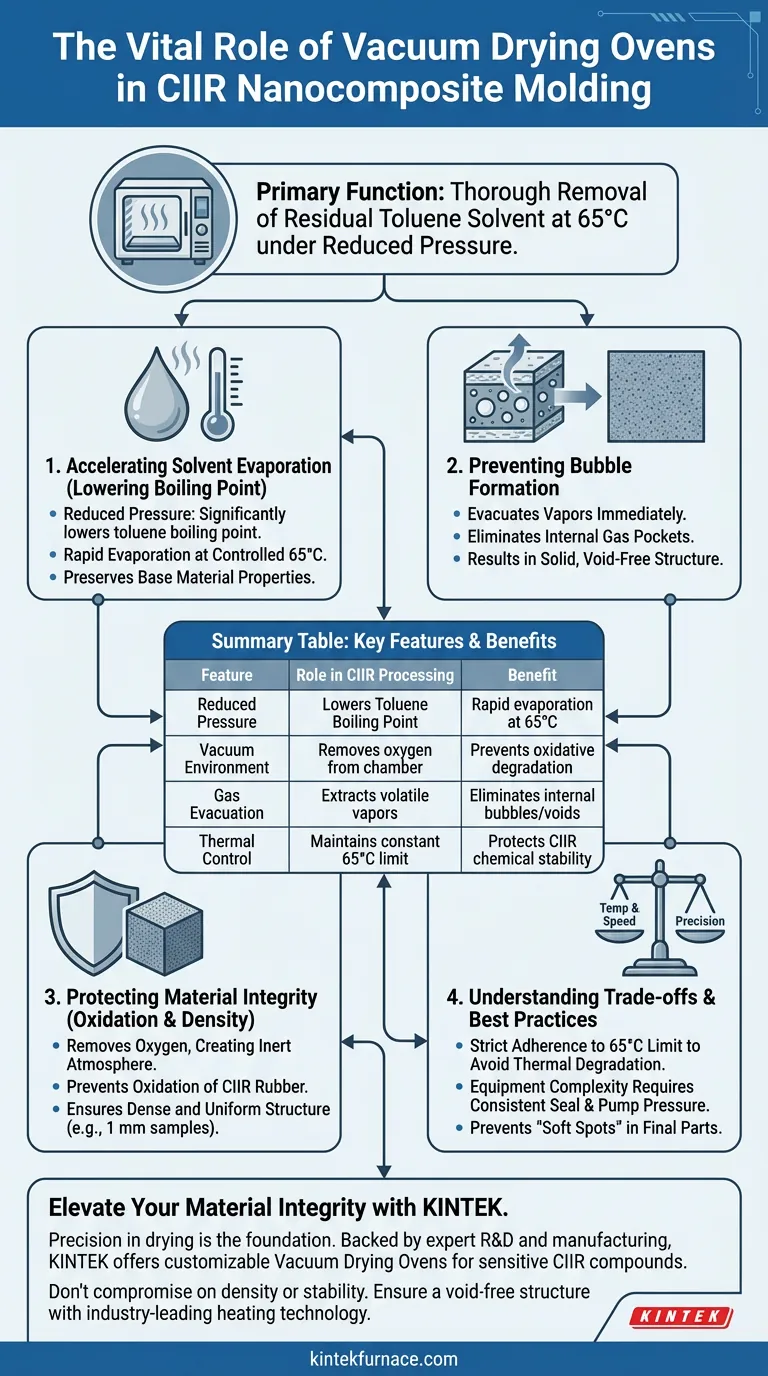
The primary function of a vacuum drying oven in the processing of Chlorobutyl Rubber (CIIR) nanocomposites is the thorough removal of residual toluene solvent. By maintaining a specific environment of 65 °C under reduced pressure, the oven accelerates solvent evaporation while simultaneously preventing the formation of bubbles and protecting the material from oxidation.
Vacuum drying is a critical quality control step that ensures structural density. It utilizes negative pressure to extract volatile solvents at moderate temperatures, preventing the voids and oxidative damage that occur with standard heating methods.
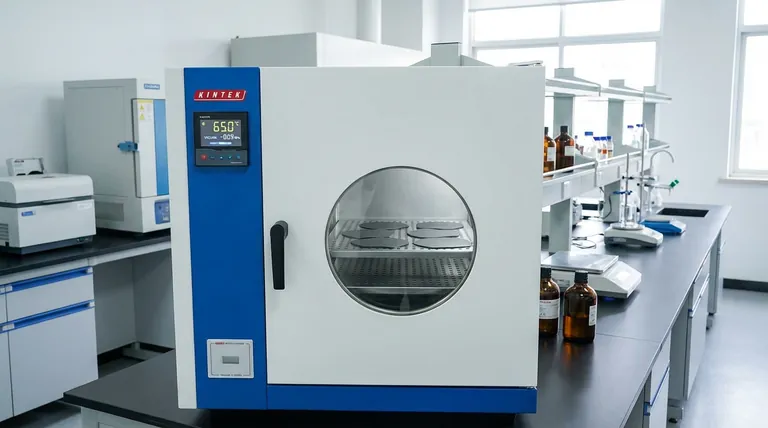
The Mechanics of Solvent Removal
Lowering the Boiling Point
The central advantage of this process is the ability to remove toluene without exposing the rubber to excessive heat.
By reducing the pressure inside the chamber, the boiling point of the solvent drops significantly.
This allows the solvent to evaporate rapidly and completely at a controlled temperature of 65 °C, preserving the base material's properties.
Preventing Bubble Formation
If solvent remains trapped within the rubber matrix as it cures or dries, it will eventually vaporize and expand.
Without the vacuum environment to draw these vapors out immediately, they form internal gas pockets or bubbles.
The vacuum drying oven ensures these vapors are evacuated, resulting in a solid, void-free structure.
Ensuring Material Integrity
Protection Against Oxidation
Standard drying ovens expose materials to heated air, which can accelerate degradation in sensitive compounds.
The vacuum environment removes oxygen from the chamber, creating an inert atmosphere during the drying phase.
This prevents oxidation of the Chlorobutyl Rubber, ensuring the chemical structure remains intact during the heating process.
Achieving Uniform Density
For the production of 1 mm thick nanocomposite samples, consistency is paramount.
Any residual solvent or trapped air creates weak points and density variations within the sample.
The vacuum process guarantees a dense and uniform structure, which is essential for accurate testing and performance of the final nanocomposite.
Understanding the Trade-offs
Temperature Precision vs. Speed
While higher temperatures might dry the material faster, they risk thermal degradation of the CIIR matrix.
You must adhere strictly to the 65 °C limit provided in the primary reference.
Rushing this process by increasing heat negates the protective benefits of the vacuum and compromises the nanocomposite.
Equipment Complexity
Vacuum drying adds a layer of complexity compared to simple convection drying.
It requires maintaining a consistent seal and pump pressure to be effective.
Inconsistent pressure levels can lead to incomplete solvent removal, leaving "soft spots" in the final molded part.
Making the Right Choice for Your Goal
To ensure the highest quality CIIR nanocomposites, apply the following principles:
- If your primary focus is structural density: Ensure the vacuum pressure is sufficient to fully evacuate evaporated toluene to prevent internal voids.
- If your primary focus is chemical stability: strictly monitor the temperature at 65 °C to avoid thermal degradation while relying on the vacuum for drying speed.
The success of your molding process relies on treating drying not just as a heating step, but as a precise purification technique.
Summary Table:
| Feature | Role in CIIR Nanocomposite Processing | Benefit |
|---|---|---|
| Reduced Pressure | Lowers the boiling point of Toluene | Rapid solvent evaporation at 65°C |
| Vacuum Environment | Removes oxygen from the chamber | Prevents oxidative degradation of rubber |
| Gas Evacuation | Extracts volatile vapors immediately | Eliminates internal bubbles and voids |
| Thermal Control | Maintains constant 65°C limit | Protects chemical stability of CIIR matrix |
Elevate Your Material Integrity with KINTEK
Precision in drying is the foundation of high-performance nanocomposites. Backed by expert R&D and manufacturing, KINTEK offers a wide range of laboratory solutions, including specialized Vacuum Drying Ovens, Muffle, Tube, and CVD systems. Whether you are working with sensitive CIIR compounds or advanced ceramics, our equipment is fully customizable to meet your unique temperature and pressure requirements.
Don't compromise on density or stability. Ensure a void-free structure for your samples with our industry-leading heating technology. Contact our technical specialists today to find the perfect drying solution for your lab!
Visual Guide
References
- Tomy Muringayil Joseph, Sabu Thomas. Effects of Nanofillers and Synergistic Action of Carbon Black/Nanoclay Hybrid Fillers in Chlorobutyl Rubber. DOI: 10.3390/jcs8060209
This article is also based on technical information from Kintek Furnace Knowledge Base .
Related Products
- Vacuum Heat Treat Sintering and Brazing Furnace
- Vacuum Heat Treat Sintering Furnace Molybdenum Wire Vacuum Sintering Furnace
- Dental Porcelain Zirconia Sintering Ceramic Vacuum Press Furnace
- Molybdenum Vacuum Heat Treat Furnace
- Vacuum Hot Press Furnace Machine Heated Vacuum Press
People Also Ask
- What is one of the most important uses of vacuum heat treating furnaces in aerospace? Achieve Superior Strength in Aircraft Alloys
- What are the benefits of using vacuum heat treating furnaces for metal alloys? Achieve Superior Metal Properties and Performance
- How does vacuum heat treating affect the grain structure of metal alloys? Achieve Precise Microstructure Control
- What is the temperature of a vacuum furnace brazing? Optimize Your Joint Strength and Cleanliness
- What are the steps involved in a typical vacuum brazing treatment? Master the Process for Strong, Clean Joints












