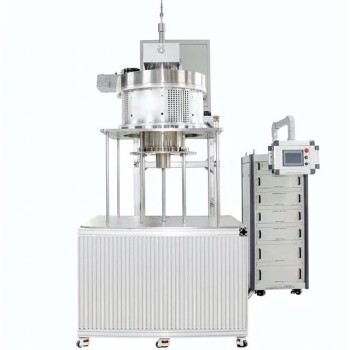
The primary function of a high-pressure reactor in subcritical hydrothermal carbonization is to create and maintain a sealed environment that prevents water from boiling off at elevated temperatures. By sustaining high pressure, the reactor keeps water in a liquid state even at temperatures around 230°C, acting as the essential vessel for facilitating the chemical decomposition and structural transformation of biomass.
The reactor serves as the physical enabler of the subcritical state, allowing superheated liquid water to drive dehydration and decarboxylation reactions while effectively fixing heavy metals within a stable hydrochar skeleton.
Creating the Subcritical Environment
Maintaining Liquid State at High Heat
The defining characteristic of this process is the use of temperatures that exceed water's standard boiling point, typically reaching levels such as 230°C.
Without a high-pressure reactor, water would vaporize, halting the hydrothermal process. The reactor facilitates a subcritical state, ensuring water remains liquid to act as a solvent and reaction medium.
Generating Autogenous Pressure
The reactor does not necessarily require external gas injection to build pressure.
Instead, it utilizes a sealed design to generate autogenous pressure derived from the solvents (like water) expanding during the heating process. This internal pressure is critical for accelerating the carbonization of biomass precursors.
Driving Chemical Transformations
Enhanced Hydrolysis Capabilities
Inside the reactor, the subcritical water exhibits significantly altered properties compared to ambient water.
It demonstrates enhanced dissolution and hydrolysis capabilities, allowing it to break down complex biomass structures more effectively. This environment promotes intense physical and chemical changes that would not occur under standard atmospheric conditions.
Dehydration and Decarboxylation
The high-pressure environment facilitates specific chemical pathways necessary for converting raw biomass into carbonaceous materials.
Specifically, the biomass—such as wood powder—undergoes dehydration (removal of water molecules) and decarboxylation (removal of carboxyl groups). These reactions are fundamental to the pre-carbonization process, stripping away oxygen and hydrogen to increase carbon density.
Structural Formation and Metal Fixation
Building the Hydrochar Skeleton
The reactor provides the conditions necessary for biomass to convert into a pre-carbonized hydrochar skeleton.
This creates a physical foundation with specific morphologies. For example, it can convert soft biomass like watermelon peel into structured carbon hydrogel skeletons, establishing the architecture required for subsequent activation steps.
Fixation of Heavy Metals
In scenarios involving contaminated biomass, the reactor plays a crucial role in remediation.
During the conversion of heavy metal-contaminated wood powder, the reactor's environment allows for the effective enrichment and fixation of metals like copper. The heavy metals are locked into the generated hydrochar structure, preventing them from leaching and preparing them for use as active sites in hybridized materials.
Understanding the Trade-offs
The "Pre-Carbonized" Limitation
It is important to recognize that the output of this specific reactor process is often an intermediate material.
The process produces a pre-carbonized hydrochar, not necessarily a fully activated carbon. While it provides the physical foundation, subsequent activation steps are often required to achieve maximum surface area or porosity.
Process Complexity
Using a high-pressure reactor introduces significant safety and operational complexity compared to open-air pyrolysis.
The requirement for a perfectly sealed environment means that temperature and pressure must be monitored rigorously to prevent equipment failure or inconsistent carbonization results.
Making the Right Choice for Your Goal
The high-pressure reactor is a precision tool for specific material engineering goals.
- If your primary focus is Environmental Remediation: Use this reactor to fixate heavy metals (like copper) directly into the carbon lattice, stabilizing contaminants while creating functional materials.
- If your primary focus is Material Synthesis: Rely on the reactor to control morphology and create a robust "skeleton" or hydrogel network that serves as a precursor for advanced activated carbons.
This reactor is not merely a heating vessel; it is a synthesis chamber that forces water to act as a powerful catalyst for structural change.
Summary Table:
| Feature | Function in Subcritical HTC |
|---|---|
| Pressure Mode | Generates autogenous pressure to keep water in a liquid state at 230°C |
| Chemical Action | Promotes enhanced hydrolysis, dehydration, and decarboxylation |
| Material Output | Produces pre-carbonized hydrochar skeletons and carbon hydrogels |
| Metal Remediation | Enables fixation and enrichment of heavy metals within the carbon lattice |
| Reaction Medium | Superheated liquid water acts as a powerful solvent and catalyst |
Elevate Your Biomass Research with KINTEK
Unlock the full potential of hydrothermal carbonization with KINTEK’s precision engineering. Backed by expert R&D and manufacturing, KINTEK offers a comprehensive range of Muffle, Tube, Rotary, Vacuum, and CVD systems, along with specialized high-pressure vessels customizable for your unique lab requirements.
Whether you are focusing on environmental remediation or advanced material synthesis, our systems provide the stability and control needed to transform biomass into high-value hydrochars.
Ready to optimize your carbonization process? Contact KINTEK today to discuss your custom furnace and reactor needs with our technical team!
References
- Jieni Wang, Shicheng Zhang. Cu-Ion Hybrid Porous Carbon with Nanoarchitectonics Derived from Heavy-Metal-Contaminated Biomass as Ultrahigh-Performance Supercapacitor. DOI: 10.3390/ijms26020569
This article is also based on technical information from Kintek Furnace Knowledge Base .
Related Products
- Custom Made Versatile CVD Tube Furnace Chemical Vapor Deposition CVD Equipment Machine
- High Pressure Laboratory Vacuum Tube Furnace
- Slide PECVD Tube Furnace with Liquid Gasifier PECVD Machine
- MPCVD Machine System Reactor Bell-jar Resonator for Lab and Diamond Growth
- Laboratory Quartz Tube Furnace RTP Heating Tubular Furnace
People Also Ask
- Why are CVD tube furnace sintering systems indispensable for 2D material research and production? Unlock Atomic-Scale Precision
- What is a CVD tube furnace and what is its primary function? Discover Precision Thin-Film Deposition
- Which industries and research fields benefit from CVD tube furnace sintering systems for 2D materials? Unlock Next-Gen Tech Innovations
- How does CVD tube furnace sintering enhance graphene growth? Achieve Superior Crystallinity and High Electron Mobility
- What future trends are expected in the development of CVD tube furnaces? Discover Smarter, More Versatile Systems