
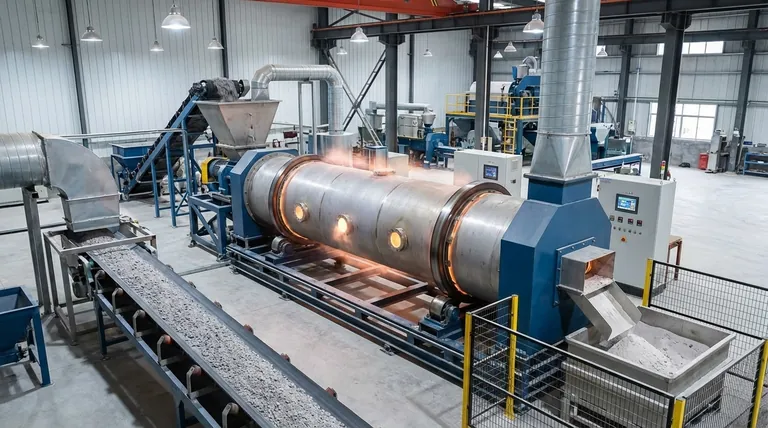
High-temperature industrial furnaces act as the critical activation step in the lithium extraction supply chain. By maintaining a precise thermal environment between 1050°C and 1100°C, these systems force a physical phase change in spodumene ore that is essential for making the lithium accessible for chemical processing.
The core purpose of the furnace is to drive the transformation from alpha-spodumene to beta-spodumene. This shifts the ore's crystal structure from a dense, unreactive state to a porous, expanded form that is receptive to leaching.
The Mechanism of Phase Transformation
Targeting the Beta-Phase
The primary objective of the furnace is to trigger a specific phase transformation. The naturally occurring ore exists as alpha-spodumene, which is highly stable and resistant to chemicals.
By heating the material to a window of 1050°C to 1100°C, the furnace provides the energy required to break this stability. This thermal input converts the material into beta-spodumene.
Altering the Crystal Lattice
This transformation is not merely a change in temperature; it is a fundamental restructuring of the material's atomic arrangement.
The process converts the crystal structure from a dense monoclinic system to a tetragonal system. This structural shift is the physical mechanism that "unlocks" the ore.
Why Structure Matters for Extraction
Creating Volume Expansion
When the crystal structure changes from monoclinic to tetragonal, the material undergoes significant volume expansion.
This expansion physically disrupts the dense nature of the original rock. It creates a fractured, more open internal matrix.
Enhancing Porosity and Reactivity
The shift to a tetragonal structure makes the spodumene significantly more porous.
This increased porosity is the foundation for all subsequent processing. It allows chemical agents to penetrate the ore during leaching processes, facilitating the release of lithium that would otherwise remain trapped in the dense alpha-phase.
Critical Process Constraints
The Necessity of Temperature Precision
The furnace does not simply heat the ore; it must maintain a stable thermal environment within a tight tolerance (1050°C–1100°C).
Deviating from this specific range can compromise the phase change. Without this precise thermal control, the conversion efficiency drops, directly impacting the yield of the entire extraction operation.
The Risk of Under-Conversion
If the physical transformation is incomplete, the ore retains its dense, monoclinic structure.
In this state, the material remains chemically inert. No amount of downstream chemical processing can effectively extract lithium from unconverted alpha-spodumene, rendering the material waste.
Optimizing for Extraction Efficiency
To ensure maximum yield from your lithium extraction process, focus on the following operational goals:
- If your primary focus is process reliability: Ensure your furnace creates a stable thermal profile strictly between 1050°C and 1100°C to guarantee consistent phase conversion.
- If your primary focus is downstream reactivity: Prioritize the completeness of the alpha-to-beta transformation to maximize porosity and volume expansion for the leaching stage.
The industrial furnace serves as the essential gatekeeper, physically restructuring the ore to enable the chemical release of lithium.
Summary Table:
| Process Phase | Crystal Structure | Density & Porosity | Chemical Reactivity |
|---|---|---|---|
| Alpha-Spodumene (Pre-treatment) | Monoclinic (Dense) | High density, non-porous | Chemically inert/Stable |
| Beta-Spodumene (1050°C-1100°C) | Tetragonal (Expanded) | High porosity, fractured | Highly reactive for leaching |
Unlock Maximum Lithium Yield with KINTEK
Precise thermal control is the difference between high-purity lithium and wasted ore. Backed by expert R&D and manufacturing, KINTEK offers specialized Rotary, Tube, and Vacuum systems designed to maintain the exact 1050°C–1100°C window required for spodumene phase transformation.
Whether you need customizable lab-scale high-temp furnaces or industrial-grade systems, our technology ensures consistent alpha-to-beta conversion and optimized downstream reactivity.
Ready to scale your extraction efficiency? Contact our experts today to find the perfect thermal solution for your unique mineral processing needs.
Visual Guide

References
- Sara El Hakim, Alexandre Chagnes. A Novel Approach to Lithium Extraction From Spodumene by Combining Maleic Acid Leaching and Cyanex 936P Solvent Extraction. DOI: 10.1002/metm.70011
This article is also based on technical information from Kintek Furnace Knowledge Base .
Related Products
- High Temperature Muffle Oven Furnace for Laboratory Debinding and Pre Sintering
- 2200 ℃ Graphite Vacuum Heat Treat Furnace
- 2200 ℃ Tungsten Vacuum Heat Treat and Sintering Furnace
- 1400℃ High Temperature Laboratory Tube Furnace with Alumina Tube
- 1700℃ High Temperature Laboratory Tube Furnace with Alumina Tube
People Also Ask
- What thermal phenomena occur during polymer binder burnout in ceramic green bodies? Lab Furnace Guide
- What role does a high-temperature muffle furnace play in STFO synthesis? Achieve Pure Perovskite Results
- Why is controlled heat treatment in a muffle furnace necessary for calcined clay? Achieve Optimal Pozzolanic Activity
- How does a high-temperature muffle furnace facilitate the formation of LaNbxAl1−xO3+δ perovskite structures? Key Roles
- What role does a high-temperature muffle furnace play in the formation of biochar catalysts? Master Catalyst Synthesis



















