The primary purpose of maintaining a 70°C environment is to subject Li-NASICON (LTGP) materials to an accelerated aging process. By utilizing constant temperature heating equipment, researchers can artificially increase chemical reaction kinetics to simulate the long-term wear and degradation that a lithium-air battery would experience during years of actual operation, all within a compressed experimental timeframe.
Core Takeaway This thermal protocol acts as a "time machine" for material durability. By stabilizing the environment at 70°C, researchers amplify reaction rates to reveal long-term thermodynamic and kinetic weaknesses in alkaline solutions that would otherwise remain undetected in standard short-term testing.
The Mechanics of Accelerated Aging
Boosting Reaction Kinetics
The fundamental reason for applying heat is to overcome energy barriers. At 70°C, the chemical reaction kinetics between the Li-NASICON material and the alkaline solution are significantly increased.
This added energy forces potential degradation reactions to occur much more rapidly than they would at room temperature.
Compressing the Timeline
Real-world material degradation can take years to manifest, which is impractical for laboratory development cycles.
By maintaining a constant elevated temperature, the experiment allows researchers to observe long-term degradation effects in a reasonable, manageable period.
Evaluating Stability Dimensions
Simulating Operational Stress
Batteries rarely operate in perfectly static, room-temperature conditions.
The 70°C environment simulates the rigorous conditions a lithium-air battery faces during actual operation. This ensures the material is tested against the thermal and chemical stresses inherent to real-world usage.
Thermodynamic and Kinetic Assessment
The ultimate goal of this setup is to rigorously evaluate the material's stability on two fronts.
First, it tests thermodynamic stability, determining if the material will chemically break down in the alkaline environment. Second, it tests kinetic stability, measuring the rate at which that breakdown occurs under stress.
Methodological Considerations and Trade-offs
The Necessity of Temperature Consistency
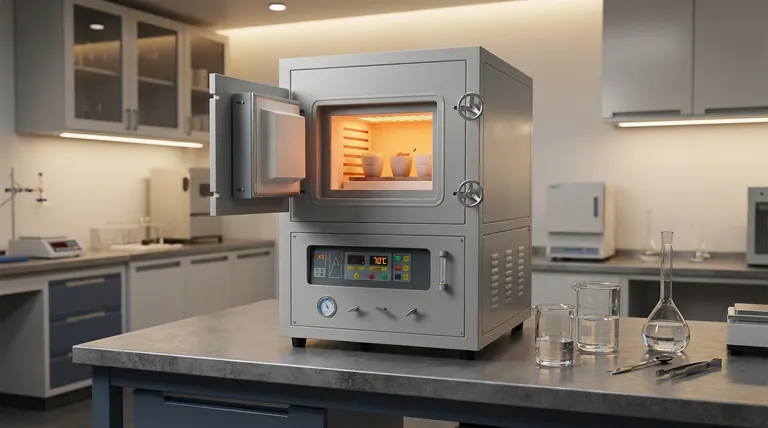
The use of specific equipment, such as a water bath or constant temperature oven, is critical.
Fluctuations in temperature can alter reaction rates unpredictably. To derive accurate data regarding stability, the heat source must be constant and uniform throughout the entire experiment.
The Limits of Simulation
While effective, this method relies on the assumption that high-temperature behavior accurately maps to low-temperature longevity.
It is a powerful tool for identifying failure points, but it is strictly an accelerated simulation intended to predict, rather than perfectly replicate, the exact timeline of natural aging.
Making the Right Choice for Your Experiment
When designing stability experiments for Li-NASICON materials, consider your specific analytical goals:
- If your primary focus is rapid material screening: Use the 70°C environment to quickly identify and disqualify materials that show immediate signs of kinetic degradation.
- If your primary focus is validating real-world lifespan: Ensure your heating equipment maintains tight thermal regulation to accurately model the long-term thermodynamic stability required for commercial battery operation.
By strictly controlling this thermal variable, you transform a simple soak test into a predictive model for future battery reliability.
Summary Table:
| Factor | Purpose in Alkali Stability Experiments |
|---|---|
| Temperature (70°C) | Boosts reaction kinetics to overcome energy barriers |
| Process Simulation | Accelerated aging to model years of real-world use |
| Stability Metrics | Evaluates both thermodynamic and kinetic degradation |
| Equipment Needs | Requires constant, uniform heating (Water Bath/Oven) |
| Target Material | Li-NASICON (LTGP) for lithium-air batteries |
Precision Heating for Advanced Material Research
Don't let temperature fluctuations compromise your Li-NASICON stability data. KINTEK provides high-performance constant temperature solutions—including Muffle, Tube, and Vacuum systems—engineered for the rigorous demands of battery material R&D.
Our expert manufacturing ensures uniform heat distribution, enabling you to accurately simulate years of operational stress in a fraction of the time. Whether you need a standard setup or a customizable high-temp furnace for unique experimental protocols, KINTEK delivers the reliability your research deserves.
Ready to elevate your lab's testing capabilities?
Contact KINTEK Today for a Custom Quote
References
- Benjamin X. Lam, Gerbrand Ceder. Degradation Mechanism of Phosphate‐Based Li‐NASICON Conductors in Alkaline Environment. DOI: 10.1002/aenm.202403596
This article is also based on technical information from Kintek Furnace Knowledge Base .
Related Products
- Electric Rotary Kiln Continuous Working Small Rotary Furnace Kiln for Pyrolysis Plant Heating
- Multi Heating Zones CVD Tube Furnace Machine for Chemical Vapor Deposition Equipment
- 2200 ℃ Graphite Vacuum Heat Treat Furnace
- 2200 ℃ Tungsten Vacuum Heat Treat and Sintering Furnace
- Silicon Carbide SiC Thermal Heating Elements for Electric Furnace
People Also Ask
- What are the advantages of electric rotary kilns compared to fuel-fired ones? Boost Precision and Efficiency in Your Process
- What materials can be processed in an electric rotary kiln? Versatile Solutions for Advanced Materials
- What advantages do electric rotary kilns offer over fuel-based kilns? Boost Efficiency and Purity in Your Process
- What are the primary applications of electric rotary kilns? Precision Thermal Processing for High-Value Materials
- How do electric rotary kilns achieve high thermal efficiency? Unlock Over 95% Thermal Efficiency