
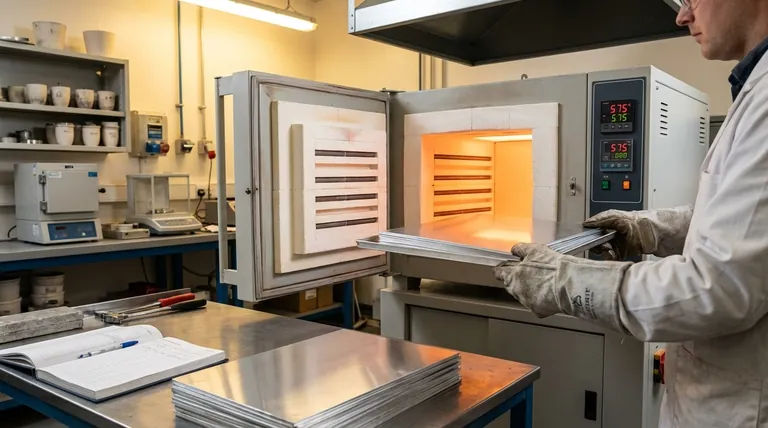
Industrial electric furnaces serve as the precise control mechanism for defining the mechanical properties of EN AW-6082 aluminum alloy sheets. Their primary function is to execute critical heat treatment cycles—specifically annealing, solution heat treatment, and artificial aging—which manipulate the alloy's internal structure. By maintaining exact temperatures and holding times, these furnaces prepare the material for demanding manufacturing techniques like Single Point Incremental Forming (SPIF).
The Core Objective The furnace does not simply heat the metal; it acts as a microstructure regulator. Its goal is to facilitate the dissolution or precipitation of the Mg2Si strengthening phase, allowing you to accurately dial in the specific hardness or plasticity required for your final application.
The Role of Microstructure Manipulation
Controlling the Mg2Si Phase
The defining characteristic of EN AW-6082 is its reliance on the magnesium silicide (Mg2Si) phase for strength.
The electric furnace is responsible for controlling the state of this phase. Depending on the temperature profile, the furnace causes these phases to either dissolve into the aluminum matrix, precipitate out, or aggregate.
Adjusting Baseline Hardness
By manipulating the strengthening phases, the furnace directly alters the material's hardness.
This allows manufacturers to reset the alloy's mechanical state. You can transition the sheet from a hard, brittle state to a softer state suitable for shaping, or vice versa.
Modifying Plasticity for Forming
Plasticity is essential for processes that deform the metal, such as SPIF.
The furnace treatments ensure the material has sufficient ductility to undergo deformation without cracking. This preparation is a prerequisite for achieving complex geometries during the forming stage.
Specific Treatment Cycles
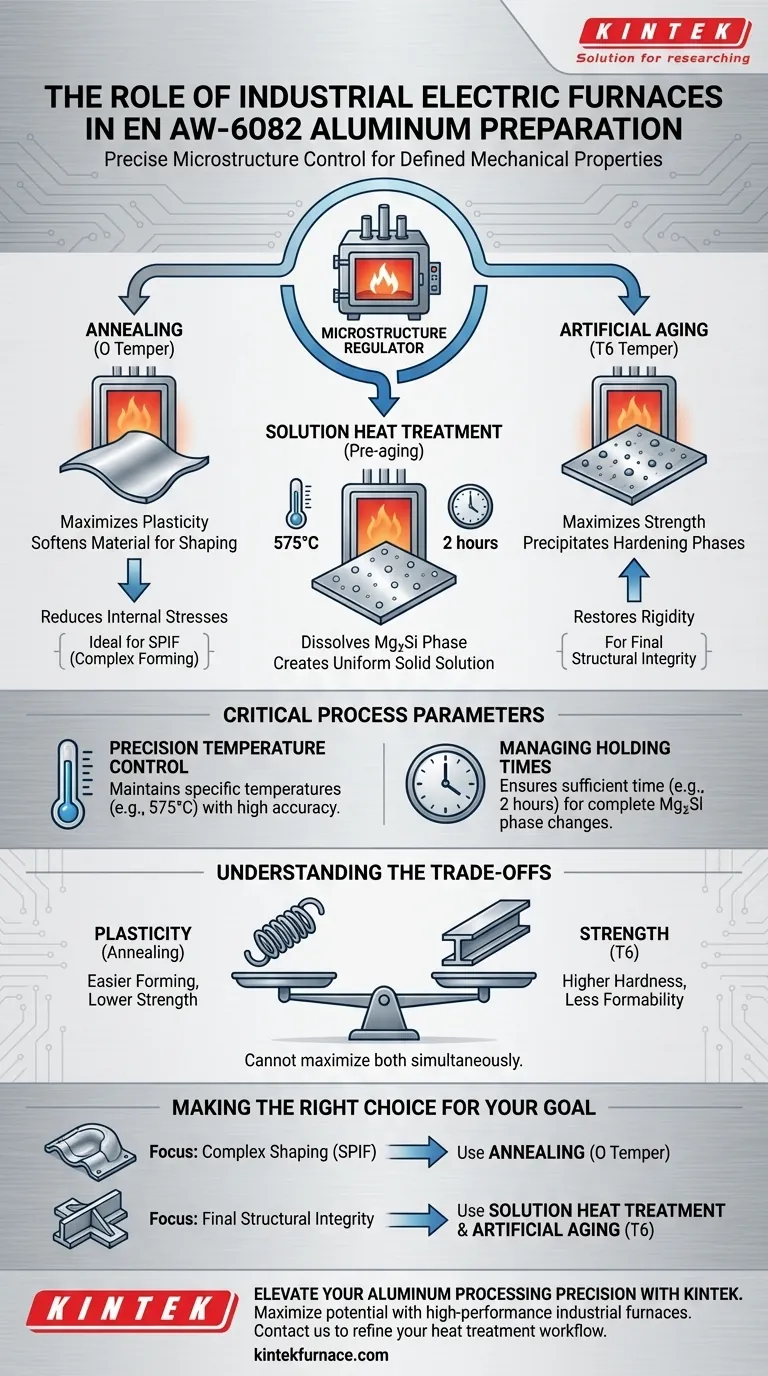
Solution Heat Treatment
This process involves heating the alloy to high temperatures to dissolve soluble elements.
The primary reference highlights specific parameters, such as maintaining a temperature of 575°C. This ensures a uniform solid solution is created before subsequent steps.
Annealing (O Temper)
When maximum plasticity is required, the furnace is used for annealing.
This process softens the alloy, reducing internal stresses and maximizing ductility. It is the ideal preparation when the aluminum sheet must undergo significant mechanical deformation.
Artificial Aging (T6 Temper)
Once the material is formed, the furnace can be used to restore strength.
Through artificial aging, the furnace encourages the controlled precipitation of strengthening particles. This returns the component to a T6 temper, providing the rigidity and durability needed for the final product.
Critical Process Parameters
Precision Temperature Control
The effectiveness of the heat treatment hinges on thermal stability.
Industrial electric furnaces are utilized because they can maintain specific temperatures, such as the 575°C required for solution treatment, with high accuracy. Deviations here can result in inconsistent mechanical properties.
Managing Holding Times
Time is just as critical as temperature in these chemical reactions.
The reference notes specific durations, such as 2 hours, which allow sufficient time for the Mg2Si phases to reach the desired state. Cutting this time short prevents the complete dissolution or precipitation necessary for the target temper.
Understanding the Trade-offs
Plasticity vs. Strength
You cannot maximize both properties simultaneously in a single step.
The furnace allows you to prioritize plasticity (via annealing) to facilitate forming, but this temporarily sacrifices strength. Conversely, aging creates strength but reduces the material's ability to be formed without breaking.
The Cost of Precision
Achieving these specific tempers requires rigorous adherence to parameters.
If the furnace fails to hold 575°C consistently or if the 2-hour window is shortened, the material will not meet the baseline requirements for SPIF. There is no shortcut; the process requires exact compliance with the thermal recipe.
Making the Right Choice for Your Goal
To optimize your EN AW-6082 preparation, align the furnace cycle with your immediate manufacturing step:
- If your primary focus is complex shaping (SPIF): Utilize the furnace for Annealing (O Temper) to maximize plasticity and minimize the risk of cracking during deformation.
- If your primary focus is final structural integrity: Utilize the furnace for Solution Heat Treatment and Artificial Aging (T6) to precipitate Mg2Si and maximize hardness.
By leveraging the industrial electric furnace as a tool for phase management, you ensure your aluminum sheets are perfectly tuned to the demands of your specific fabrication process.
Summary Table:
| Heat Treatment Process | Target Temper | Primary Function | Key Parameters (Typical) |
|---|---|---|---|
| Annealing | O Temper | Maximizes plasticity & reduces stress for shaping | Softens material for deformation |
| Solution Heat Treatment | Pre-aging State | Dissolves Mg2Si phase into aluminum matrix | ~575°C for 2 hours |
| Artificial Aging | T6 Temper | Precipitates hardening phases for strength | Controlled cooling & reheating |
| Microstructure Control | N/A | Regulates hardness and ductility via Mg2Si | Precise thermal holding times |
Elevate Your Aluminum Processing Precision
Maximize the potential of EN AW-6082 and other advanced alloys with KINTEK’s high-performance industrial furnaces. Backed by expert R&D and world-class manufacturing, we provide Muffle, Tube, Rotary, Vacuum, and CVD systems tailored for precise temperature control and uniform microstructure manipulation. Whether you need to optimize plasticity for SPIF or achieve maximum T6 hardness, our customizable lab and industrial solutions are engineered for your unique needs.
Ready to refine your heat treatment workflow? Contact KINTEK today for a consultation!
Visual Guide
References
- Łukasz Kuczek, Ryszard Sitek. Influence of Heat Treatment on Properties and Microstructure of EN AW-6082 Aluminium Alloy Drawpieces After Single-Point Incremental Sheet Forming. DOI: 10.3390/app15020783
This article is also based on technical information from Kintek Furnace Knowledge Base .
Related Products
- Electric Rotary Kiln Small Rotary Furnace for Activated Carbon Regeneration
- Electric Rotary Kiln Continuous Working Small Rotary Furnace Kiln for Pyrolysis Plant Heating
- Electric Rotary Kiln Pyrolysis Furnace Plant Machine Small Rotary Kiln Calciner
- Spark Plasma Sintering SPS Furnace
- 1200℃ Controlled Inert Nitrogen Atmosphere Furnace
People Also Ask
- What are the main applications of a rotary kiln electric furnace? Achieve Uniform Heat Treatment for Powders
- What are the key components of a rotary kiln electric furnace? Unlock Efficient Thermal Processing
- What is the significance of the refractory lining in a rotary kiln electric furnace? Unlock Efficiency and Longevity
- What advantages do electric rotary kilns offer over fuel-based kilns? Boost Efficiency and Purity in Your Process
- What materials can be processed in an electric rotary kiln? Versatile Solutions for Advanced Materials



















