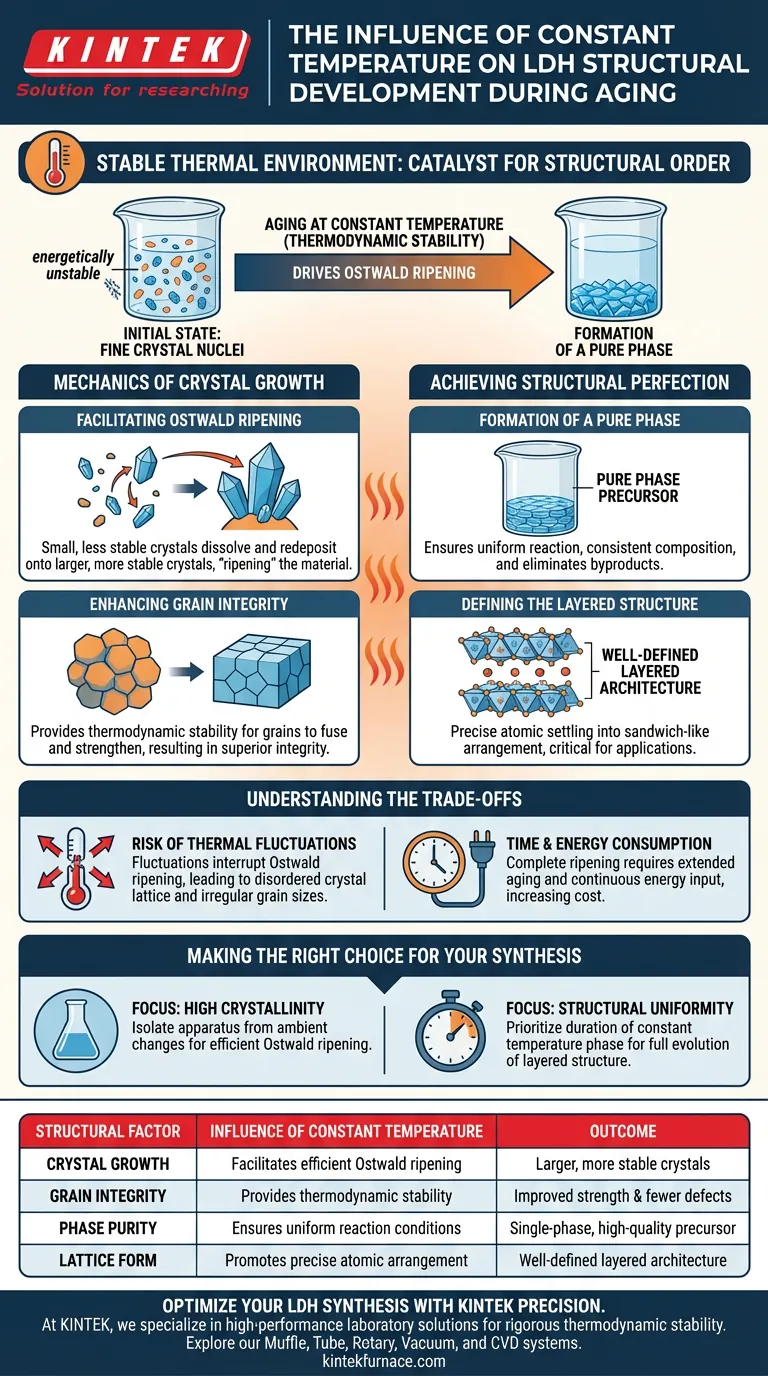
A stable thermal environment is the catalyst for structural order. When aging Layered Double Hydroxides (LDHs), maintaining a constant temperature is essential for converting the initial fine crystal nuclei into robust structures. This specific environmental condition drives Ostwald ripening, which directly improves grain integrity and ensures the material develops into a pure phase precursor with a well-defined layered architecture.
Thermodynamic stability during the aging process is the primary mechanism for achieving high-quality LDH crystals. By maintaining a constant temperature, you facilitate the controlled growth of grains, preventing structural defects and ensuring the formation of a distinct, uniform layered lattice.
The Mechanics of Crystal Growth
Facilitating Ostwald Ripening
The co-precipitation process generates a multitude of fine crystal nuclei. These initial particles are small and energetically unstable.
A constant temperature environment allows Ostwald ripening to occur efficiently. In this process, smaller, less stable crystals dissolve and redeposit onto larger, more stable crystals, effectively "ripening" the material into a more mature state.
Enhancing Grain Integrity
Without thermal stability, the growth of these crystals can be chaotic and uneven.
By strictly controlling the temperature, you provide the thermodynamic stability required for the grains to fuse and strengthen. This results in superior grain integrity, making the final material more robust and structurally sound.
Achieving Structural Perfection
Formation of a Pure Phase
Inconsistent temperatures can lead to mixed phases or incomplete crystallization.
A stable environment ensures the reaction proceeds uniformly, leading to a pure phase precursor. This means the chemical composition and crystal structure are consistent throughout the entire sample, eliminating unwanted byproducts.
Defining the Layered Structure
LDHs are defined by their specific "sandwich-like" layered arrangement.
The aging process under constant heat allows the atoms to settle into this typical layered structure with high precision. This structural definition is critical for the material's performance in applications such as catalysis or anion exchange.
Understanding the Trade-offs
The Risk of Thermal Fluctuations
While constant temperature is beneficial, achieving it requires rigorous control.
Any significant fluctuation in temperature can interrupt the Ostwald ripening process. This interruption may result in a distribution of irregular grain sizes or a disordered crystal lattice, compromising the material's final properties.
Time and Energy Consumption
Facilitating complete Ostwald ripening is not an instantaneous process.
Maintaining a constant temperature often requires extended aging periods and continuous energy input. While this yields a superior structure, it increases the time and cost of the synthesis compared to rapid, uncontrolled aging methods.
Making the Right Choice for Your Synthesis
To apply these principles effectively to your LDH project, consider your specific structural requirements:
- If your primary focus is high crystallinity: Ensure your apparatus is isolated from ambient temperature changes to maximize the efficiency of Ostwald ripening.
- If your primary focus is structural uniformity: Prioritize the duration of the constant temperature phase to allow the fine nuclei to fully evolve into a well-defined layered structure.
Mastering the thermal environment during aging is the difference between a disordered mixture and a high-performance engineered material.
Summary Table:
| Structural Factor | Influence of Constant Temperature | Outcome |
|---|---|---|
| Crystal Growth | Facilitates efficient Ostwald ripening | Larger, more stable crystals |
| Grain Integrity | Provides thermodynamic stability | Improved strength & fewer defects |
| Phase Purity | Ensures uniform reaction conditions | Single-phase, high-quality precursor |
| Lattice Form | Promotes precise atomic arrangement | Well-defined layered architecture |
Optimize Your LDH Synthesis with KINTEK Precision
Precision in thermal control is the key to mastering the structural evolution of Layered Double Hydroxides. At KINTEK, we specialize in providing high-performance laboratory solutions backed by expert R&D and manufacturing. Our diverse range of Muffle, Tube, Rotary, Vacuum, and CVD systems is designed to maintain the rigorous thermodynamic stability required for perfect crystal growth.
Whether you need uniform aging environments or customizable high-temperature furnaces, KINTEK offers the reliability your research demands. Contact us today to find the perfect system for your unique synthesis needs.
Visual Guide
References
- Daisy W. Leung, Dermot O’Hare. Optimising the acid–base ratio of Mg–Al layered double oxides to enhance CO<sub>2</sub> capture performance: the critical role of calcination conditions. DOI: 10.1039/d4dt00270a
This article is also based on technical information from Kintek Furnace Knowledge Base .
Related Products
- Molybdenum Disilicide MoSi2 Thermal Heating Elements for Electric Furnace
- Controlled Inert Nitrogen Hydrogen Atmosphere Furnace
- Multi Zone Laboratory Quartz Tube Furnace Tubular Furnace
- Magnesium Extraction and Purification Condensing Tube Furnace
People Also Ask
- What are the typical application temperatures for molybdenum disilicide (MoSi2) heating elements? Master High-Temp Performance
- What is the primary use of molybdenum disilicide? Ideal for High-Temp Heating Elements
- What are the characteristics of molybdenum disilicide heating elements? Unlock High-Temp Performance
- What are the properties of molybdenum disilicide (MoSi2) that make it suitable for high-temperature applications? Discover Its High-Temp Resilience
- What are the applications of molybdenum disilicide heating elements? Achieve Extreme Heat Stability for Industrial Processes