Knowledge What functions does ammonia (NH3) perform beyond acting as a nitrogen source? Unlock Advanced Surface Engineering
Author avatar

Tech Team · Kintek Furnace

Updated 1 day ago

What functions does ammonia (NH3) perform beyond acting as a nitrogen source? Unlock Advanced Surface Engineering


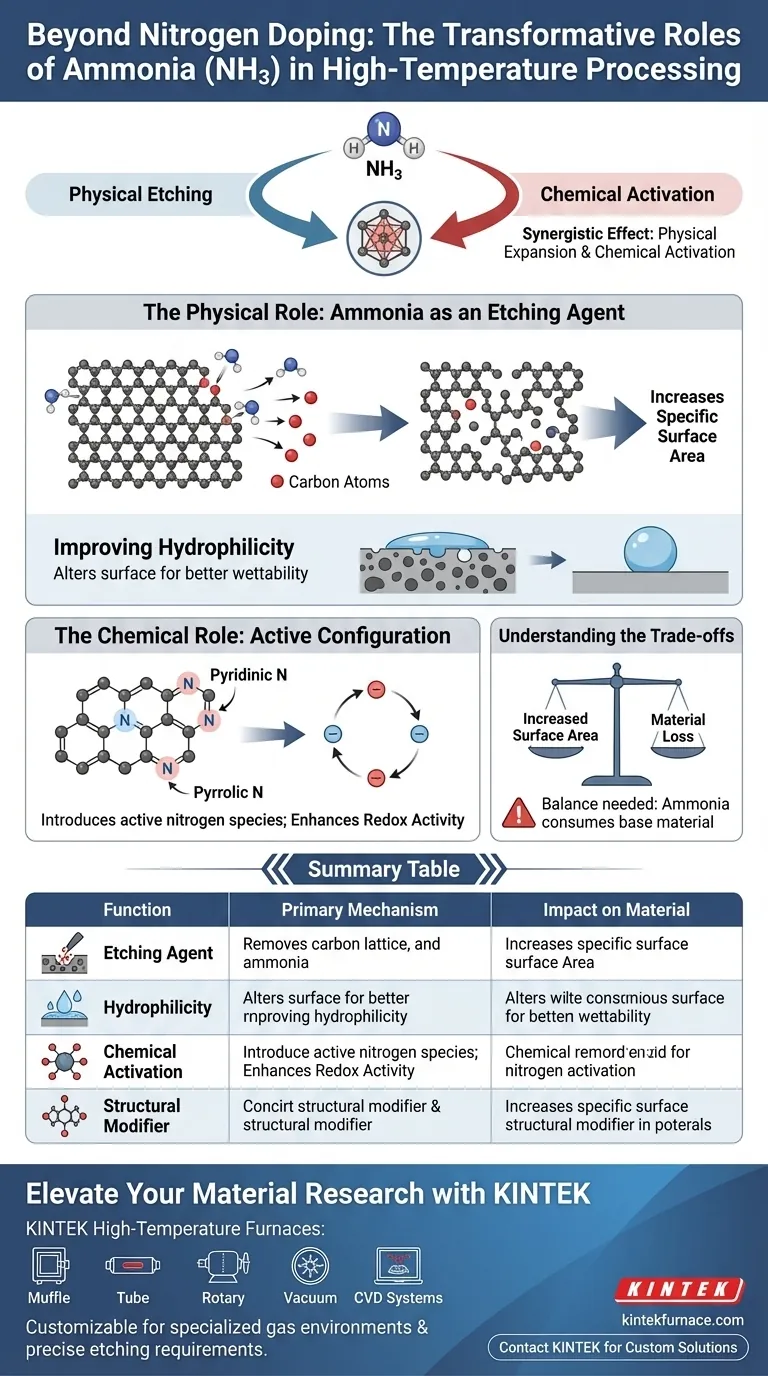
Beyond its role as a dopant, ammonia (NH3) functions primarily as a significant etching agent during high-temperature processing. While it introduces nitrogen into the material lattice, it simultaneously triggers a physical restructuring of the material, actively consuming carbon to create porosity and altering surface chemistry to enhance wettability.

The true power of ammonia lies in its synergistic effect: it physically expands the material's active surface area through etching while chemically activating that surface with specific nitrogen configurations.
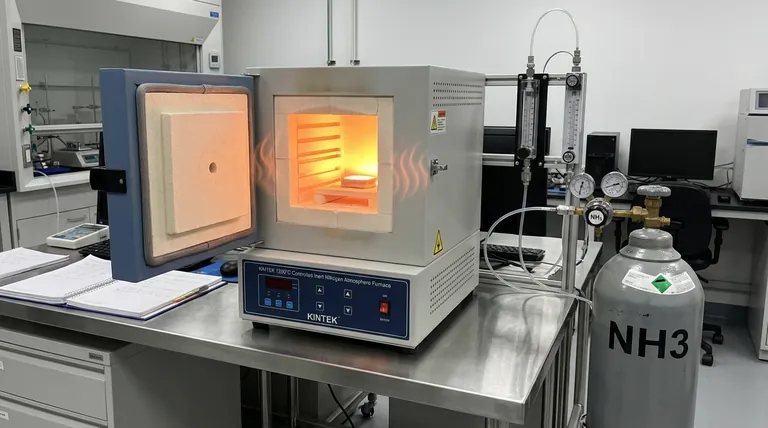
What functions does ammonia (NH3) perform beyond acting as a nitrogen source? Unlock Advanced Surface Engineering

The Physical Role: Ammonia as an Etching Agent

Increasing Specific Surface Area

In high-temperature environments, ammonia does not simply sit on the material; it reacts aggressively with it.

Acting as an etching agent, NH3 removes carbon atoms from the material structure.

This process creates voids and defects, significantly increasing the specific surface area of the material.

Improving Hydrophilicity

The structural changes caused by ammonia processing directly affect how the material interacts with liquids.

The combination of increased surface roughness (from etching) and chemical alteration makes the resulting carbon material more hydrophilic.

This improves the material's wettability, allowing for better interaction with electrolytes or other liquid mediums.

The Chemical Role: Active Configuration

Introducing Active Nitrogen Species

While you know NH3 acts as a nitrogen source, the type of nitrogen it introduces is critical.

Ammonia processing specifically favors the formation of pyridinic and pyrrolic nitrogen configurations.

These are considered "active" configurations, distinct from generic nitrogen doping, and are highly sought after for catalytic applications.

Enhancing Redox Activity

The presence of these specific nitrogen groups creates a higher density of functional sites on the material's surface.

These sites facilitate electron transfer, directly improving the material's redox activity.

This makes the material significantly more effective in applications requiring rapid reduction-oxidation reactions.

Understanding the Trade-offs

Managing Material Loss

Because ammonia acts as an etching agent, it inherently involves the consumption of the base material.

Extended exposure or excessively high temperatures can lead to significant mass loss.

Operators must balance the need for increased surface area against the structural integrity and yield of the final product.

Making the Right Choice for Your Goal

To utilize ammonia effectively, you must align the processing parameters with your specific material requirements.

  • If your primary focus is maximizing active sites: Prioritize NH3 processing to specifically target the formation of pyridinic and pyrrolic nitrogen groups, which drive redox activity.
  • If your primary focus is increasing porosity: Leverage the etching properties of NH3 to strip away carbon and expand the specific surface area for better physical interaction.

Ammonia is not just an additive; it is a transformative tool that reshapes both the physical architecture and chemical potential of your material.

Summary Table:

Function Primary Mechanism Impact on Material
Etching Agent Reacts with and removes carbon atoms Increases specific surface area and creates porosity
Hydrophilicity Alters surface roughness and chemistry Improves wettability and interaction with liquids
Chemical Activation Favors pyridinic/pyrrolic N configurations Enhances redox activity and electron transfer
Structural Modifier Creates voids and physical defects Physically expands active surface area

Elevate Your Material Research with KINTEK

Precision matters when managing the aggressive etching and chemical transformation of ammonia processing. KINTEK provides industry-leading Muffle, Tube, Rotary, Vacuum, and CVD systems designed to handle specialized gas environments with unmatched stability.

Backed by expert R&D and world-class manufacturing, our lab high-temperature furnaces are fully customizable to meet your unique etching and nitrogen-doping requirements. Don't settle for generic results—optimize your porosity and redox activity today.

Contact KINTEK to find your custom furnace solution

Visual Guide
What functions does ammonia (NH3) perform beyond acting as a nitrogen source? Unlock Advanced Surface Engineering Visual Guide

References

  1. Xing Huang, Dessie Ashagrie Tafere. Waste-derived green N-doped materials: mechanistic insights, synthesis, and comprehensive evaluation. DOI: 10.1039/d5su00555h

This article is also based on technical information from Kintek Furnace Knowledge Base .

Related Products

People Also Ask

Related Products

1200℃ Controlled Inert Nitrogen Atmosphere Furnace

1200℃ Controlled Inert Nitrogen Atmosphere Furnace

KINTEK 1200℃ Controlled Atmosphere Furnace: Precision heating with gas control for labs. Ideal for sintering, annealing, and material research. Customizable sizes available.

1700℃ Controlled Inert Nitrogen Atmosphere Furnace

1700℃ Controlled Inert Nitrogen Atmosphere Furnace

KT-17A Controlled Atmosphere Furnace: Precise 1700°C heating with vacuum & gas control. Ideal for sintering, research & material processing. Explore now!

1700℃ High Temperature Laboratory Tube Furnace with Quartz or Alumina Tube

1700℃ High Temperature Laboratory Tube Furnace with Quartz or Alumina Tube

KINTEK's Tube Furnace with Alumina Tube: Precision heating up to 1700°C for material synthesis, CVD, and sintering. Compact, customizable, and vacuum-ready. Explore now!

1400℃ Controlled Inert Nitrogen Atmosphere Furnace

1400℃ Controlled Inert Nitrogen Atmosphere Furnace

KT-14A Controlled Atmosphere Furnace for labs & industry. 1400°C max temp, vacuum sealing, inert gas control. Customizable solutions available.

Custom Made Versatile CVD Tube Furnace Chemical Vapor Deposition CVD Equipment Machine

Custom Made Versatile CVD Tube Furnace Chemical Vapor Deposition CVD Equipment Machine

KINTEK's CVD Tube Furnace offers precision temperature control up to 1600°C, ideal for thin film deposition. Customizable for research and industrial needs.

1400℃ High Temperature Laboratory Tube Furnace with Quartz and Alumina Tube

1400℃ High Temperature Laboratory Tube Furnace with Quartz and Alumina Tube

KINTEK's Tube Furnace with Alumina Tube: Precision high-temperature processing up to 2000°C for labs. Ideal for material synthesis, CVD, and sintering. Customizable options available.

Multi Heating Zones CVD Tube Furnace Machine for Chemical Vapor Deposition Equipment

Multi Heating Zones CVD Tube Furnace Machine for Chemical Vapor Deposition Equipment

KINTEK's Multi-Zone CVD Tube Furnaces offer precision temperature control for advanced thin film deposition. Ideal for research and production, customizable for your lab needs.

Vertical Laboratory Quartz Tube Furnace Tubular Furnace

Vertical Laboratory Quartz Tube Furnace Tubular Furnace

Precision KINTEK Vertical Tube Furnace: 1800℃ heating, PID control, customizable for labs. Ideal for CVD, crystal growth & materials testing.

Vacuum Heat Treat Furnace with Ceramic Fiber Liner

Vacuum Heat Treat Furnace with Ceramic Fiber Liner

KINTEK's Vacuum Furnace with Ceramic Fiber Lining offers precise high-temperature processing up to 1700°C, ensuring uniform heat distribution and energy efficiency. Ideal for labs and production.

1400℃ Muffle Oven Furnace for Laboratory

1400℃ Muffle Oven Furnace for Laboratory

KT-14M Muffle Furnace: Precision 1400°C heating with SiC elements, PID control, and energy-efficient design. Ideal for labs.

Split Chamber CVD Tube Furnace with Vacuum Station CVD Machine

Split Chamber CVD Tube Furnace with Vacuum Station CVD Machine

Split Chamber CVD Tube Furnace with Vacuum Station - High precision 1200°C lab furnace for advanced materials research. Customizable solutions available.

Laboratory Muffle Oven Furnace with Bottom Lifting

Laboratory Muffle Oven Furnace with Bottom Lifting

Boost lab efficiency with KT-BL Bottom Lifting Furnace: precise 1600℃ control, superior uniformity, and enhanced productivity for material science and R&D.

High Pressure Laboratory Vacuum Tube Furnace Quartz Tubular Furnace

High Pressure Laboratory Vacuum Tube Furnace Quartz Tubular Furnace

KINTEK High Pressure Tube Furnace: Precision heating up to 1100°C with 15Mpa pressure control. Ideal for sintering, crystal growth, and lab research. Customizable solutions available.

1800℃ High Temperature Muffle Oven Furnace for Laboratory

1800℃ High Temperature Muffle Oven Furnace for Laboratory

KINTEK Muffle Furnaces: Precision 1800°C heating for labs. Energy-efficient, customizable, with PID control. Ideal for sintering, annealing, and research.

1200℃ Split Tube Furnace Laboratory Quartz Tube Furnace with Quartz Tube

1200℃ Split Tube Furnace Laboratory Quartz Tube Furnace with Quartz Tube

Discover KINTEK's 1200℃ Split Tube Furnace with quartz tube for precise high-temperature lab applications. Customizable, durable, and efficient. Get yours now!

Vacuum Heat Treat Sintering Furnace Molybdenum Wire Vacuum Sintering Furnace

Vacuum Heat Treat Sintering Furnace Molybdenum Wire Vacuum Sintering Furnace

KINTEK's Vacuum Molybdenum Wire Sintering Furnace excels in high-temperature, high-vacuum processes for sintering, annealing, and material research. Achieve precise 1700°C heating with uniform results. Custom solutions available.

High Temperature Muffle Oven Furnace for Laboratory Debinding and Pre Sintering

High Temperature Muffle Oven Furnace for Laboratory Debinding and Pre Sintering

KT-MD Debinding & Pre-Sintering Furnace for ceramics - precise temperature control, energy-efficient design, customizable sizes. Boost your lab efficiency today!

2200 ℃ Graphite Vacuum Heat Treat Furnace

2200 ℃ Graphite Vacuum Heat Treat Furnace

2200℃ Graphite Vacuum Furnace for high-temperature sintering. Precise PID control, 6*10⁻³Pa vacuum, durable graphite heating. Ideal for research & production.

Vacuum Heat Treat Sintering and Brazing Furnace

Vacuum Heat Treat Sintering and Brazing Furnace

KINTEK Vacuum Brazing Furnaces deliver precision, clean joints with superior temperature control. Customizable for diverse metals, ideal for aerospace, medical, and thermal applications. Get a quote!

9MPa Air Pressure Vacuum Heat Treat and Sintering Furnace

9MPa Air Pressure Vacuum Heat Treat and Sintering Furnace

Achieve superior ceramic densification with KINTEK's advanced air pressure sintering furnace. High-pressure up to 9MPa, precise 2200℃ control.


Leave Your Message



















