
The integrity of ceramic molds for single crystal alloys depends on a precise, multi-layered material strategy. To manufacture these molds effectively, you must utilize a ceramic alumina slurry combined with alumina sand particles for the primary coating, while employing mullite sand for the subsequent backing layers.
Success hinges on segregating the mold's functions: the inner surface must provide absolute chemical inertness against the reactive melt, while the outer structure must deliver the mechanical robustness required to survive the thermal stresses of directional solidification.
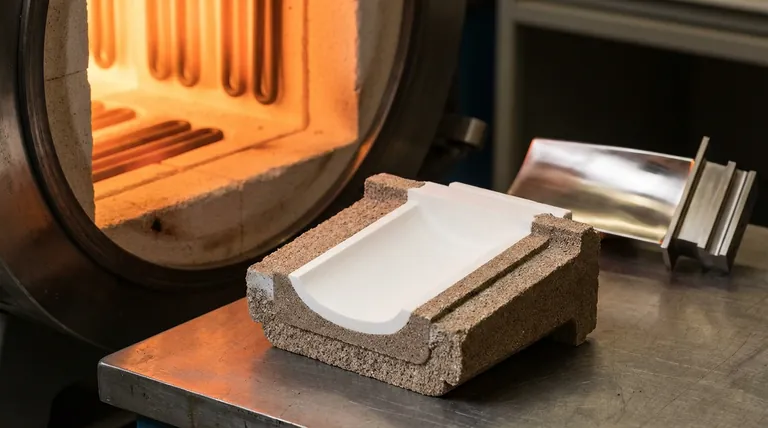
The Primary Layer: Prioritizing Chemical Stability
The Material Composition
The initial layer, which comes into direct contact with the molten metal, is critical. It utilizes a ceramic alumina slurry reinforced with alumina sand particles.
Ensuring Inertness
The choice of alumina for this layer is driven by the need for chemical stability.
Because single crystal alloys are cast at extremely high temperatures, the mold face must not react with the melt. Alumina prevents surface contamination and ensures the purity of the cast alloy.
The Backing Layers: Ensuring Structural Integrity
Switching to Mullite
Once the primary layer is established, the material selection shifts for the backing layers. These layers utilize mullite sand.
Leveraging Particle Size
Unlike the fine finish of the primary layer, these backing layers employ larger-diameter particles. This change in texture contributes to the overall build-up of the shell.
Managing Thermal Stress
The primary reason for selecting mullite in the backing layers is its excellent thermal shock stability.
Additionally, mullite provides high-temperature mechanical strength. This prevents the shell from cracking under the extreme thermal gradients inherent in the casting process.
Understanding the Trade-offs: Dimensional Accuracy
The Necessity of Thickness
Material selection alone is not enough; the quantity of material matters. The application of these layers must increase the mold wall thickness to approximately 8 mm.
Withstanding the Withdrawal Process
This specific thickness is required to maintain the dimensional accuracy of the mold cavity.
During the high-temperature withdrawal process used in directional solidification, the mold is subjected to significant mechanical and thermal loads. A thinner shell would likely distort, compromising the precise geometry required for single crystal components.
Making the Right Choice for Your Goal
When designing the shell system for your specific alloy application, keep these functional priorities in mind:
- If your primary focus is Surface Quality and Purity: Prioritize the consistency of the alumina slurry and sand mixture in the primary layer to prevent melt reaction.
- If your primary focus is Mold Survival: Ensure the mullite backing layers are built to sufficient thickness (approx. 8 mm) using larger-diameter sand to resist thermal shock and distortion.
By strictly adhering to this material hierarchy, you ensure the mold can withstand the rigors of casting without compromising the alloy's crystal structure.
Summary Table:
| Layer Type | Primary Layer (Inner) | Backing Layers (Outer) |
|---|---|---|
| Material | Alumina Slurry & Alumina Sand | Mullite Sand |
| Key Function | Chemical Inertness & Purity | Mechanical Strength & Thermal Stability |
| Particle Size | Fine (Smooth Finish) | Large Diameter (Structural Build) |
| Critical Goal | Prevent melt reaction | Resist thermal shock & distortion |
| Wall Thickness | - | Approx. 8 mm (Total) |
Achieve Perfection in Single Crystal Casting with KINTEK
Precise material selection is the difference between a flawless cast and a failed mold. Backed by expert R&D and manufacturing, KINTEK offers high-performance laboratory solutions including Muffle, Tube, Rotary, Vacuum, and CVD systems, all fully customizable to meet your unique high-temperature processing needs. Whether you are perfecting ceramic mold integrity or exploring advanced material synthesis, our technical experts are ready to help you optimize your results.
Ready to elevate your lab's capabilities? Contact us today to discuss your custom furnace requirements!
References
- Study of the Non-uniform Distribution of Primary Dendrite Arm Spacing (PDAS) Across the Width of a Single-Crystal Nickel-Based Superalloy Casting. DOI: 10.1007/s40962-025-01717-1
This article is also based on technical information from Kintek Furnace Knowledge Base .
Related Products
- High Temperature Muffle Oven Furnace for Laboratory Debinding and Pre Sintering
- Dental Porcelain Zirconia Sintering Ceramic Vacuum Press Furnace
- Vacuum Dental Porcelain Sintering Furnace for Dental Laboratories
- Chairside Dental Porcelain Zirconia Sintering Furnace with Transformer for Ceramic Restorations
- Multi Heating Zones CVD Tube Furnace Machine for Chemical Vapor Deposition Equipment
People Also Ask
- What thermal phenomena occur during polymer binder burnout in ceramic green bodies? Lab Furnace Guide
- What role does a high-temperature muffle furnace play in STFO synthesis? Achieve Pure Perovskite Results
- Why is controlled heat treatment in a muffle furnace necessary for calcined clay? Achieve Optimal Pozzolanic Activity
- How does a high-temperature muffle furnace facilitate the formation of LaNbxAl1−xO3+δ perovskite structures? Key Roles
- What role does a high-temperature muffle furnace play in the multi-stage synthesis of Li0.5MnFe1.5O4? Key to Pure Spinel



















