
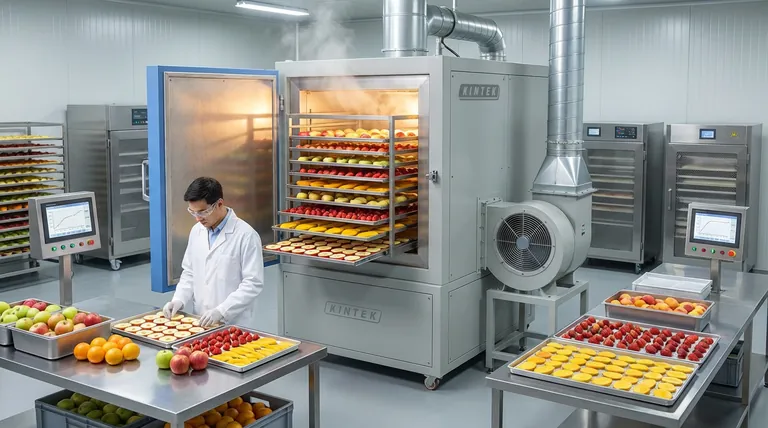
Industrial drying ovens equipped with fan systems function as the primary engine for forced convection, ensuring the uniform and efficient removal of moisture from fruit materials. By generating a consistent cycle of heated air, these systems eliminate cold spots and prevent localized moisture buildup. This controlled environment allows for dehydration at lower temperatures, which is essential for maintaining the physical and chemical integrity of the fruit.
The core role of fan-equipped ovens is to provide a stable, low-temperature environment through forced convection. This balance enables efficient moisture extraction while protecting the fruit’s delicate bioactive profile from thermal damage.
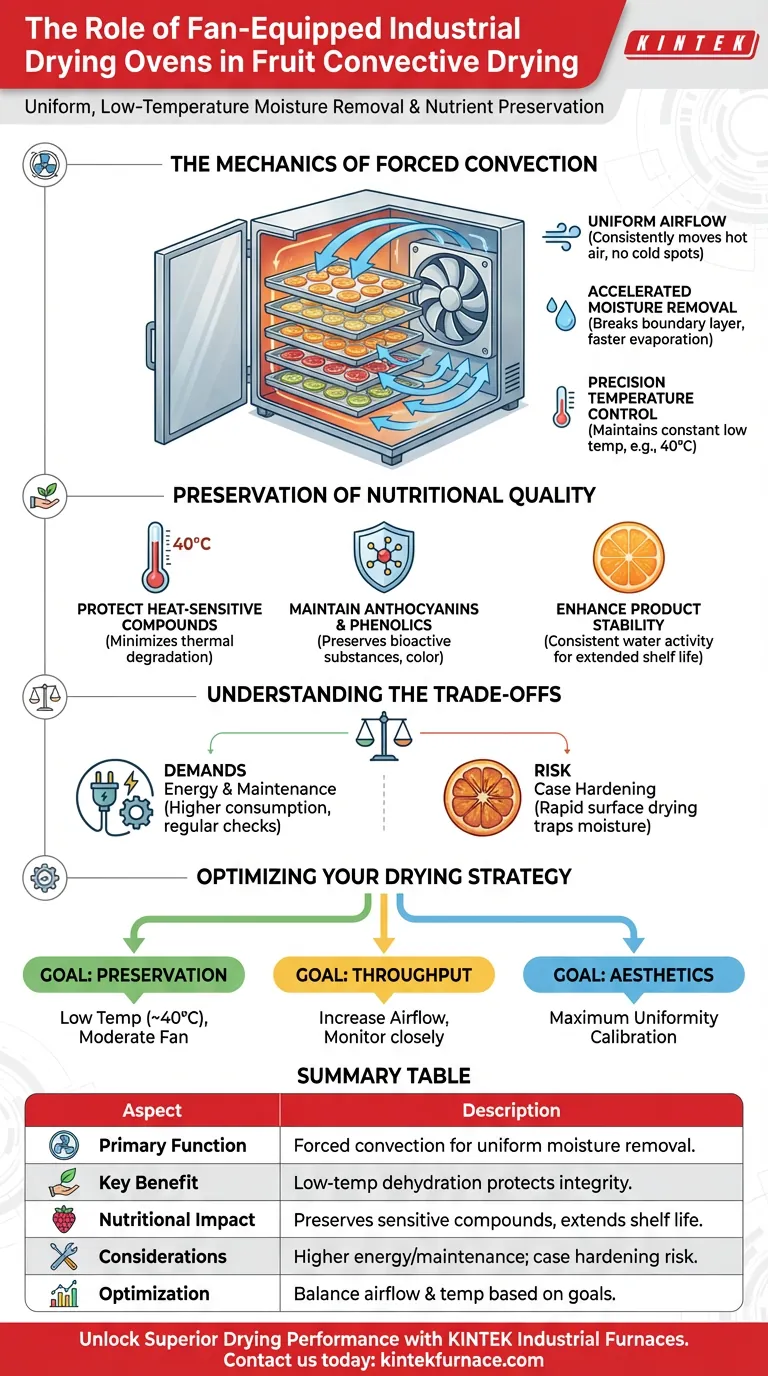
The Mechanics of Forced Convection
Achieving Uniform Airflow
The integration of fan systems transforms a static heating chamber into a dynamic forced convection environment. This ensures that hot air moves consistently across the entire surface of the fruit material, such as a puree, rather than relying on natural air movement.
Accelerating Moisture Removal
Consistent airflow effectively breaks down the boundary layer of saturated air that forms on the fruit's surface. This allows for a much faster and more predictable evaporation rate, facilitating the continuous migration of water from the center of the material to its exterior.
Precision Temperature Control
Fan systems allow the oven to maintain a constant temperature—often as low as 40°C—throughout the drying cycle. This precision prevents temperature spikes that could lead to uneven drying or scorched edges on the fruit.
Preservation of Nutritional Quality
Protecting Heat-Sensitive Compounds
Many fruits contain delicate bioactive substances that break down quickly under high heat. Because fan-driven ovens can dry effectively at lower temperatures, they minimize the thermal degradation of these valuable nutrients.
Maintaining Anthocyanins and Phenolics
Specific antioxidants, such as anthocyanins and phenolic substances, are highly susceptible to heat damage. The gentle, controlled environment of a fan-equipped oven ensures these compounds remain intact, preserving both the fruit's nutritional value and its natural color.
Enhancing Product Stability
By removing moisture uniformly, these ovens ensure the final product has a consistent water activity level. This uniformity is critical for extending shelf life and preventing microbial growth without the need for excessive heat.
Understanding the Trade-offs
Energy and Maintenance Demands
While fan systems significantly improve product quality, they increase the overall energy consumption of the drying process. Additionally, the mechanical nature of fans requires a regular maintenance schedule to prevent motor failure or airflow obstructions.
The Risk of Case Hardening
If the fan speed is set too high, the surface of the fruit may dry and harden too quickly, a phenomenon known as case hardening. This creates a barrier that traps moisture inside the product, potentially leading to internal spoilage despite a dry exterior.
Optimizing Your Drying Strategy
Selecting the right parameters for your fan-driven drying system depends on your specific product goals and the sensitivity of your raw materials.
- If your primary focus is nutritional preservation: Use a low-temperature setting (approximately 40°C) with moderate fan speeds to protect sensitive anthocyanins and phenolics.
- If your primary focus is production throughput: Increase the airflow velocity to accelerate evaporation, but monitor the product closely for signs of surface hardening.
- If your primary focus is color and aesthetics: Ensure the fan system is calibrated for maximum uniformity to prevent localized "hot spots" that cause browning or discoloration.
Mastering the balance between airflow velocity and temperature is the key to producing high-quality dried fruit that retains its natural health benefits.
Summary Table:
| Aspect | Description |
|---|---|
| Primary Function | Forced convection for uniform, efficient moisture removal in fruit drying. |
| Key Benefit | Enables dehydration at lower temperatures (e.g., 40°C) to protect product integrity. |
| Nutritional Impact | Preserves heat-sensitive compounds (anthocyanins, phenolics) and extends shelf life. |
| Considerations | Higher energy/maintenance demands; risk of case hardening with improper settings. |
| Optimization | Balance airflow and temperature based on specific goals: preservation, throughput, or aesthetics. |
Unlock superior drying performance for your fruit materials. Our KINTEK industrial furnaces, including Muffle, Tube, Rotary, Vacuum, and CVD systems, are engineered with expert R&D and manufacturing to meet your specific needs. From precise temperature control to uniform drying, we deliver customizable high-temp solutions that ensure optimal product quality and nutrient preservation. Ready to enhance your process? Contact us today to discuss your industrial drying oven requirements!
Visual Guide
References
- Recep Güneş. A Study on Quality Properties of Blackthorn (<i>Prunus spinosa</i> L.) Fruit Powder Obtained by Different Drying Treatments. DOI: 10.1051/bioconf/20248501011
This article is also based on technical information from Kintek Furnace Knowledge Base .
Related Products
- Electric Rotary Kiln Pyrolysis Furnace Plant Machine Small Rotary Kiln Calciner
- High Temperature Muffle Oven Furnace for Laboratory Debinding and Pre Sintering
- Electric Rotary Kiln Continuous Working Small Rotary Furnace Kiln for Pyrolysis Plant Heating
- Vacuum Heat Treat Sintering and Brazing Furnace
- Electric Rotary Kiln Small Rotary Furnace for Activated Carbon Regeneration
People Also Ask
- What are the advantages of electric rotary kilns compared to fuel-fired ones? Boost Precision and Efficiency in Your Process
- What advantages do electric rotary kilns offer over fuel-based kilns? Boost Efficiency and Purity in Your Process
- What materials can be processed in an electric rotary kiln? Versatile Solutions for Advanced Materials
- What are the main applications of a rotary kiln electric furnace? Achieve Uniform Heat Treatment for Powders
- What is the significance of the refractory lining in a rotary kiln electric furnace? Unlock Efficiency and Longevity



















