
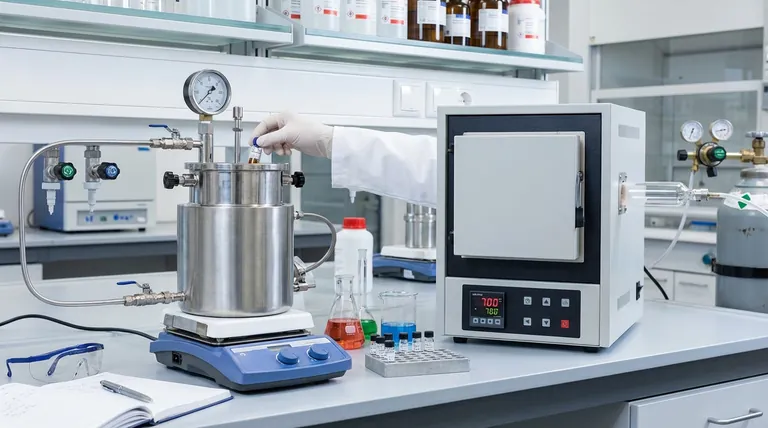
A high-temperature stainless steel autoclave acts as the pressurized reaction vessel essential for synthesizing Copper Ferrite (CuFe2O4) through hydrothermal methods. It creates a sealed environment that allows reactants to reach 230 °C, generating the internal pressure required to drive the phase transformation of metal salts into spinel-type nanoparticles.
The autoclave creates a unique "hydrothermal" environment where high heat and high pressure force liquid-phase precursors to crystallize into specific magnetic structures, a process that cannot occur in open containers at atmospheric pressure.
Creating the Hydrothermal Environment
Generating Autogenous Pressure
The defining feature of this synthesis is the "closed system."
When the autoclave is heated to 230 °C, the liquid inside creates its own pressure, known as autogenous pressure.
This pressure elevates the boiling point of the solution, forcing the metal salt precursors to react and dissolve in ways they would not under standard conditions.
Facilitating Phase Transformation
The combination of heat and pressure drives the chemical evolution of the material.
Inside the vessel, the precursors undergo a phase transformation.
This process rearranges the atomic structure, resulting in the growth of spinel-type nanoparticles with specific magnetic properties.
Ensuring Chemical Purity
The Role of the PTFE Liner
While the exterior is stainless steel for strength, the interior utilizes a polytetrafluoroethylene (PTFE) liner.
This liner is critical because it creates an inert barrier between the reactive chemicals and the steel casing.
It ensures that the synthesized Copper Ferrite remains chemically pure and is not contaminated by the vessel itself.
Distinguishing Synthesis from Calcination
Understanding the Process Flow
It is vital to distinguish between the role of the autoclave and subsequent heating steps.
The autoclave handles the initial hydrothermal synthesis at lower temperatures (around 230 °C) to form the nanoparticles.
The Role of the Muffle Furnace
In contrast, a high-temperature muffle furnace is often used after the autoclave step.
Operating at much higher temperatures (e.g., 700 °C), the furnace creates a stable environment for calcination.
This secondary step removes organic impurities (like thioglycolic acid residues) and improves the final crystallinity and stability of the material, but it is distinct from the autoclave's function.
Operational Trade-offs
Material Limitations
While the stainless steel shell is robust, the PTFE liner introduces temperature constraints.
You must ensure the synthesis temperature does not exceed the melting or deformation point of the PTFE liner.
Safety Considerations
The generation of autogenous pressure turns the vessel into a potential hazard if not managed correctly.
The fill volume of the liner impacts the pressure generated; overfilling can lead to dangerous pressure levels during the 230 °C heating cycle.
Making the Right Choice for Your Goal
To ensure successful Copper Ferrite synthesis, apply the equipment to the correct stage of the process:
- If your primary focus is Phase Nucleation: Use the autoclave to drive the initial reaction of metal salts into magnetic nanoparticles under high pressure.
- If your primary focus is Structural Stability: Follow the autoclave step with calcination in a muffle furnace to remove organic residues and enhance catalytic activity.
The autoclave initiates the chemistry, while the furnace finalizes the structure.
Summary Table:
| Feature | Role in CuFe2O4 Synthesis | Key Specification |
|---|---|---|
| Pressure Vessel | Generates autogenous pressure for phase transformation | Stainless Steel Shell |
| PTFE Liner | Prevents chemical contamination and ensures purity | Inert, up to 230°C |
| Hydrothermal Environment | Facilitates nanoparticle nucleation from liquid precursors | Closed system heating |
| Post-Processing | Calcination for structural stability | Muffle Furnace (700°C) |
Elevate Your Material Synthesis with KINTEK Precision
Are you looking to achieve superior crystallinity and purity in your nanoparticle research? Backed by expert R&D and manufacturing, KINTEK offers high-performance Muffle, Tube, Rotary, Vacuum, and CVD systems, along with customizable high-temperature lab furnaces and hydrothermal autoclaves designed for your unique needs.
Whether you are synthesizing magnetic structures or performing high-temperature calcination, our equipment provides the stability and control your lab requires. Contact us today to find the perfect high-temp solution for your application!
References
- Soumya Mishra, Prangya Ranjan Rout. Construction of a novel ternary synergistic CuFe <sub>2</sub> O <sub>4</sub> –SnO <sub>2</sub> -rGO heterojunction for efficient removal of cyanide from contaminated water. DOI: 10.1039/d4ra02217c
This article is also based on technical information from Kintek Furnace Knowledge Base .
Related Products
- 1800℃ High Temperature Muffle Oven Furnace for Laboratory
- 1700℃ High Temperature Muffle Oven Furnace for Laboratory
- 1700℃ High Temperature Laboratory Tube Furnace with Alumina Tube
- 1400℃ High Temperature Laboratory Tube Furnace with Alumina Tube
- 1200℃ Muffle Oven Furnace for Laboratory
People Also Ask
- What is the primary function of a high-temperature laboratory muffle furnace in chemical synthesis? Achieve Precision.
- How does a high-temperature laboratory muffle furnace affect material properties? Transform Anodic Oxide Films Fast
- Why is a laboratory high-temperature muffle furnace used for BaTiO3? Achieve Optimal Tetragonal Crystalline Phases
- Why is a laboratory high-temperature muffle furnace required for LaNixFe1-xO3 catalysts? Optimize Two-Stage Synthesis
- What is the critical role of a laboratory high-temperature muffle furnace in TiO2/LDH? Unlock Superior Crystallization


















