
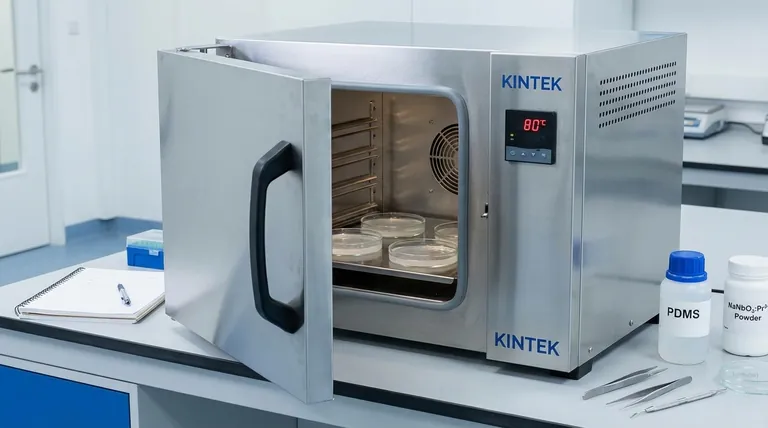
The laboratory oven functions as a precision thermal reactor during the encapsulation process. It maintains a specific, constant temperature (typically 80 °C) to supply the necessary thermal energy that accelerates the chemical curing of the mixture containing Polydimethylsiloxane (PDMS) and NaNbO3:Pr3+ powder. This controlled environment is essential for transforming the liquid composite into a solid, functional elastomer.
The oven's primary role is to drive the cross-linking process through stable heat. This ensures a tight mechanical bond between the polymer matrix and the luminescent particles, which is critical for the device’s ability to detect dynamic writing stress.
The Mechanics of Thermal Acceleration
Providing Stable Energy
The laboratory oven is not merely a heating element; it is a stabilization tool. It provides a constant thermal environment, preventing fluctuations that could lead to uneven material properties.
For this specific application, the oven targets a steady temperature, such as 80 °C. This specific thermal input is required to initiate and sustain the reaction effectively.
Driving the Chemical Phase Change
The heat supplied by the oven acts as the catalyst for the composite mixture. It accelerates the transition of the PDMS and NaNbO3:Pr3+ combination from a liquid state to a solid state.
Without this external thermal energy, the curing process would be inefficient or incomplete. The oven ensures the reaction proceeds at a predictable rate.
Impact on Material Structure
Facilitating Molecular Cross-Linking
At the microscopic level, the oven's heat drives the cross-linking of the PDMS polymer chains. This chemical bridging is what turns the silicone into a durable rubber-like material.
A complete cross-linking network is vital for the structural integrity of the device. It determines the final mechanical properties of the anti-counterfeiting tag.
Ensuring Matrix Integrity
The curing process establishes a "tight bond" between the elastomer matrix and the embedded mechanoluminescent particles.
This bond locks the NaNbO3:Pr3+ powder securely in place. It ensures the particles are uniformly distributed and fixed within the rubber, rather than floating loosely.
From Curing to Functionality
Enabling Stress Transmission
The ultimate goal of the oven curing stage is to enable the transmission of mechanical stress.
Because the matrix is tightly bonded to the particles, any external pressure (such as handwriting) is transferred directly to the mechanoluminescent powder.
Achieving High Sensitivity
Proper oven curing is directly linked to the device's sensitivity.
A well-cured composite effectively captures dynamic writing forces. This allows the device to respond accurately to the mechanical stress of a pen, fulfilling its role in anti-counterfeiting security.
Critical Process Considerations
Temperature Precision vs. Material Degradation
While heat accelerates curing, precision is paramount. Deviating significantly from the target temperature (e.g., 80 °C) can compromise the device.
Excessive heat may degrade the polymer or alter the properties of the luminescent powder. Conversely, insufficient heat results in a gummy, under-cured matrix that cannot transmit stress effectively.
Uniformity is Essential
The oven must provide uniform heat distribution.
If the curing is uneven, the device will have "soft spots" where the bond between the PDMS and the powder is weak. This results in inconsistent sensitivity across the surface of the device.
Optimizing the Curing Process
To ensure the anti-counterfeiting device functions as intended, the thermal treatment must be aligned with your specific performance goals.
- If your primary focus is High Sensitivity: Ensure the oven maintains a rigorous 80 °C to maximize the tightness of the bond between the PDMS and the mechanoluminescent particles.
- If your primary focus is Structural Durability: prioritize a stable, uninterrupted heating cycle to guarantee that the cross-linking of the elastomer matrix is absolute and uniform.
The laboratory oven effectively bridges the gap between a raw chemical mixture and a high-performance security tool.
Summary Table:
| Curing Stage Feature | Role of Laboratory Oven |
|---|---|
| Energy Source | Supplies constant 80°C thermal energy to initiate chemical reactions. |
| Phase Change | Accelerates the transition from liquid composite to a solid elastomer. |
| Structural Integrity | Facilitates molecular cross-linking for a durable rubber-like matrix. |
| Functional Bond | Ensures a tight mechanical bond between PDMS and luminescent particles. |
| Performance Output | Enables precise stress transmission for high-sensitivity writing detection. |
Elevate Your Materials Research with KINTEK Precision
Ensure absolute thermal uniformity for your most sensitive PDMS and encapsulation projects. Backed by expert R&D and manufacturing, KINTEK offers high-performance Muffle, Tube, Rotary, Vacuum, and CVD systems—all customizable to your unique lab requirements.
Don't let temperature fluctuations compromise your device sensitivity. Contact us today to find the perfect furnace for your application!
Visual Guide

References
- Zhangnan WANG. Personalized Electronic Signature Technology Based on Stress Luminescent Materials. DOI: 10.5755/j02.ms.39962
This article is also based on technical information from Kintek Furnace Knowledge Base .
Related Products
- Laboratory Muffle Oven Furnace with Bottom Lifting
- 1200℃ Muffle Oven Furnace for Laboratory
- 1400℃ Muffle Oven Furnace for Laboratory
- 1800℃ High Temperature Muffle Oven Furnace for Laboratory
- 1700℃ High Temperature Muffle Oven Furnace for Laboratory
People Also Ask
- Why is a high-temperature muffle furnace required for FeOx-MOx/TiO2? Engineering High-Performance Nanocomposites
- What is the importance of the calcination process? Master High-Purity Calcium Phosphate Nanopowder Production
- Why is a high-temperature laboratory muffle furnace essential for the alkali fusion process in zeolite synthesis?
- What function does a muffle furnace perform in Ba0.75Ca0.25TiO3 calcination? Ensure Phase Purity & Synthesis
- What are the primary functions of a high-temperature laboratory muffle furnace in the preparation of biosorbent materials?



















