
The availability of specialized furnace systems transforms thermal processing from a generic variable into a precise experimental control. Systems like Rotary, Vacuum, and Chemical Vapor Deposition (CVD) allow researchers to match the furnace's architecture directly to their specific chemical goals, ensuring that the thermal environment enhances rather than limits the scientific outcome.
By aligning the furnace type with the specific physical and chemical requirements of the experiment—such as atmosphere control or mechanical agitation—researchers can eliminate variables that lead to defects and ensure data reproducibility.
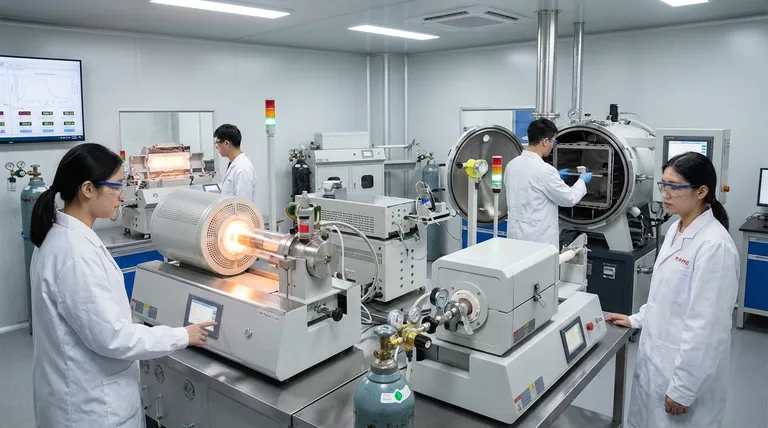
Matching Thermal Architecture to Research Goals
The Role of Rotary Systems in Powder Processing
Rotary furnaces are specifically designed to address the challenges of heating granular materials. Unlike static ovens, these systems facilitate uniform powder processing by keeping the material in motion.
This continuous movement ensures that every particle is exposed to the same thermal conditions. It prevents the formation of thermal gradients within the sample, which is critical for achieving chemical homogeneity in bulk powders.
Precision and Purity in Vacuum Systems
Vacuum systems provide a tailored solution for research requiring atmosphere-controlled synthesis where air interaction causes degradation. By operating in a vacuum, these furnaces create a highly stable heating environment free from reactive gases.
This lack of atmospheric interference significantly improves product quality. It helps reduce common heat treatment defects, such as deformation and cracking, ensuring that the final material maintains its intended structural integrity and consistency.
Controlled Synthesis via CVD Systems
CVD systems represent the pinnacle of atmosphere-controlled synthesis for surface chemistry. These platforms are engineered to manage gas flow and temperature simultaneously to facilitate chemical reactions on a substrate.
For researchers working on coatings or nanomaterials, CVD systems provide the necessary precision to dictate exactly how materials deposit and grow. This allows for the creation of complex structures that are impossible to achieve with standard heating methods.
Understanding the Trade-offs
Specificity vs. Flexibility
The primary advantage of these systems—specialization—is also their main constraint. A furnace optimized for uniform powder processing (Rotary) is rarely suitable for precise thin-film deposition (CVD).
Complexity of Operation
Specialized environments often require more rigorous setup and maintenance. Achieving a high-quality vacuum or a precise CVD gas mixture introduces variables that must be managed carefully to avoid compromising the product quality.
Making the Right Choice for Your Goal
To maximize the impact of your research, you must select the furnace architecture that directly addresses your primary experimental barrier.
- If your primary focus is powder homogeneity: Prioritize Rotary systems to ensure consistent particle mixing and uniform thermal exposure throughout the batch.
- If your primary focus is defect reduction and purity: Select Vacuum systems to eliminate oxidation and prevent physical issues like cracking or deformation.
- If your primary focus is surface engineering: Utilize CVD systems to gain precise control over gas-phase reactions and deposition rates.
The right thermal platform turns the heating process from a passive step into an active tool for chemical precision.
Summary Table:
| Furnace Type | Core Research Application | Primary Benefit |
|---|---|---|
| Rotary Furnace | Powder & Granular Processing | Ensures chemical homogeneity via continuous motion and uniform heating. |
| Vacuum Furnace | High-Purity Material Synthesis | Eliminates oxidation; prevents structural defects like cracking and deformation. |
| CVD System | Surface Engineering & Nanomaterials | Enables precise control over gas-phase reactions and thin-film deposition. |
Elevate Your Research with Precision Thermal Solutions
Are you looking to eliminate experimental variables and achieve superior product quality? KINTEK empowers researchers with high-performance, specialized furnace systems designed for the most demanding chemical research environments.
Backed by expert R&D and world-class manufacturing, we offer a comprehensive range of Muffle, Tube, Rotary, Vacuum, and CVD systems. Whether you need to ensure powder homogeneity or master complex surface engineering, our lab high-temp furnaces are fully customizable to meet your unique experimental needs.
Take the next step in chemical precision. Contact us today to consult with our experts and find the perfect thermal architecture for your laboratory.
Visual Guide

References
- Cu‐Content Engineering in FeCoNiCuAl High‐Entropy Alloy Precursors: A Pathway to Advanced HEA‐Derived Sulfide Electrocatalysts for Efficient Oxygen Evolution Reaction. DOI: 10.1002/cctc.202500147
This article is also based on technical information from Kintek Furnace Knowledge Base .
Related Products
- Vacuum Sealed Continuous Working Rotary Tube Furnace Rotating Tube Furnace
- Electric Rotary Kiln Small Rotary Furnace Biomass Pyrolysis Plant Rotating Furnace
- Electric Rotary Kiln Continuous Working Small Rotary Furnace Kiln for Pyrolysis Plant Heating
- Electric Rotary Kiln Small Rotary Furnace for Activated Carbon Regeneration
- Laboratory Vacuum Tilt Rotary Tube Furnace Rotating Tube Furnace
People Also Ask
- What is the purpose of rotary tube furnaces? Achieve Uniform Heat Treatment for Powders and Granules
- What are the key advantages of using a rotary tube furnace? Achieve Dynamic, Uniform Heating for Powders
- How does the amount of material processed vary between batch and continuous rotary tube furnaces? Scale Your Production Efficiently
- What are the advantages of rotary tube furnaces in fuel compatibility? Boost Efficiency and Cut Costs
- What is the temperature range of some rotary tube furnaces? Achieve Uniform Heating Up to 1200°C



















