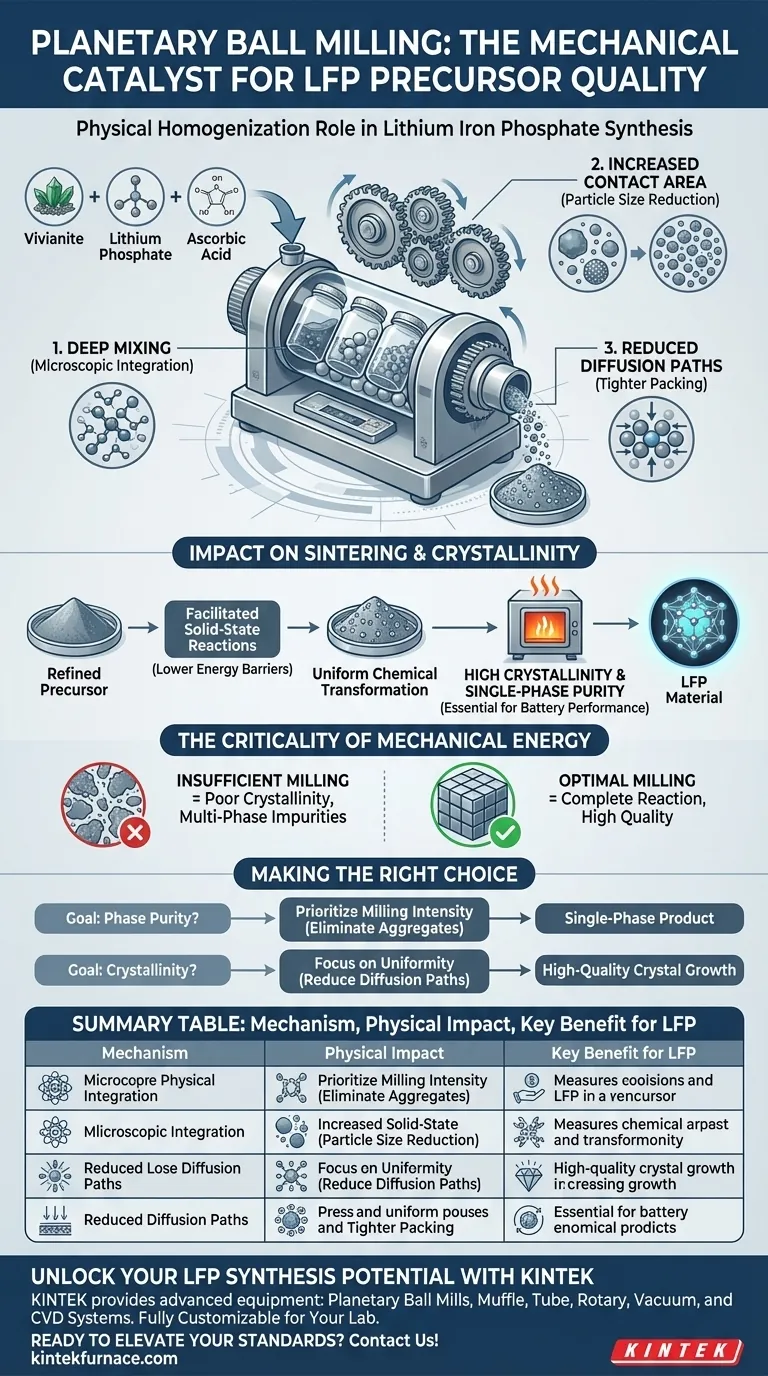
Planetary ball milling serves as the foundational mechanical catalyst for synthesizing high-quality lithium iron phosphate (LFP). It utilizes intense mechanical force to achieve deep mixing and refinement of specific raw materials, including Vivianite, lithium phosphate, and ascorbic acid.
By maximizing particle contact area and minimizing diffusion paths, planetary ball milling bridges the gap between raw ingredients and the formation of single-phase, high-crystallinity lithium iron phosphate.
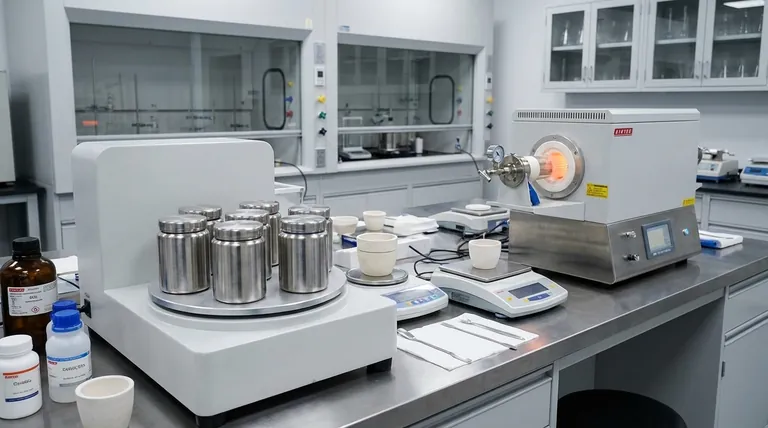
The Mechanics of Precursor Refinement
Deep Mixing of Reactants
The process does more than blend ingredients; it provides the mechanical force required to intimately mix complex precursors.
Specifically, it integrates Vivianite, lithium phosphate, and ascorbic acid at a microscopic level.
This prevents the separation of ingredients that often occurs with less aggressive mixing methods.
Increasing Contact Area
The primary physical outcome of ball milling is the reduction of particle size.
By refining the raw materials, the process drastically increases the contact area between reactant particles.
This surface area maximization is the physical prerequisite for efficient chemical bonding.
Reducing Diffusion Paths
Solid-state synthesis is limited by how far atoms must travel to react with one another.
Ball milling effectively shortens these diffusion paths by pressing reactants tightly together.
This tight packing allows reactions to proceed faster and more completely during subsequent heating.
Impact on Sintering and Crystallinity
Facilitating Solid-State Reactions
The work done during milling directly impacts the efficiency of the high-temperature sintering stage.
By pre-conditioning the mixture physically, the material requires less time or lower energy barriers to react in the laboratory furnace.
This ensures the chemical transformation is uniform throughout the entire batch.
Ensuring Phase Purity
The ultimate measure of LFP quality is the formation of a single-phase structure.
Homogenization eliminates "dead zones" where unreacted materials could linger as impurities.
This uniformity leads to high crystallinity, which is essential for the electrochemical performance of the final battery material.
The Criticality of Mechanical Energy
The Cost of Insufficient Milling
It is crucial to understand that the furnace cannot correct errors made during the milling stage.
If the mechanical force is insufficient, the diffusion paths remain too long for the solid-state reaction to complete.
This results in a material with poor crystallinity or multi-phase impurities, regardless of how precise the sintering temperature is.
Making the Right Choice for Your Goal
To optimize your lithium iron phosphate synthesis, consider how milling aligns with your specific objectives:
- If your primary focus is Phase Purity: Prioritize milling intensity to eliminate all aggregates, ensuring that the Vivianite and lithium phosphate react completely to form a single-phase product.
- If your primary focus is Crystallinity: Focus on the uniformity of the mix to reduce diffusion paths, facilitating the growth of high-quality crystals during sintering.
Mastering the physical homogenization step is the only way to unlock the full chemical potential of your LFP precursors.
Summary Table:
| Mechanism | Physical Impact | Key Benefit for LFP |
|---|---|---|
| Deep Mixing | Microscopic integration of Vivianite & Li-phosphate | Prevents ingredient separation |
| Particle Refinement | Drastic increase in surface contact area | Lowers chemical bonding energy barriers |
| Diffusion Control | Reduced atomic travel distance | Enables faster, complete solid-state reactions |
| Mechanical Catalyst | Pre-conditioning of raw ingredients | Ensures high crystallinity and single-phase purity |
Unlock the Full Potential of Your LFP Synthesis
High-performance battery materials require more than just the right recipe—they demand precision at every stage. KINTEK provides the advanced equipment necessary to bridge the gap between raw ingredients and high-crystallinity lithium iron phosphate.
Backed by expert R&D and manufacturing, KINTEK offers a comprehensive range of Planetary Ball Mills, Muffle, Tube, Rotary, Vacuum, and CVD systems, all fully customizable to meet your unique lab requirements. Whether you are optimizing phase purity or refining sintering protocols, our high-temperature furnaces and homogenization tools ensure your precursors achieve the chemical excellence they were designed for.
Ready to elevate your research and manufacturing standards? Contact us today to find your custom equipment solution!
Visual Guide
References
- Tengshu Chen, Liyao Chen. Research on the synthesis of lithium iron phosphate using vivianite prepared from municipal sludge. DOI: 10.1038/s41598-025-16378-7
This article is also based on technical information from Kintek Furnace Knowledge Base .
Related Products
- Electric Rotary Kiln Continuous Working Small Rotary Furnace Kiln for Pyrolysis Plant Heating
- Electric Rotary Kiln Pyrolysis Furnace Plant Machine Small Rotary Kiln Calciner
- Electric Rotary Kiln Small Rotary Furnace Biomass Pyrolysis Plant Rotating Furnace
- High Temperature Muffle Oven Furnace for Laboratory Debinding and Pre Sintering
- Multi Heating Zones CVD Tube Furnace Machine for Chemical Vapor Deposition Equipment
People Also Ask
- What are the advantages of electric rotary kilns compared to fuel-fired ones? Boost Precision and Efficiency in Your Process
- What materials can be processed in an electric rotary kiln? Versatile Solutions for Advanced Materials
- What advantages do electric rotary kilns offer over fuel-based kilns? Boost Efficiency and Purity in Your Process
- What are the primary applications of electric rotary kilns? Precision Thermal Processing for High-Value Materials
- How do electric rotary kilns achieve high thermal efficiency? Unlock Over 95% Thermal Efficiency