
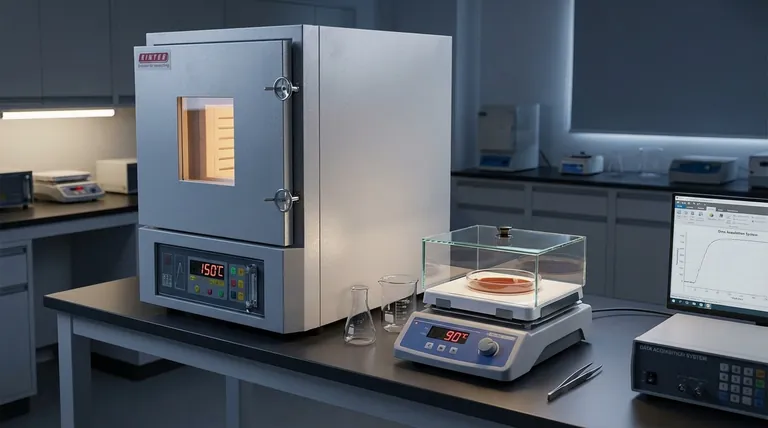
High-precision laboratory ovens and hot plates provide a strictly controlled stable thermodynamic environment essential for the processing of perovskite thin films. Through precise thermal regulation, these devices facilitate segmented heating protocols—such as pre-annealing at 90°C followed by a 150°C phase—to systematically govern solvent evaporation and crystal structure formation.
The physical environment provided is not merely high temperature, but a precise thermodynamic state that directs crystal growth and specifically determines whether lattice strains are released or retained within the film.
The Core Mechanism: Thermodynamic Stability
Controlled Thermal Consistency
The primary function of these devices is to maintain a non-fluctuating thermal baseline.
This stability is required to induce crystallization while preventing thermal shock, which could damage the thin film structure.
The Role of Atmospheric Regulation
Beyond temperature, the physical environment often includes specific humidity parameters.
For example, effective annealing protocols may require a 40% humidity environment during the high-temperature phase to assist in proper film formation.
Managing Crystallization via Segmented Heating
Enabling Multi-Stage Protocols
High-precision equipment allows for segmented heating, a critical process for perovskite.
A typical protocol involves a pre-annealing stage (e.g., 90°C for one minute) to initiate the process, followed by a longer, hotter annealing stage (e.g., 150°C for ten minutes).
Regulating Solvent Evaporation
This staged approach allows for the controlled removal of residual solvents.
By managing the rate of evaporation, the environment prevents rapid volume changes that could lead to internal defects or poor coverage.
Promoting Crystal Growth
The sustained thermal energy provided by the oven or hot plate drives the further growth of perovskite crystals.
This phase is essential for optimizing grain size and improving the overall crystallinity of the thick-film structure.
Understanding the Trade-offs: Lattice Strain
The Criticality of Precision
The most significant variable controlled by this environment is lattice strain.
The specific temperature and duration settings act as a toggle, determining the final mechanical state of the material.
Strain Release vs. Retention
Depending on the exact thermal profile applied, the environment can be tuned to either release or retain specific lattice strains.
Improper control here is a common pitfall; failing to adhere to precise parameters can result in a film with undesirable strain characteristics, negatively affecting device performance.
Making the Right Choice for Your Goal
To maximize the efficacy of your annealing treatment, align your heating protocol with your specific material objectives:
- If your primary focus is Structural Integrity: Utilize segmented heating to gradually remove solvents, preventing defects caused by rapid evaporation.
- If your primary focus is Strain Engineering: Strictly adhere to the precise temperature and time thresholds (e.g., 150°C) required to either lock in or alleviate lattice strain.
Precision in your thermal environment is the defining factor between a functional film and an optimized, high-efficiency device.
Summary Table:
| Feature | Physical Environment Provided | Impact on Perovskite Thin Film |
|---|---|---|
| Thermal Baseline | Constant, non-fluctuating heat | Prevents thermal shock; ensures uniform crystal growth |
| Segmented Heating | Multi-stage protocols (e.g., 90°C to 150°C) | Regulates solvent evaporation and prevents internal defects |
| Atmospheric Control | Regulated humidity (e.g., 40% RH) | Facilitates proper film formation and chemical stability |
| Lattice Management | Precise time/temperature thresholds | Controls strain release or retention for device optimization |
Elevate Your Material Research with KINTEK Precision
Achieving the perfect perovskite crystal structure requires more than just heat—it requires absolute thermodynamic control. Backed by expert R&D and manufacturing, KINTEK offers high-performance Muffle, Tube, Rotary, Vacuum, and CVD systems, along with customizable lab high-temp furnaces designed to meet your most rigorous annealing protocols.
Whether you are engineering lattice strain or optimizing solvent evaporation, our systems provide the stability your thin films demand. Contact us today to find the perfect thermal solution for your lab!
References
- Pengju Shi, Rui Wang. Strain regulates the photovoltaic performance of thick-film perovskites. DOI: 10.1038/s41467-024-47019-8
This article is also based on technical information from Kintek Furnace Knowledge Base .
Related Products
- High Temperature Muffle Oven Furnace for Laboratory Debinding and Pre Sintering
- Laboratory Muffle Oven Furnace with Bottom Lifting
- 1400℃ Muffle Oven Furnace for Laboratory
- 1800℃ High Temperature Muffle Oven Furnace for Laboratory
- 1200℃ Muffle Oven Furnace for Laboratory
People Also Ask
- What thermal phenomena occur during polymer binder burnout in ceramic green bodies? Lab Furnace Guide
- Why is controlled heat treatment in a muffle furnace necessary for calcined clay? Achieve Optimal Pozzolanic Activity
- What role does a high-temperature muffle furnace play in STFO synthesis? Achieve Pure Perovskite Results
- How does a high-temperature muffle furnace facilitate the formation of LaNbxAl1−xO3+δ perovskite structures? Key Roles
- What role does a high-temperature muffle furnace play in the multi-stage synthesis of Li0.5MnFe1.5O4? Key to Pure Spinel












