Glass frit serves as a critical healing agent during the heat treatment of Silicon Oxycarbide (SiOC) coatings. It functions as a functional consumable that transforms into a liquid-phase plasticizer, melting to actively repair structural defects caused by the curing process.
During the conversion of SiOC, volume shrinkage inevitably creates micro-cracks that compromise the coating's integrity. Glass frit acts as a self-repairing mechanism, melting into a liquid to fill these voids and transforming a brittle film into a dense, coherent composite barrier.
The Mechanism of Liquid-Phase Healing
Transformation into a Plasticizer
In the raw state, glass frit exists as solid particles within the coating matrix. However, during the middle and high-temperature stages of heat treatment, it undergoes a physical transformation.
The frit softens and melts, effectively becoming a liquid-phase plasticizer. This change in state is essential for it to function as a mobile repair agent rather than a static filler.
Counteracting Volume Shrinkage
The conversion of precursors into ceramic SiOC involves significant chemical changes that lead to volume shrinkage.
Without intervention, this shrinkage exerts stress on the coating, resulting in the formation of micro-cracks. These cracks are the primary failure mode for brittle ceramic films, compromising their protective abilities.
The Crack-Filling Process
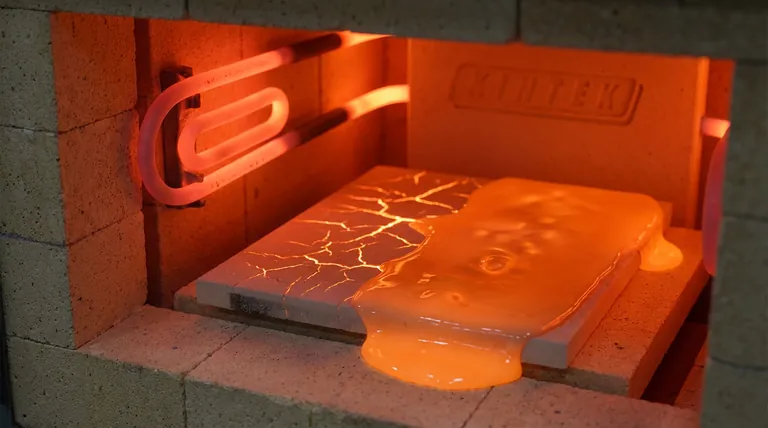
Driven by the thermal field of the high-temperature furnace, the liquefied glass frit flows into the newly formed micro-cracks.
This process is a form of liquid-phase healing. The molten glass penetrates the defects, effectively bridging the gaps created by the shrinkage stress.
Densification of the Barrier
Once the frit has filled the voids and the coating cools, the structure is fundamentally altered.
The healing process transforms what would have been a porous, brittle ceramic film into a coherent and dense composite barrier layer. The glass frit integrates with the SiOC to create a continuous, robust surface.
Understanding the Constraints
Dependency on Thermal Fields
The efficacy of glass frit is entirely dependent on the thermal field of the furnace.
If the temperature does not reach the specific softening point of the frit during the critical shrinkage stage, the "healing" mechanism will not activate. Precise thermal management is required to synchronize the melting of the frit with the cracking of the SiOC matrix.
The Composite Nature
It is important to recognize that the final product is a composite, not pure SiOC.
The glass frit is described as a "functional consumable," meaning it becomes a permanent part of the barrier layer. The final properties of the coating will be a hybrid of the ceramic SiOC and the glass material used for healing.
Making the Right Choice for Your Goal
To maximize the performance of your SiOC coatings, consider how the glass frit interacts with your specific processing parameters.
- If your primary focus is Defect Reduction: Ensure your heat treatment schedule maintains the "high-temperature stage" long enough for the frit to fully liquefy and penetrate all micro-cracks.
- If your primary focus is Barrier Density: Select a glass frit formulation that matches the viscosity requirements needed to fill the specific volume shrinkage anticipated in your SiOC precursor.
By leveraging the liquid-phase healing capability of glass frit, you can successfully convert a brittle ceramic precursor into a robust, industrial-grade protective layer.
Summary Table:
| Function Category | Mechanism of Action | Impact on SiOC Coating |
|---|---|---|
| Physical State | Transforms into a liquid-phase plasticizer | Enables mobility to repair structural defects |
| Defect Repair | Liquid-phase healing of micro-cracks | Fills voids caused by volume shrinkage |
| Structural Change | Bridges gaps in the ceramic matrix | Converts brittle films into dense composites |
| System Role | Functional consumable/filler | Becomes a permanent part of the protective layer |
Maximize Your Coating Integrity with KINTEK Precision
Achieving the perfect liquid-phase healing for SiOC coatings requires precise thermal field management. KINTEK provides the advanced high-temperature solutions you need to synchronize glass frit melting with precursor shrinkage perfectly.
Backed by expert R&D and manufacturing, KINTEK offers Muffle, Tube, Rotary, Vacuum, and CVD systems, all fully customizable to meet your unique materials science challenges. Whether you are aiming for defect reduction or superior barrier density, our lab furnaces deliver the uniform heating essential for high-performance ceramic composites.
Ready to elevate your lab's thermal processing? Contact us today to discuss your custom furnace requirements!
References
- Ravi Arukula, Xiaoning Qi. Corrosion resistant coating fabrication through synergies between SiOC conversion and iron oxidation at high temperatures. DOI: 10.1038/s41529-025-00584-9
This article is also based on technical information from Kintek Furnace Knowledge Base .
Related Products
- Ultra-High Vacuum Flange Aviation Plug Glass Sintered Airtight Circular Connector for KF ISO CF
- Ultra High Vacuum Observation Window KF Flange 304 Stainless Steel High Borosilicate Glass Sight Glass
People Also Ask
- Why is an Ultra-High Vacuum (UHV) System Required for In2Se3? Achieving Atomic-Level Ferroelectric Clarity
- What is the function of PTFE sealing rings in plastic pyrolysis? Ensure Safe, Anaerobic Material Decomposition
- Why is a PTFE-lined stainless steel autoclave used for Ni12P5 synthesis? Key Benefits for Nanomaterial Production
- What is the function of a Teflon-lined stainless steel autoclave in the hydrothermal synthesis of Bi2O3 precursors?
- Why is a stainless steel autoclave with a Teflon liner necessary for BiVO4? Ensure Purity & High Performance