
Carbon coating processes and specialized heat treatment are not optional add-ons; they are fundamental necessities for stabilizing silicon-based anode materials. By utilizing equipment like tube furnaces to thermally decompose precursors such as coal tar pitch, manufacturers create a uniform conductive skin around silicon particles. This layer is the primary mechanism for mitigating silicon’s inherent weaknesses—specifically its poor conductivity and massive volume expansion—thereby enabling high-performance battery operation.
Silicon has immense potential but suffers from structural instability during charging. Carbon coating acts as a stabilizing interface that enhances electron flow and physically contains the silicon, transforming a volatile material into a durable battery component.
The Critical Functions of Carbon Coating
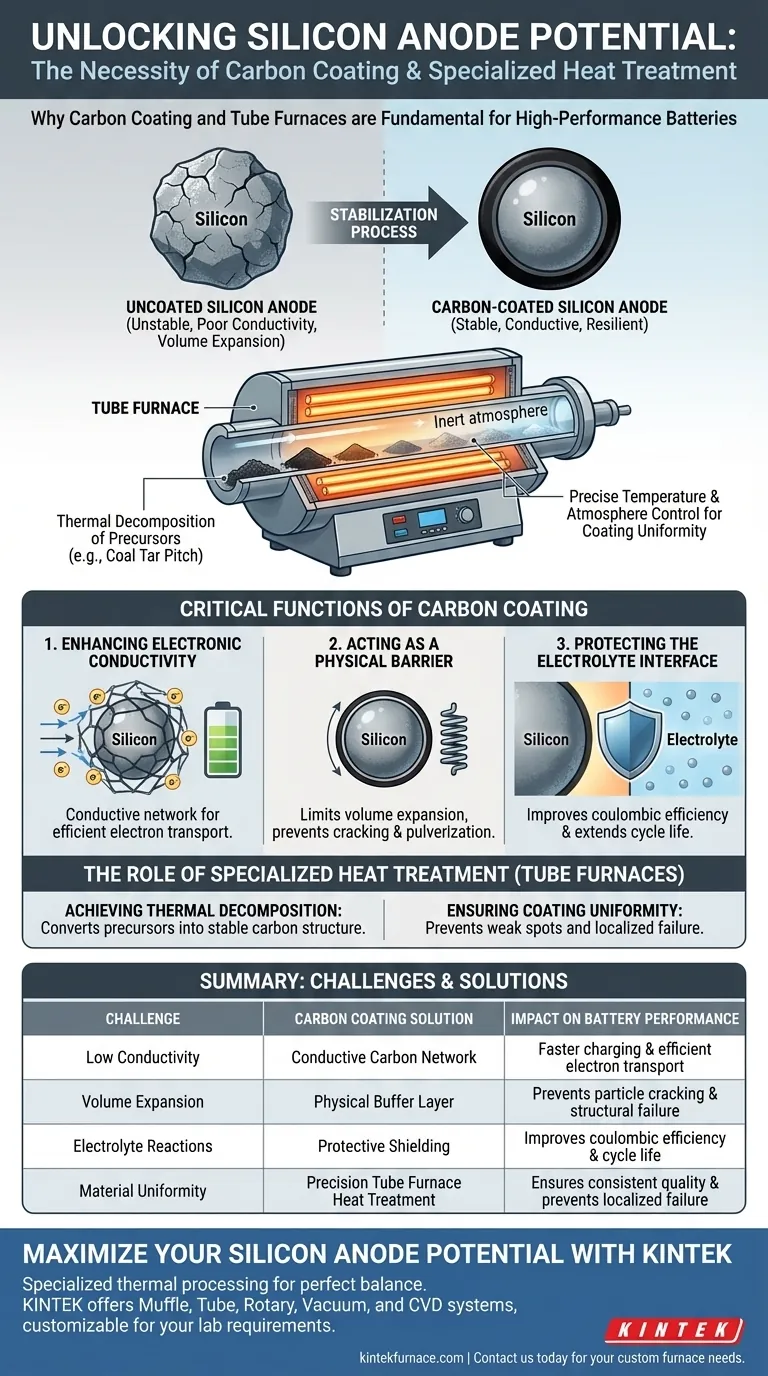
To understand why this process is necessary, you must look at the specific failures that occur in uncoated silicon anodes. The carbon layer addresses three distinct physical and chemical challenges.
Enhancing Electronic Conductivity
Silicon is a semiconductor, meaning its natural ability to transport electrons is relatively low compared to traditional graphite anodes.
Carbon coating creates a highly conductive network across the surface of the composite particles. This ensures efficient electron transport during rapid charging and discharging cycles.
Acting as a Physical Barrier
One of the most significant challenges with silicon is that it swells dramatically when absorbing lithium ions.
The carbon layer serves as a rigid but resilient buffer. It limits the volume expansion of the active silicon substances, preventing the particle from cracking or pulverizing under stress.
Protecting the Electrolyte Interface
When raw silicon comes into direct contact with battery electrolytes, it often causes unwanted side reactions.
The carbon coating acts as a shield, reducing direct contact between the active silicon and the electrolyte. This preservation of the interface improves coulombic efficiency (the efficiency of electron transfer) and extends the overall cycle life of the battery.
The Role of Specialized Heat Treatment
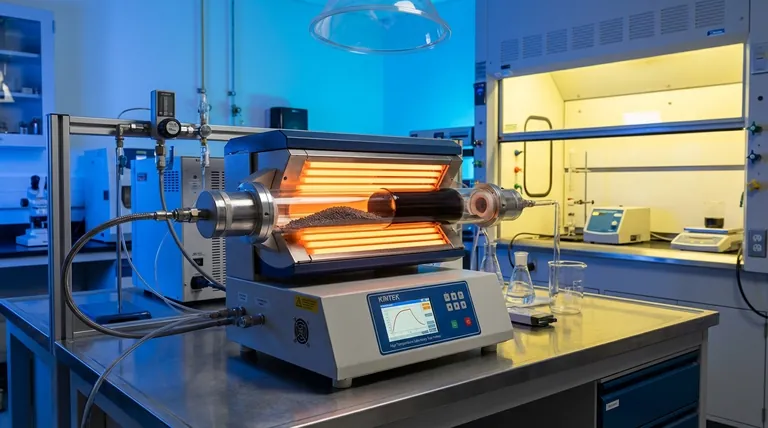
The quality of the carbon coating is entirely dependent on the precision of the thermal processing. This is where equipment like tube furnaces becomes essential.
Achieving Thermal Decomposition
You cannot simply "paint" carbon onto silicon. The process requires the thermal decomposition of carbon-rich precursors, such as coal tar pitch.
Tube furnaces provide the controlled high-temperature environment necessary to break down these precursors and convert them into a stable, solid carbon structure.
Ensuring Coating Uniformity
For the anode to function reliably, the carbon layer must be uniform across every particle.
Specialized heat treatment equipment allows for precise control over temperature gradients and atmosphere. This ensures the carbon layer forms evenly, preventing weak spots that could lead to localized failure or swelling.
Understanding the Trade-offs
While carbon coating is necessary, it introduces specific variables that must be managed to maintain material performance.
Process Complexity vs. Performance
Implementing high-temperature carbonization adds steps to the manufacturing workflow.
Using tube furnaces increases energy consumption and processing time compared to simpler production methods. However, this "cost" is unavoidable for achieving the stability required for high-performance applications.
Balancing the Layer Thickness
The carbon layer must be thick enough to provide protection but thin enough not to impede lithium ion movement.
If the decomposition process is not controlled, an excessively thick carbon layer could reduce the overall specific capacity of the anode, negating the benefits of using silicon in the first place.
Making the Right Choice for Your Goal
When designing your production process for silicon-based anodes, your heat treatment strategy should align with your specific performance targets.
- If your primary focus is Cycle Life: Prioritize coating uniformity and structural integrity to ensure the carbon barrier can withstand repeated volume expansion without cracking.
- If your primary focus is High-Rate Capability: Focus on the quality of the carbon precursor and decomposition temperature to maximize the electronic conductivity of the surface layer.
Mastering the carbon coating process is the definitive step in bridging the gap between raw silicon potential and a commercially viable energy storage solution.
Summary Table:
| Challenge | Carbon Coating Solution | Impact on Battery Performance |
|---|---|---|
| Low Conductivity | Conductive Carbon Network | Faster charging & efficient electron transport |
| Volume Expansion | Physical Buffer Layer | Prevents particle cracking & structural failure |
| Electrolyte Reactions | Protective Shielding | Improves coulombic efficiency & cycle life |
| Material Uniformity | Precision Tube Furnace Heat Treatment | Ensures consistent quality & prevents localized failure |
Maximize Your Silicon Anode Potential with KINTEK
Precise carbon coating requires specialized thermal processing to achieve the perfect balance of conductivity and structural resilience. At KINTEK, we understand the nuances of battery material innovation.
Backed by expert R&D and manufacturing, KINTEK offers Muffle, Tube, Rotary, Vacuum, and CVD systems—all customizable to meet your unique high-temperature lab requirements. Whether you are optimizing coal tar pitch decomposition or scaling up silicon-carbon composite production, our systems provide the uniform temperature control necessary for superior performance.
Ready to elevate your energy storage research? Contact us today to discuss your custom furnace needs with our technical team.
Visual Guide
References
- Hyunsik Yoon, Hansu Kim. Magnesiated Si‐Rich SiO<sub><i>x</i></sub> Materials for High‐Performance Lithium‐Ion Batteries. DOI: 10.1002/batt.202500473
This article is also based on technical information from Kintek Furnace Knowledge Base .
Related Products
- Vacuum Sealed Continuous Working Rotary Tube Furnace Rotating Tube Furnace
- 1400℃ High Temperature Laboratory Tube Furnace with Alumina Tube
- 1700℃ High Temperature Laboratory Tube Furnace with Alumina Tube
- Magnesium Extraction and Purification Condensing Tube Furnace
- High Pressure Laboratory Vacuum Tube Furnace
People Also Ask
- What is the purpose of rotary tube furnaces? Achieve Uniform Heat Treatment for Powders and Granules
- What are the key advantages of using a rotary tube furnace? Achieve Dynamic, Uniform Heating for Powders
- How does the amount of material processed vary between batch and continuous rotary tube furnaces? Scale Your Production Efficiently
- What are the advantages of rotary tube furnaces in fuel compatibility? Boost Efficiency and Cut Costs
- What is the temperature range of some rotary tube furnaces? Achieve Uniform Heating Up to 1200°C



















