
The primary role of an industrial high-speed ball mill in this context is to rapidly pulverize raw clay using a combination of high-frequency impact and shear force. This mechanical action reduces the low-grade kaolin to a fine powder with a particle size distribution comparable to cement, significantly altering its physical structure in a short period.
Core Takeaway: While the immediate output is finer powder, the deeper value is the increase in apparent specific surface area. This physical modification creates the necessary conditions for uniform heating, effectively establishing the foundational reactivity required for successful thermal activation.
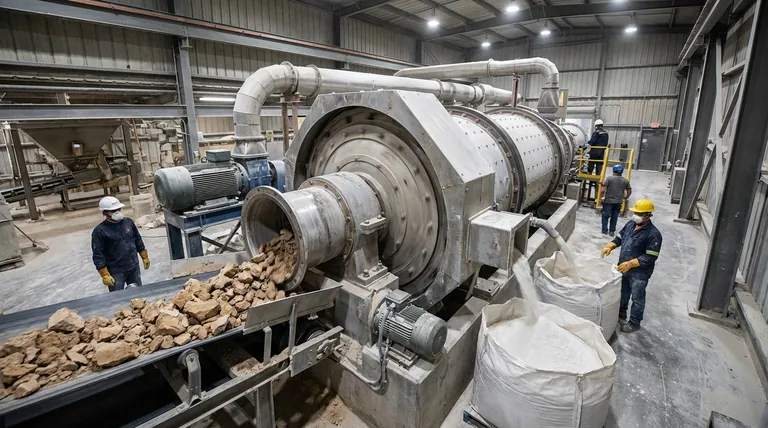
The Mechanics of Physical Modification
High-Frequency Impact and Shear
The mill operates by utilizing grinding media that subjects the raw clay to intense mechanical forces. Specifically, it employs high-frequency impacts combined with shear forces to break down the material.
Rapid Size Reduction
Unlike slower milling processes, this high-speed equipment achieves the desired reduction quickly. It transforms the raw clay into a specific particle size distribution that mirrors that of cement.
Impact on Downstream Processing
Increasing Specific Surface Area
The pulverization process serves as a critical physical modification step. Its most important technical outcome is the significant increase in the material's apparent specific surface area.
Optimizing Thermal Activation
A larger, more exposed surface area directly influences the next stage of processing. It ensures that the material undergoes uniform heating, preventing inconsistent results during thermal activation.
Establishing Reactivity
The ultimate goal of this pretreatment is not just size reduction, but chemical potential. By optimizing the physical state of the clay, the mill establishes the foundation for the reactivity of the low-grade kaolin.
Critical Process Considerations
The Necessity of Uniformity
The requirement for a "cement-like" particle distribution is not merely about aesthetics; it is a functional requisite. Failing to achieve this specific distribution compromises the uniformity of the subsequent heating phase.
Mechanical Force vs. Processing Time
The efficiency of this method relies on the intensity of the shear and impact forces. Because these forces are applied at high frequency, the process achieves the necessary physical changes within a notably short timeframe.
How to Apply This to Your Project
To maximize the value of low-grade kaolin, align your milling strategy with your specific processing goals:
- If your primary focus is processing speed: Leverage the high-frequency impact mechanism to achieve target particle sizes within a significantly reduced timeframe.
- If your primary focus is activation quality: Prioritize the expansion of specific surface area to guarantee uniform heating conditions and maximize the reactivity of the final product.
By effectively controlling the pulverization stage, you convert a raw, low-grade input into a highly reactive precursor ready for thermal processing.
Summary Table:
| Feature | Mechanical Impact | Technical Outcome |
|---|---|---|
| Mechanism | High-frequency impact & shear force | Rapid particle size reduction |
| Particle Size | Cement-like distribution | Improved material uniformity |
| Physical State | Increased specific surface area | Enhanced chemical reactivity |
| Downstream Value | Optimized thermal activation | Foundation for high-grade output |
Maximize Your Material Reactivity with KINTEK
Are you looking to transform low-grade kaolin into high-value reactive precursors? KINTEK provides the cutting-edge technology needed to master your pulverization and thermal processing workflows.
Backed by expert R&D and world-class manufacturing, we offer a comprehensive range of Muffle, Tube, Rotary, Vacuum, and CVD systems, alongside specialized lab high-temp furnaces—all fully customizable to meet your unique project requirements. Whether you are scaling up industrial throughput or perfecting laboratory-scale thermal activation, our engineering team is ready to provide the precision tools your research demands.
Ready to optimize your mineral processing? Contact KINTEK today for a customized solution!
References
- P. Vargas, Lourdes Soriano. Optimisation of Using Low-Grade Kaolinitic Clays in Limestone Calcined Clay Cement Production (LC3). DOI: 10.3390/ma18020285
This article is also based on technical information from Kintek Furnace Knowledge Base .
Related Products
People Also Ask
- What are the advantages of electric rotary kilns compared to fuel-fired ones? Boost Precision and Efficiency in Your Process
- What advantages do electric rotary kilns offer over fuel-based kilns? Boost Efficiency and Purity in Your Process
- What materials can be processed in an electric rotary kiln? Versatile Solutions for Advanced Materials
- What is the significance of the refractory lining in a rotary kiln electric furnace? Unlock Efficiency and Longevity
- What are the main applications of a rotary kiln electric furnace? Achieve Uniform Heat Treatment for Powders
