
The primary purpose of using an industrial oven for the pretreatment of reinforcement powders is to thermally condition materials like Silicon Carbide (SiC), Alumina (Al2O3), and Cerium Oxide (CeO2) prior to stir casting. By heating these powders for 1 to 2 hours, the process removes adsorbed moisture and oxidizes the particle surfaces to ensure successful integration with the aluminum matrix.
Pretreatment is not merely a drying step; it is a critical surface modification process. It eliminates moisture-induced defects and alters surface chemistry to maximize wettability, ensuring a strong metallurgical bond between the ceramic reinforcement and the molten aluminum alloy.
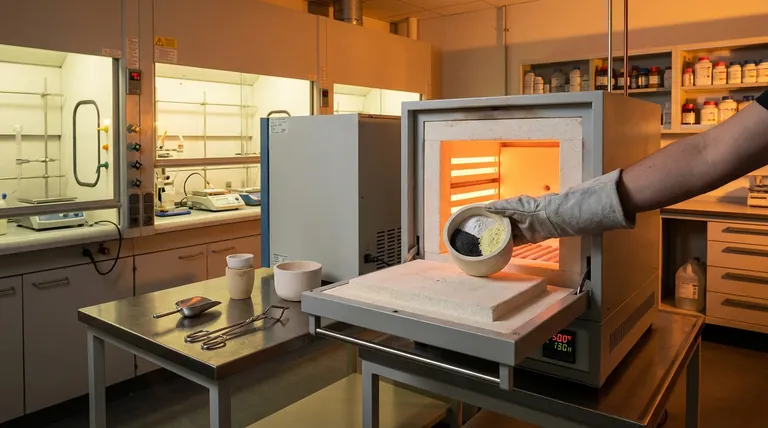
The Mechanics of Powder Pretreatment
To understand why this step is non-negotiable for high-quality composites, we must look at how the oven alters the physical and chemical state of the reinforcement powders.
Removing Adsorbed Moisture
Ceramic powders naturally accumulate moisture from the atmosphere while in storage. If these "wet" particles are introduced directly into molten aluminum, the water creates steam and chemical reactions instantly.
This rapid expansion leads to gas porosity within the final casting. Oven heating drives off this volatile moisture before the powder ever touches the melt, ensuring a dense, void-free composite.
Modifying Surface Chemistry
Beyond simple drying, the thermal treatment actively modifies the surface chemistry of the particles. The heat induces surface oxidation on the reinforcement powders.
This oxidation layer plays a pivotal role in changing how the particle interacts with the liquid metal. It acts as a chemical bridge, preparing the inert ceramic surface to accept the metallic matrix.
The Impact on Material Performance
The ultimate goal of using an industrial oven is to solve the inherent incompatibility between ceramic particles and molten metal.
Improving Wettability
Molten aluminum has high surface tension and naturally resists spreading over ceramic surfaces (a phenomenon known as poor wettability). Without pretreatment, the metal may repel the particles, causing them to clump or float rather than mix.
The oxidized surface created in the oven significantly improves wettability. This allows the molten aluminum to flow smoothly over the particles, encapsulating them completely.
Enhancing Bonding Strength
Structural integrity relies on the interface between the reinforcement and the matrix. If the metal does not wet the particle effectively, the interface remains weak, leading to premature failure under load.
By optimizing the surface chemistry, the oven treatment fosters a stronger interfacial bond. This ensures that load transfer between the soft aluminum matrix and the hard ceramic reinforcement is efficient and robust.
Understanding the Trade-offs
While the benefits are clear, the parameters of the oven treatment must be controlled to avoid process inefficiencies.
The Necessity of Time
The reference specifies a heating duration of 1 to 2 hours. Rushing this process risks leaving residual moisture in the powder core or failing to achieve sufficient surface oxidation.
Conversely, while not explicitly detailed in the reference, excessive heating times in industrial contexts generally yield diminishing returns and increase energy costs without further improving wettability. Adhering to the 1-2 hour window provides the optimal balance for these specific materials.
Making the Right Choice for Your Goal
The use of an industrial oven is a foundational step in fabricating aluminum-based hybrid composites.
- If your primary focus is Defect Reduction: Ensure the full heating duration is met to drive off all moisture and prevent gas porosity in the final casting.
- If your primary focus is Mechanical Strength: Prioritize this thermal treatment to maximize surface oxidation, which directly correlates to stronger bonding and better load transfer.
Skipping this pretreatment ensures a weaker interface and a porous product; properly executing it guarantees a composite that performs to its potential.
Summary Table:
| Process Objective | Mechanism | Key Benefit |
|---|---|---|
| Moisture Removal | 1-2 hours of thermal heating | Eliminates gas porosity and voids in final casting |
| Surface Modification | Controlled surface oxidation | Creates a chemical bridge between ceramic and metal |
| Wettability Enhancement | Reducing surface tension | Prevents particle clumping and ensures uniform distribution |
| Interfacial Strength | Improved metallurgical bonding | Enhances load transfer and mechanical durability |
Maximize Your Material Performance with KINTEK
Don’t let moisture and poor wettability compromise your material integrity. Backed by expert R&D and manufacturing, KINTEK offers specialized Muffle, Tube, Rotary, Vacuum, and CVD systems designed for the precise thermal conditioning of ceramic reinforcements.
Whether you are working with SiC, Al2O3, or CeO2, our lab high-temperature furnaces are fully customizable to meet your unique fabrication needs. Contact us today to discuss how our advanced heating solutions can help you achieve defect-free, high-strength aluminum-based hybrid composites.
References
- Vipin Sharma, Shalom Akhai. CHARACTERIZATION OF Al 6061/Al2O3/SiC COMPOSITES WITH CERIUM OXIDE: CORROSION ANALYSIS AND MICROSTRUCTURAL INSIGHTS. DOI: 10.62753/ctp.2024.07.1.1
This article is also based on technical information from Kintek Furnace Knowledge Base .
Related Products
- High Temperature Muffle Oven Furnace for Laboratory Debinding and Pre Sintering
- 1200℃ Muffle Oven Furnace for Laboratory
- Dental Porcelain Zirconia Sintering Ceramic Vacuum Press Furnace
- 1400℃ Muffle Oven Furnace for Laboratory
- 1700℃ High Temperature Muffle Oven Furnace for Laboratory
People Also Ask
- What thermal phenomena occur during polymer binder burnout in ceramic green bodies? Lab Furnace Guide
- Why is controlled heat treatment in a muffle furnace necessary for calcined clay? Achieve Optimal Pozzolanic Activity
- What role does a high-temperature muffle furnace play in STFO synthesis? Achieve Pure Perovskite Results
- How does a high-temperature muffle furnace facilitate the formation of LaNbxAl1−xO3+δ perovskite structures? Key Roles
- What role does a high-temperature muffle furnace play in the formation of biochar catalysts? Master Catalyst Synthesis








