
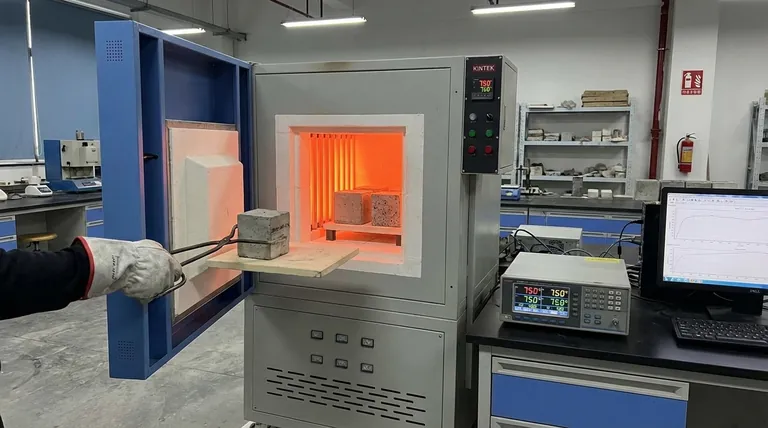
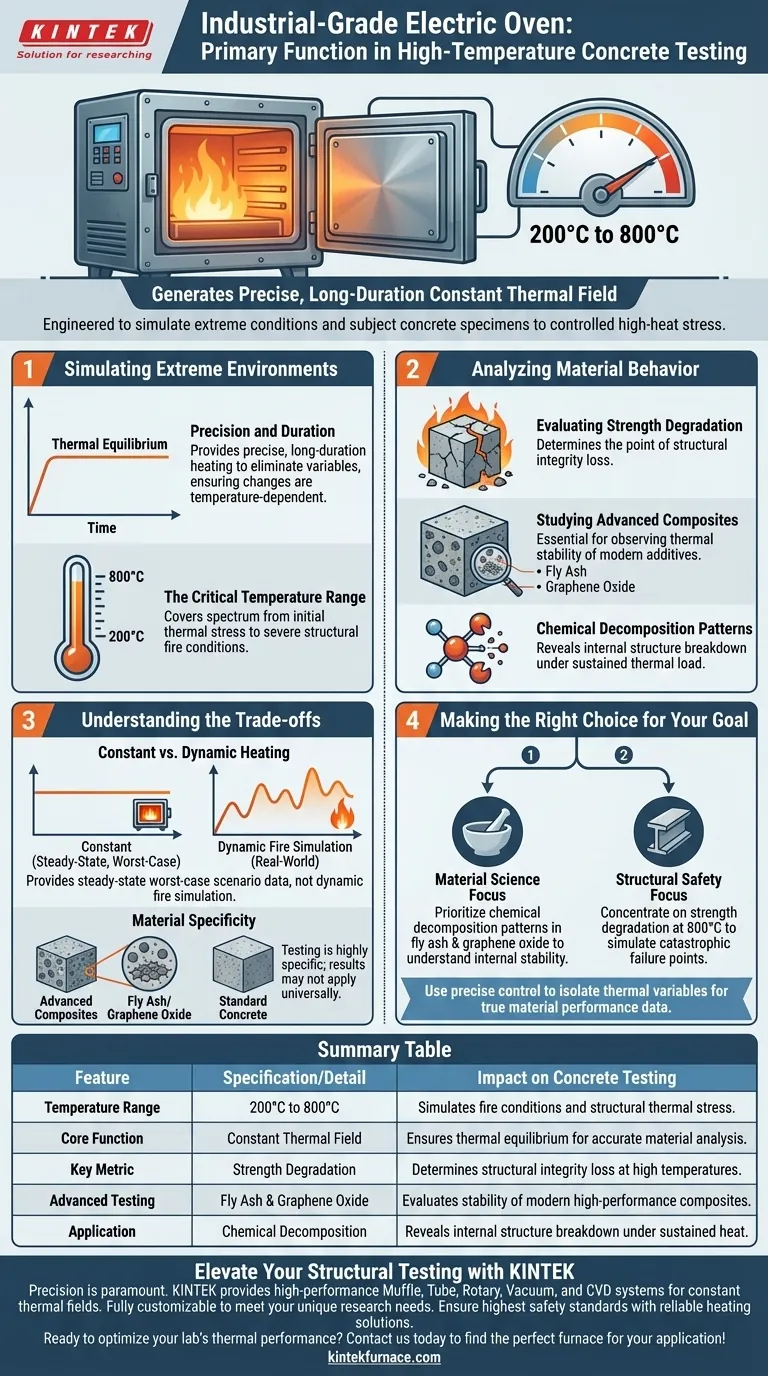
The primary function of an industrial-grade electric oven in concrete testing is to generate a precise, long-duration constant thermal field. These units are engineered to simulate extreme environmental conditions, typically ranging from 200°C to 800°C, allowing researchers to subject concrete specimens to controlled high-heat stress.
By maintaining a stable, high-temperature environment, these ovens allow for the critical evaluation of thermal stability and strength degradation in advanced concrete composites. This testing is essential for understanding how materials like fly ash and graphene oxide behave under fire-simulated conditions.
Simulating Extreme Environments
To accurately assess how concrete will perform during a fire or high-heat event, the testing environment must be rigorously controlled.
Precision and Duration
The oven's role goes beyond simply heating a specimen. It must provide precise, long-duration heating to ensure the material reaches thermal equilibrium.
This consistency eliminates variables, ensuring that any changes observed in the concrete are due to the temperature itself, not fluctuations in the heating source.
The Critical Temperature Range
Industrial-grade ovens for this purpose typically operate between 200°C and 800°C.
This specific range is crucial because it covers the spectrum from initial thermal stress to the temperatures found in severe structural fires.
Analyzing Material Behavior
The core purpose of this thermal application is to study the physical and chemical changes within the concrete matrix.
Evaluating Strength Degradation
One of the most critical metrics evaluated is strength degradation.
By subjecting specimens to fire-simulated conditions, engineers can determine at what point the concrete loses its structural integrity.
Studying Advanced Composites
Modern concrete often includes additives to improve performance. The oven is essential for studying fly ash and graphene oxide composites.
Researchers use the controlled heat to observe the specific thermal stability of these composite materials.
Chemical Decomposition Patterns
High heat causes chemical reactions within the concrete.
The oven facilitates the study of chemical decomposition patterns, revealing how the internal structure of the material breaks down under sustained thermal load.
Understanding the Trade-offs
While industrial electric ovens are vital for material characterization, understanding their operational context is key to interpreting results.
Constant vs. Dynamic Heating
The primary reference highlights the oven's ability to provide constant temperature heating.
However, real-world fires are rarely constant; they fluctuate dynamically. Therefore, data from these ovens represents a "steady-state" worst-case scenario rather than a dynamic fire simulation.
Material Specificity
The testing described is highly specific to materials like fly ash and graphene oxide composites.
Standard concrete mixes may behave differently, meaning the decomposition patterns observed in these advanced composites may not universally apply to all concrete types.
Making the Right Choice for Your Goal
When designing a testing protocol using an industrial-grade electric oven, align your parameters with your specific research objectives.
- If your primary focus is material science: Prioritize the analysis of chemical decomposition patterns in fly ash and graphene oxide to understand internal stability.
- If your primary focus is structural safety: Concentrate on evaluating strength degradation at the upper end of the 200°C to 800°C range to simulate catastrophic failure points.
Use the precise control of these ovens to isolate thermal variables, ensuring your data reflects true material performance under fire-simulated conditions.
Summary Table:
| Feature | Specification/Detail | Impact on Concrete Testing |
|---|---|---|
| Temperature Range | 200°C to 800°C | Simulates fire conditions and structural thermal stress. |
| Core Function | Constant Thermal Field | Ensures thermal equilibrium for accurate material analysis. |
| Key Metric | Strength Degradation | Determines structural integrity loss at high temperatures. |
| Advanced Testing | Fly Ash & Graphene Oxide | Evaluates stability of modern high-performance composites. |
| Application | Chemical Decomposition | Reveals internal structure breakdown under sustained heat. |
Elevate Your Structural Testing with KINTEK
Precision is paramount when simulating fire conditions or analyzing the thermal stability of advanced concrete composites. Backed by expert R&D and world-class manufacturing, KINTEK provides high-performance Muffle, Tube, Rotary, Vacuum, and CVD systems designed to deliver the constant thermal fields required for rigorous high-temperature testing.
Whether you are evaluating strength degradation or chemical decomposition patterns, our industrial-grade furnaces are fully customizable to meet your unique research needs. Ensure your materials meet the highest safety standards with our reliable heating solutions.
Ready to optimize your lab's thermal performance? Contact us today to find the perfect furnace for your application!
Visual Guide
References
- I. Ramana, N. Parthasarathi. Synergistic effects of fly ash and graphene oxide composites at high temperatures and prediction using ANN and RSM approach. DOI: 10.1038/s41598-024-83778-6
This article is also based on technical information from Kintek Furnace Knowledge Base .
Related Products
- High Temperature Muffle Oven Furnace for Laboratory Debinding and Pre Sintering
- 1700℃ High Temperature Muffle Oven Furnace for Laboratory
- 1800℃ High Temperature Muffle Oven Furnace for Laboratory
- 1200℃ Muffle Oven Furnace for Laboratory
- 1400℃ Muffle Oven Furnace for Laboratory
People Also Ask
- What thermal phenomena occur during polymer binder burnout in ceramic green bodies? Lab Furnace Guide
- What role does a high-temperature muffle furnace play in STFO synthesis? Achieve Pure Perovskite Results
- Why is controlled heat treatment in a muffle furnace necessary for calcined clay? Achieve Optimal Pozzolanic Activity
- How does a high-temperature muffle furnace facilitate the formation of LaNbxAl1−xO3+δ perovskite structures? Key Roles
- What role does a high-temperature muffle furnace play in the multi-stage synthesis of Li0.5MnFe1.5O4? Key to Pure Spinel









