Liquid nitrogen freezing and vacuum freeze-drying are necessary to instantly halt chemical reactions and preserve physical structure. By using these tools, researchers can stop the hydration process of cement and biomass at precise moments without introducing the structural damage or artificial acceleration associated with standard heat drying.
The combination of these technologies acts as a "chemical pause button." It allows researchers to capture a high-fidelity snapshot of the material's internal structure at a specific age by removing free water without heat, ensuring that microscopic analysis reflects reality rather than artifacts of the preparation process.
The Problem with Standard Drying
The Destructive Nature of Heat
Traditional methods, such as oven drying, use heat to evaporate water. In the context of cement and biomass hydration, heat is detrimental because it artificially accelerates chemical reactions.
Distorting the Timeline
If you use heat to dry a sample meant to represent "Day 1" of hydration, the heat may advance the chemistry to resemble "Day 2" or "Day 3." This makes accurate time-resolved analysis impossible.
Structural Collapse
Heat causes water to evaporate violently from pores, often creating high surface tension. This tension can collapse delicate microstructures or cause cracking, destroying the very interface you intend to study.
How the Equipment Solves the Problem
Step 1: Liquid Nitrogen Immersion
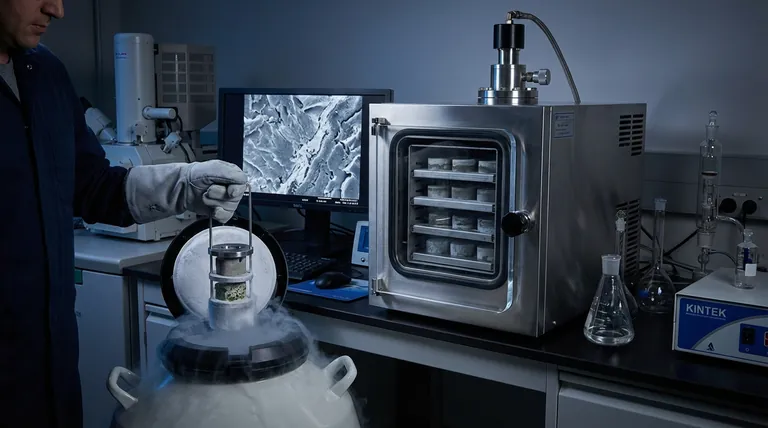
The first critical step involves immersing the sample in liquid nitrogen. This provides an immediate "flash freeze" effect.
Stopping the Clock
The extreme cold instantly creates a thermal shock that halts the hydration reaction. It transforms the liquid water within the pores into ice before it has time to react further with the cement or biomass.
Step 2: Laboratory Vacuum Freeze-Drying
Once frozen, the sample is placed in a vacuum freeze-dryer. This equipment reduces the surrounding pressure to allow for sublimation.
Sublimation Over Evaporation
Sublimation is the process where ice turns directly into vapor without becoming liquid water first. This bypasses the liquid phase entirely, removing non-chemically bound water gently.
Preserving the Interface
Protecting Morphology
By avoiding the liquid phase during drying, the capillary forces that usually crush delicate structures are eliminated. The physical framework of the hydration products remains intact.
Differentiating Water Types
This process specifically targets "non-chemically bound" water (free water). It leaves the chemically bound water—which is part of the actual crystal structure of the cement—undisturbed.
Enabling Microscopic Precision
The result is a sample that retains its true morphology. This allows for high-resolution imaging (such as SEM) to visualize the interface between cement and biomass exactly as it existed at the moment of freezing.
Understanding the Trade-offs
Equipment Complexity
While superior for preservation, this method requires specialized, expensive equipment compared to a standard laboratory oven. It also requires careful handling of cryogenic liquids.
Processing Time
Freeze-drying is significantly slower than oven drying. It can take days to fully sublimate the water from dense samples, creating a bottleneck in high-throughput testing.
Sensitivity to Handling
Samples must be transferred from liquid nitrogen to the vacuum chamber rapidly. Any thawing during transfer can re-introduce liquid water and damage the microstructure.
Making the Right Choice for Your Goal
To determine if this preparation method is required for your specific project, consider your analytical targets:
- If your primary focus is microstructural imaging (SEM): You must use freeze-drying to prevent pore collapse and shrinkage artifacts that distort the image.
- If your primary focus is reaction kinetics: You must use liquid nitrogen to instantly "stop the clock" so your data accurately represents the specific age of the sample.
- If your primary focus is bulk strength testing: You may not need this level of preservation, as minor microstructural changes might not affect macro-mechanical properties.
Reliable analysis of interfacial hydration relies on observing the structure as it exists in nature, not as it exists after heat damage.
Summary Table:
| Feature | Heat Drying (Oven) | Freeze-Drying (LN2 + Vacuum) |
|---|---|---|
| Reaction State | Artificially accelerated by heat | Instantly halted (flash freeze) |
| Water Removal | Evaporation (causes surface tension) | Sublimation (bypasses liquid phase) |
| Microstructure | Prone to collapse and cracking | Preserved high-fidelity morphology |
| Sample Accuracy | Distorts chemical timeline | Captures "true" age snapshot |
| Primary Use | Bulk mechanical testing | Microscopic analysis (SEM) & Kinetics |
Advance Your Material Science with Precision
Don't let heat artifacts compromise your research results. KINTEK provides the high-performance laboratory equipment necessary to capture the true interfacial dynamics of your materials. Backed by expert R&D and manufacturing, KINTEK offers advanced vacuum systems and laboratory solutions tailored for cement, biomass, and complex chemical studies.
Whether you need standard systems or custom-engineered solutions for your unique high-temp and vacuum needs, our team is ready to support your laboratory's success.
Ready to preserve your samples with microscopic precision? Contact us today to find the perfect equipment solution!
References
- Alysson Larsen Bonifacio, Paul Archbold. Impact of Oat Husk Extracts on Mid-Stage Cement Hydration and the Mechanical Strength of Mortar. DOI: 10.3390/constrmater4010006
This article is also based on technical information from Kintek Furnace Knowledge Base .
Related Products
- High Pressure Laboratory Vacuum Tube Furnace
- Laboratory Vacuum Tilt Rotary Tube Furnace Rotating Tube Furnace
- Small Vacuum Heat Treat and Tungsten Wire Sintering Furnace
- Vacuum Dental Porcelain Sintering Furnace for Dental Laboratories
- Vertical Laboratory Quartz Tube Furnace Tubular Furnace
People Also Ask
- What role does a high vacuum tube furnace play in Co-Al sintering? Master High-Purity Porous Material Synthesis
- What are the different types of tube furnaces available? Find the Perfect Fit for Your Lab's Needs
- What is the role of a vacuum tube furnace during the final thermal treatment stage of Fe3O4@CSAC catalysts?
- What are the main advantages of vacuum tube furnaces in the market? Achieve Purity and Precision in Material Processing
- What conditions does a tube furnace provide for post-ion-implantation? Achieve Precise Microstructural Repair