
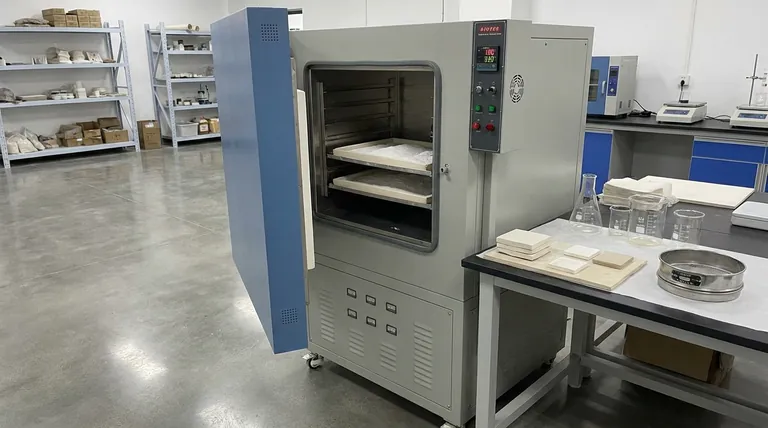
The primary function of an industrial constant temperature drying oven in the ceramic powder pretreatment stage is to apply controlled, uniform heating to ceramic slurry specifically to remove the grinding medium (typically anhydrous ethanol). By regulating the rate of evaporation, the oven transforms the wet slurry into a dry powder while preventing the formation of structural defects that occur during rapid dehydration.
Core Takeaway Achieving the correct powder morphology is just as important as removing the solvent. The industrial constant temperature drying oven mitigates the risk of hard agglomeration—a defect caused by excessively fast drying—ensuring the powder remains fine and fluid enough for high-quality molding.
The Critical Role of Controlled Evaporation
Removing the Grinding Medium
After the ball milling process, ceramic powders exist as a slurry mixed with a liquid medium, often anhydrous ethanol. The immediate surface need is to eliminate this liquid to return the material to a solid state. The oven provides a stable thermal environment to ensure the thorough removal of this medium without leaving residues that could interfere with sintering.
Preventing Hard Agglomeration
The deep need addressed by this equipment is the preservation of particle structure. If a slurry is dried too quickly or unevenly, the particles bind together tightly, forming "hard agglomerates." These clumps are difficult to break down during sieving. By precisely controlling the drying temperature and duration, the oven ensures the solvent evaporates at a moderate pace, preventing these hard bonds from forming.
Impact on Downstream Processing
Ensuring Powder Fluidity
The output of the drying process must be a fine powder. When the oven successfully prevents clumping, the resulting material passes easily through sieves. This results in high fluidity, meaning the powder flows like a liquid. This characteristic is essential for filling molds evenly and packing the particles densely.
Optimizing Green Body Quality
The ultimate goal of pretreatment is to secure the quality of the "green body" (the formed ceramic before firing). If the powder contains agglomerates or has poor fluidity due to improper drying, the green body will have uneven density. A constant temperature drying oven ensures the powder is uniform, leading to a consistent molding quality that reduces the risk of cracking or warping during the final firing stages.
Understanding the Trade-offs
Temperature Sensitivity vs. Efficiency
While standard constant temperature ovens are effective for general solvent removal (like ethanol), they rely on atmospheric pressure. The Pitfall: If your material is highly sensitive to heat or prone to oxidation (such as certain metallic powders mentioned in advanced processing), a standard oven may require higher temperatures to evaporate the solvent than the material can withstand. In these cases, the standard oven might induce oxidation or degrade surface functional groups.
Constant Temperature vs. Vacuum Drying
It is important to distinguish between a standard constant temperature oven and a vacuum drying oven.
- Constant Temperature Oven: Ideal for removing ethanol from robust ceramic slurries where oxidation is not a primary concern.
- Vacuum Oven: Lowers the boiling point of the solvent, allowing drying at significantly lower temperatures. This is necessary for oxidation-sensitive materials or preventing the collapse of delicate porous structures (like MOFs or zeolites).
Making the Right Choice for Your Goal
To select the correct drying approach for your ceramic powder, consider your specific material constraints:
- If your primary focus is standard ceramic slurry (e.g., Ethanol-based): Prioritize an industrial constant temperature oven to control evaporation rates and prevent hard agglomeration for optimal molding fluidity.
- If your primary focus is oxidation-sensitive materials (e.g., Aluminum or Boron Carbide): You typically require a vacuum drying oven to lower the evaporation temperature and exclude oxygen, preserving material purity.
Precise thermal control during drying is not just about removing liquid; it is the first step in defining the structural integrity of your final ceramic product.
Summary Table:
| Feature | Function in Ceramic Pretreatment | Impact on Material Quality |
|---|---|---|
| Controlled Heating | Evaporates liquid media (e.g., anhydrous ethanol) | Ensures thorough removal without residue |
| Evaporation Rate | Regulates the speed of dehydration | Prevents hard agglomeration and structural defects |
| Consistency | Maintains stable thermal environment | Guarantees powder fluidity for uniform mold filling |
| Fluidity Optimization | Produces fine, easily-sieved powder | Improves green body density and reduces firing cracks |
Maximize your ceramic production quality with KINTEK’s precision thermal solutions. Backed by expert R&D and manufacturing, KINTEK offers a full range of high-performance lab equipment, including Muffle, Tube, Rotary, and Vacuum systems, all customizable for your unique needs. Whether you are drying robust slurries or processing oxidation-sensitive materials, our advanced systems ensure the structural integrity of your final product. Contact us today to find the perfect drying solution for your lab!
References
- Lahbib Abbas, Zahra Ramzi. Graphite Carbone Structure. DOI: 10.4236/csta.2024.121001
This article is also based on technical information from Kintek Furnace Knowledge Base .
Related Products
- 1700℃ High Temperature Muffle Oven Furnace for Laboratory
- 1800℃ High Temperature Muffle Oven Furnace for Laboratory
- 1400℃ Muffle Oven Furnace for Laboratory
- 1200℃ Muffle Oven Furnace for Laboratory
- High Temperature Muffle Oven Furnace for Laboratory Debinding and Pre Sintering
People Also Ask
- What is the primary function of a high-temperature laboratory muffle furnace in chemical synthesis? Achieve Precision.
- How does a high-temperature laboratory muffle furnace affect material properties? Transform Anodic Oxide Films Fast
- What role does a muffle furnace play in BCZY712 electrolyte powder production? Achieve Perfect Phase Purity
- What is the role of a high-temperature muffle furnace in guava leaf carbonization? Master Precise Pyrolysis Control
- What role does a muffle furnace play in sintering photocathodes? Enhance Electrode Conductivity & Catalytic Activity





