
High-precision vacuum or atmospheric heat treatment furnaces act as the definitive tool for engineering the microstructure of Inconel 718. Their primary role is to execute the Solution Treatment and Aging (STA) process with exacting accuracy, maintaining specific temperature plateaus—most notably 980°C, 718°C, and 621°C—to transform the alloy’s internal structure. This process converts the detrimental Laves phase into the stable δ phase and drives the precipitation of the γ'' strengthening phase, which is essential for the material's mechanical performance.
Core Insight: The furnace is not merely a heating device; it is a precision instrument for phase management. By strictly controlling thermal cycles and atmospheric conditions, these furnaces dictate the morphology and volume of precipitates, directly bridging the gap between a raw component and one capable of enduring extreme tensile stress and creep.
The Mechanics of Microstructural Transformation
Optimizing Phase Transition
The central function of these furnaces is to facilitate the transformation of the Laves phase into the δ phase.
This is achieved during the solution treatment stage, typically held at 980°C.
Precise thermal regulation ensures this transformation occurs uniformly, preventing brittle phases that would otherwise compromise the alloy's integrity.
Inducing the Strengthening Phase
Following solution treatment, the furnace executes a two-step aging process at 718°C and 621°C.
This multi-stage cycling induces the precipitation of the γ'' (gamma double prime) phase.
The accuracy of the furnace determines the volume fraction of these precipitates, which is the primary driver of Inconel 718’s high strength.
Controlling Precipitate Morphology
Temperature stability within the furnace directly influences the physical shape of the precipitates.
Variations in heat can shift precipitates between needle-like and granular morphologies.
Achieving the correct morphology is critical, as it optimizes the material's tensile strength and creep life (resistance to deformation under long-term stress).
Environmental Control and Stress Management
Eliminating Residual Stress
Beyond phase transformation, these furnaces play a vital role in mechanical stabilization.
During the printing or forming process, Inconel 718 accumulates significant internal tension.
High-precision heating cycles relieve this residual stress, significantly improving the component's fatigue strength and ensuring dimensional stability.
Creating a Pure Processing Environment
Industrial-grade vacuum or atmosphere furnaces provide a controlled environment that is free from contaminants.
By lowering the oxygen partial pressure (in vacuum systems), the furnace facilitates the removal of adsorbed gases and volatile impurities.
This prevents oxidation during high-temperature cycles, ensuring the grain boundaries remain pure and the material properties remain consistent.
Homogenization Capabilities
For components requiring a reset of their elemental distribution, these furnaces can reach higher temperatures, such as 1200°C.
This homogenization step promotes elemental diffusion, smoothing out chemical inconsistencies found in the raw material.
Understanding the Trade-offs
Sensitivity to Temperature Deviations
The primary risk in this process is the "narrow window" of operation.
If the furnace fluctuates even slightly from the required temperatures (e.g., drifting from 980°C), the morphology of the precipitates will change unpredictably.
This can result in a part that looks correct on the outside but fails prematurely under stress due to sub-optimal microstructure.
Cycle Time vs. Throughput
Implementing these multi-stage cycles (Homogenization, Solution, and Double Aging) is time-intensive.
Achieving maximum material performance requires long dwell times at specific temperatures.
This creates a bottleneck in production speed, forcing a trade-off between peak material properties and manufacturing throughput.
Making the Right Choice for Your Goal
When configuring your post-processing strategy for Inconel 718, consider your specific performance requirements:
- If your primary focus is Tensile Strength and Creep Life: Prioritize the accuracy of the Solution Treatment and Aging (STA) temperatures (980°C, 718°C, 621°C) to maximize γ'' precipitation.
- If your primary focus is Dimensional Stability and Fatigue Resistance: Ensure your cycle includes sufficient stress relief and potential homogenization to eliminate residual tensions from the manufacturing process.
Precision in heat treatment is the single most significant factor in converting Inconel 718 from a raw alloy into a high-performance superalloy.
Summary Table:
| Process Stage | Temperature | Key Role & Phase Transformation |
|---|---|---|
| Homogenization | ~1200°C | Promotes elemental diffusion and resets chemical consistency |
| Solution Treatment | 980°C | Converts detrimental Laves phase into stable δ phase |
| Double Aging | 718°C & 621°C | Induces precipitation of γ'' phase for peak tensile strength |
| Stress Relief | Variable | Eliminates residual internal tension and improves fatigue life |
| Atmosphere Control | Vacuum/Inert | Prevents oxidation and removes volatile impurities |
Elevate Your Superalloy Performance with KINTEK
Don't let temperature fluctuations compromise your material integrity. KINTEK provides industry-leading heat treatment solutions designed to meet the rigorous demands of Inconel 718 processing. Backed by expert R&D and precision manufacturing, we offer a comprehensive range of Muffle, Tube, Rotary, Vacuum, and CVD systems, all fully customizable for your unique lab or industrial needs.
Our Value to You:
- Unmatched Precision: Maintain the narrow thermal windows required for optimal γ'' phase precipitation.
- Customized Solutions: Tailored furnace configurations for specific homogenization or STA cycles.
- Expert Support: Technical guidance to help you bridge the gap between raw components and high-performance alloys.
Ready to optimize your post-processing workflow? Contact KINTEK today to speak with our specialists about your high-temperature furnace requirements!
Visual Guide
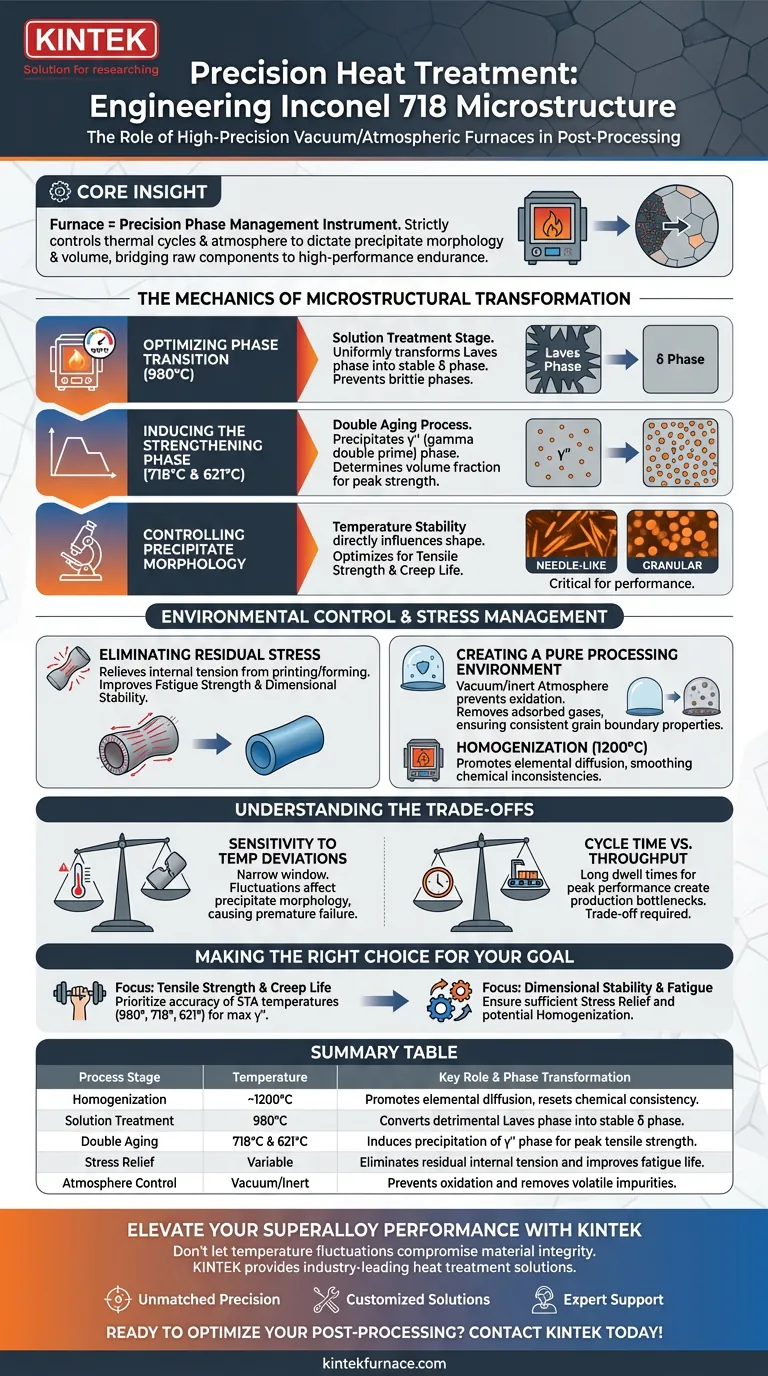
References
- Koji Kakehi, Shohei Ishisako. Effects of base plate temperature on microstructure evolution and high-temperature mechanical properties of IN718 processed by laser powder bed fusion using simulation and experiment. DOI: 10.1007/s00170-024-13028-6
This article is also based on technical information from Kintek Furnace Knowledge Base .
Related Products
- Vacuum Heat Treat Furnace with Ceramic Fiber Liner
- 2200 ℃ Graphite Vacuum Heat Treat Furnace
- Molybdenum Vacuum Heat Treat Furnace
- 2200 ℃ Tungsten Vacuum Heat Treat and Sintering Furnace
- Vacuum Heat Treat Sintering and Brazing Furnace
People Also Ask
- How does vacuum heat treating affect the grain structure of metal alloys? Achieve Precise Microstructure Control
- What are the benefits of using vacuum heat treating furnaces for metal alloys? Achieve Superior Metal Properties and Performance
- What is one of the most important uses of vacuum heat treating furnaces in aerospace? Achieve Superior Strength in Aircraft Alloys
- How does a vacuum heat treat furnace work? Achieve Pristine, High-Performance Results
- What is the difference between heat treat and vacuum heat treat? Achieve Superior Metal Properties with Pristine Finishes



















