
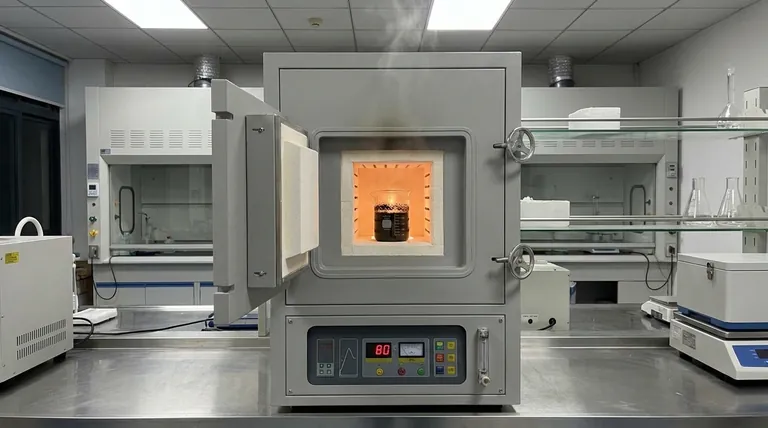
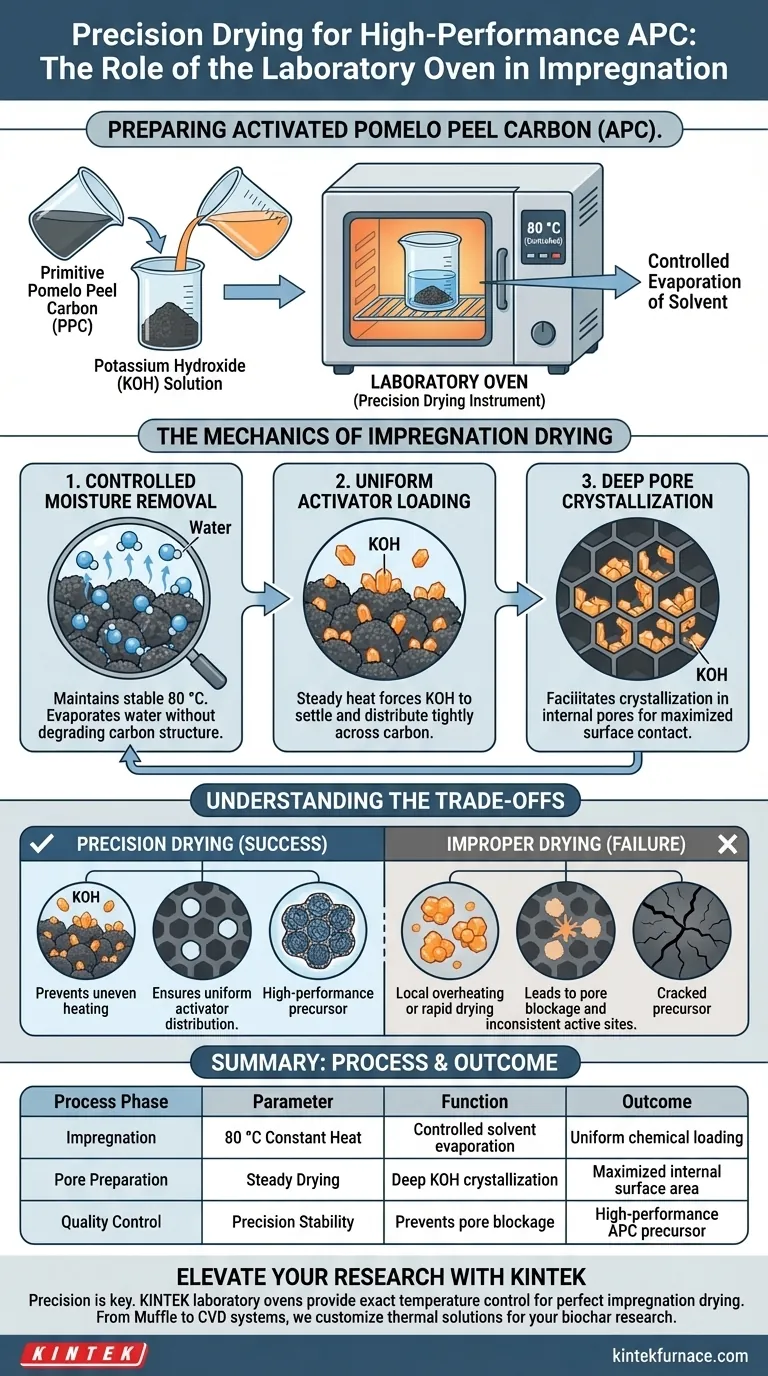
In the preparation of activated pomelo peel carbon (APC), the laboratory oven acts as a precision drying instrument during the critical impregnation phase. It is specifically employed to heat the mixture of primitive pomelo peel carbon (PPC) and potassium hydroxide (KOH) solution at a controlled temperature of 80 °C.
The primary function of the oven is to drive off moisture through smooth, controlled evaporation, ensuring the chemical activator (KOH) is uniformly loaded and crystallized within the biochar's pore structure prior to high-temperature activation.
The Mechanics of Impregnation Drying
Controlled Moisture Removal
The laboratory oven provides a stable thermal environment, maintaining the mixture at exactly 80 °C.
This specific temperature is sufficient to evaporate the solvent (water) without triggering premature chemical reactions or degrading the carbon structure.
Uniform Activator Loading
As the moisture evaporates, the oven’s steady heat forces the KOH activator to settle onto the carbon material.
Instead of pooling on the surface, the activator is tightly loaded and distributed evenly across the primitive carbon.
Deep Pore Crystallization
The drying process facilitates the crystallization of KOH not just on the surface, but deep within the pore structures of the biochar.
This deep penetration is vital, as it ensures the activating agent is in direct contact with the internal surface area of the carbon.
Understanding the Trade-offs
The Importance of Thermal Stability
Using a laboratory oven prevents the risks associated with uneven heating or rapid drying.
Local overheating can cause the solvent to boil violently rather than evaporate smoothly.
Risks of Improper Drying
If the temperature fluctuates or is set too high, the activator may distribute unevenly.
This can lead to pore blockage or the creation of inconsistent active sites, effectively ruining the material's potential performance during the subsequent high-temperature activation stage.
Optimization for Material Success
To ensure the highest quality activated pomelo peel carbon, consider the following based on your specific objectives:
- If your primary focus is Surface Area: Ensure the oven maintains a strict 80 °C to allow gradual crystallization, maximizing the activator's contact with the internal pore network.
- If your primary focus is Process Consistency: Use a precision constant temperature oven to prevent local overheating, ensuring every batch of APC has identical chemical loading.
The laboratory oven effectively transforms a simple wet mixture into a structurally prepared precursor ready for activation.
Summary Table:
| Process Phase | Parameter | Function | Outcome |
|---|---|---|---|
| Impregnation | 80 °C Constant Heat | Controlled solvent evaporation | Uniform chemical loading |
| Pore Preparation | Steady Drying | Deep KOH crystallization | Maximized internal surface area |
| Quality Control | Precision Stability | Prevents pore blockage | High-performance APC precursor |
Elevate Your Material Research with KINTEK
Precision is the difference between a blocked pore and a high-performance catalyst. At KINTEK, we understand that APC preparation requires unwavering thermal stability. Our laboratory ovens provide the exact temperature control needed for perfect impregnation drying.
Backed by expert R&D and manufacturing, KINTEK offers Muffle, Tube, Rotary, Vacuum, and CVD systems, along with specialized lab high-temp furnaces. Whether you are scaling up biochar production or developing custom carbon structures, our systems are fully customizable to meet your unique research needs.
Ready to optimize your activation process? Contact our experts today to find the perfect thermal solution for your laboratory.
Visual Guide
References
- Jing Gong, Baowei Hu. Honeycomb-structured biochar from waste pomelo peel for synergistic adsorptive and photocatalytic removal of Cr(VI). DOI: 10.1007/s44246-024-00174-5
This article is also based on technical information from Kintek Furnace Knowledge Base .
Related Products
- Laboratory Muffle Oven Furnace with Bottom Lifting
- 1200℃ Muffle Oven Furnace for Laboratory
- 1400℃ Muffle Oven Furnace for Laboratory
- 1800℃ High Temperature Muffle Oven Furnace for Laboratory
- 1700℃ High Temperature Muffle Oven Furnace for Laboratory
People Also Ask
- What function does a muffle furnace perform in Ba0.75Ca0.25TiO3 calcination? Ensure Phase Purity & Synthesis
- What is the importance of the calcination process? Master High-Purity Calcium Phosphate Nanopowder Production
- Why is a high-temperature muffle furnace required for FeOx-MOx/TiO2? Engineering High-Performance Nanocomposites
- Why is a high-temperature laboratory muffle furnace essential for the alkali fusion process in zeolite synthesis?
- What are the primary functions of a high-temperature laboratory muffle furnace in the preparation of biosorbent materials?



















