
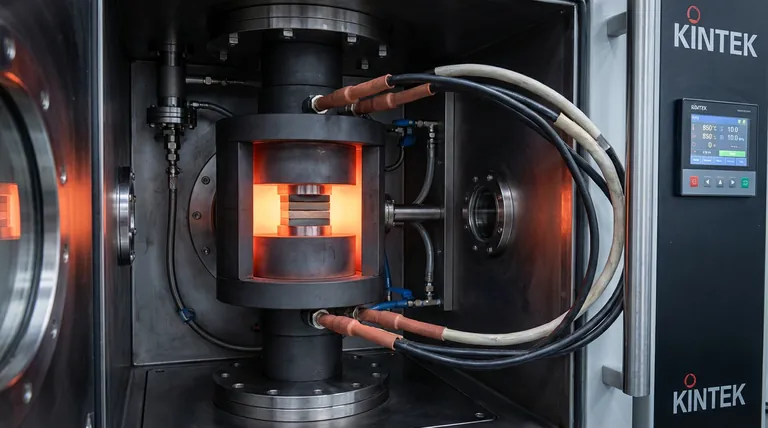
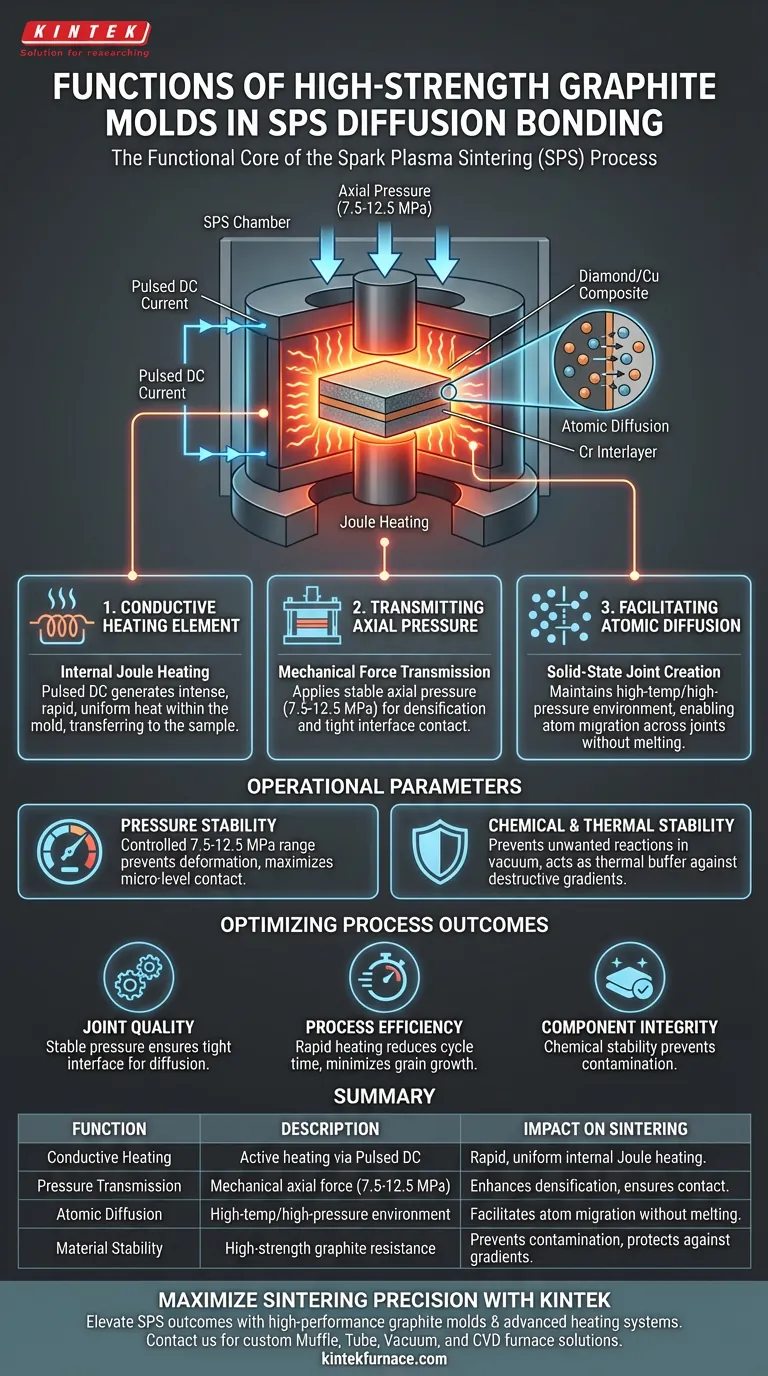
High-strength graphite molds serve as the functional core of the Spark Plasma Sintering (SPS) process. They act simultaneously as the sample containment vessel, the primary conductive heating element, and the mechanical medium for transmitting critical axial pressure to the workpiece.
In the SPS environment, the graphite mold is not merely a passive container; it is an active component that synchronizes electrical heating with mechanical compression to force atomic diffusion at the material interface.
The Triple Function of the Graphite Mold
Acting as a Conductive Heating Element
In SPS, heat is not applied externally; it is generated internally. The graphite mold is electrically conductive, allowing pulsed direct current (DC) to pass through it.
This flow of electricity generates intense Joule heating directly within the mold walls. Because of the graphite's high thermal conductivity, this thermal energy is transferred rapidly and uniformly to the internal sample, such as a Diamond/Cu composite.
Transmitting Axial Pressure
Simultaneous to heating, the mold serves as the transmission vehicle for mechanical force. Working with a pressurization system, the mold applies stable axial pressure—specifically between 7.5 and 12.5 MPa in Diamond/Cu and Chromium (Cr) applications—to the assembly.
This pressure is vital for densification. It mechanically forces the materials together, breaking down surface irregularities to ensure tight interface contact.
Facilitating Atomic Diffusion
The ultimate goal of combining heat and pressure is to drive atomic diffusion. By maintaining the sample in a contained, high-pressure, high-temperature environment, the mold enables atoms to migrate across the joint interface.
This creates high-quality, solid-state joints between dissimilar materials, such as the Diamond/Cu composite and the Cr interlayer, without melting the bulk material.
Understanding the Operational Parameters
Pressure Stability
While high-purity graphite can withstand pressures exceeding 20 MPa, the specific SPS process for Diamond/Cu composites relies on a controlled range of 7.5 to 12.5 MPa.
Operating within this specific window prevents mold deformation while ensuring enough force is applied to maximize contact area at the micro-level.
Chemical and Thermal Stability
The mold must maintain structural integrity in harsh environments. High-strength graphite provides chemical stability, preventing unwanted reactions with the sample materials in a vacuum environment.
It also acts as a thermal buffer, ensuring that the rapid heating rates characteristic of SPS do not create destructive thermal gradients within the sample.
Optimizing Process Outcomes
If your primary focus is Joint Quality: Ensure the mold is capable of maintaining stable pressure between 7.5 and 12.5 MPa to guarantee the tight interface contact required for atomic diffusion.
If your primary focus is Process Efficiency: Leverage the graphite's electrical and thermal conductivity to achieve rapid heating rates, reducing overall cycle time while minimizing grain growth.
If your primary focus is Component Integrity: Rely on the chemical stability of high-purity graphite to prevent contamination of sensitive materials like Diamond/Cu composites during high-temperature sintering.
The success of the SPS diffusion bonding process relies entirely on the graphite mold's ability to balance electrical conductivity with mechanical rigidity.
Summary Table:
| Function | Description | Impact on Sintering |
|---|---|---|
| Conductive Heating | Acts as an active heating element via Pulsed DC | Enables rapid, internal Joule heating for uniform thermal energy. |
| Pressure Transmission | Mechanically transmits axial force (7.5 - 12.5 MPa) | Enhances densification and ensures tight interface contact. |
| Atomic Diffusion | Maintains high-temp/high-pressure environment | Facilitates atom migration across joints without melting bulk material. |
| Material Stability | High-strength graphite provides chemical/thermal resistance | Prevents contamination and protects against destructive thermal gradients. |
Maximize Your Sintering Precision with KINTEK
Elevate your Spark Plasma Sintering (SPS) outcomes with high-performance graphite molds and advanced heating systems. Backed by expert R&D and manufacturing, KINTEK offers state-of-the-art Muffle, Tube, Rotary, Vacuum, and CVD systems, along with other lab high-temperature furnaces—all fully customizable to meet your unique materials research and industrial needs. Whether you are working on Diamond/Cu composites or complex diffusion bonding, our solutions ensure stable pressure control and optimal thermal conductivity.
Ready to optimize your lab's efficiency? Contact us today to discuss your custom furnace requirements!
Visual Guide
References
- Ying Zhou, Degan Xiong. An Investigation on the Spark Plasma Sintering Diffusion Bonding of Diamond/Cu Composites with a Cr Interlayer. DOI: 10.3390/ma17246026
This article is also based on technical information from Kintek Furnace Knowledge Base .
Related Products
People Also Ask
- How does the heating mechanism of Spark Plasma Sintering (SPS) function? Enhance TiC/SiC Composite Fabrication
- Why is it necessary to maintain a high vacuum environment during the SPS of SiC? Key to High-Density Ceramics
- What are the technical advantages of using an SPS sintering furnace? Elevate Al2O3-TiC Material Performance
- What are the steps in the discharge plasma sintering process? Master Fast, High-Density Material Consolidation
- What are the advantages of spark plasma sintering (SPS) over traditional forging? Precision Microstructural Control

