
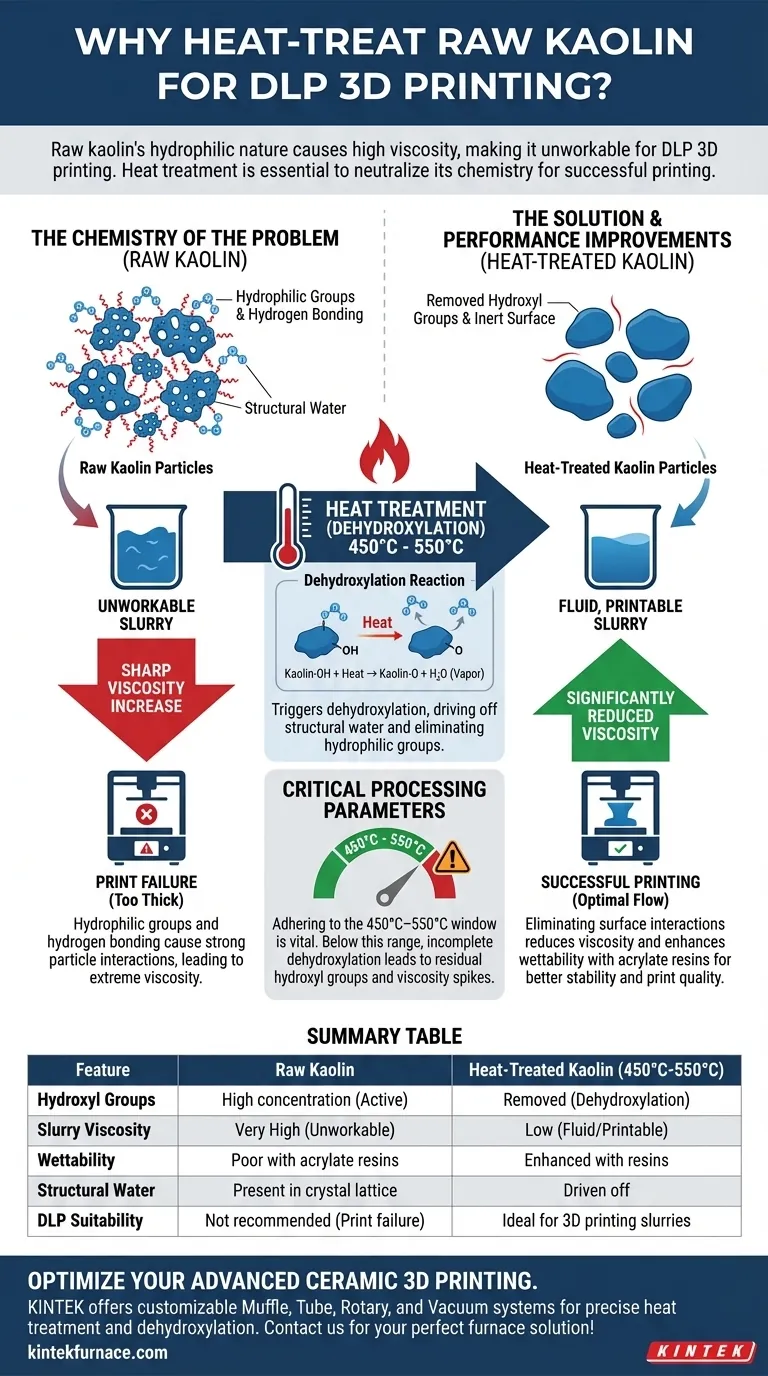
Raw kaolin requires heat treatment prior to use in Digital Light Processing (DLP) to neutralize its surface chemistry, specifically by removing hydrophilic hydroxyl groups. Without this thermal processing step, the interaction between raw kaolin and photosensitive resin causes a drastic increase in viscosity, rendering the slurry too thick for the fluid dynamics required by the printing process.
Raw kaolin contains structural water and hydroxyl groups that bond strongly, creating unworkable slurries. Heat treatment between 450°C and 550°C triggers dehydroxylation, effectively stripping these groups to lower viscosity and enable successful printing.

The Chemistry of the Problem
Hydrophilic Groups and Hydrogen Bonding
In its raw state, kaolin is chemically active in ways that are detrimental to 3D printing resins. The material contains a significant number of hydrophilic groups and hydrogen bonding sites.
These surface features cause the particles to interact strongly with one another and the surrounding medium. This chemical "stickiness" resists the flow necessary for liquid processing.
The Impact on Viscosity
When untreated kaolin is added directly to photosensitive resin, the suspension viscosity increases sharply.
DLP technology relies on a liquid resin that can flow back over the build plate quickly and evenly. The high viscosity caused by raw kaolin fails to meet these fluidity requirements, causing print failures or inability to form layers.
The Mechanism of Heat Treatment
Triggering Dehydroxylation
To solve the viscosity issue, the kaolin must undergo heat treatment at temperatures between 450°C and 550°C.
This specific temperature range triggers a chemical reaction known as dehydroxylation. During this phase, the structural water inherently bound within the kaolin crystal lattice is driven off.
Eliminating Surface Interactions
As the structural water is removed, the heat treatment effectively eliminates the problematic hydroxyl groups from the particle surface.
By removing these groups, you remove the chemical sites responsible for hydrogen bonding. This transforms the clay from a hydrophilic material into one that is more chemically inert regarding viscosity buildup.
Improvements in Material Performance
Reduced Slurry Viscosity
The primary result of dehydroxylation is a significant reduction in the viscosity of the final slurry.
This allows the material to flow freely, ensuring that the printer can accurately recoat the build platform between layers without mechanical resistance or air entrapment.
Enhanced Wettability
Heat treatment does not just lower thickness; it improves the interface between the solid and liquid components.
Processing improves the wettability between the kaolin particles and the acrylate resin. This results in a more homogeneous suspension where the resin can effectively coat each particle, leading to better suspension stability and print quality.
Critical Processing Parameters
Adhering to the Temperature Window
It is essential to strictly observe the 450°C to 550°C processing window mentioned in technical literature.
Processing below this range may result in incomplete dehydroxylation, leaving residual hydroxyl groups that will still spike viscosity. The goal is the complete removal of structural water to ensure consistent rheological behavior.
Optimizing Your Slurry Preparation
To ensure your kaolin-based slurries are viable for DLP printing, apply the following principles to your preparation workflow:
- If your primary focus is flow mechanics: Target the 450°C–550°C range to fully trigger dehydroxylation, which is the only way to prevent the sharp viscosity spikes that stall DLP printers.
- If your primary focus is mixture homogeneity: Use this heat treatment to improve the wettability of the particles, ensuring the acrylate resin bonds properly with the ceramic filler.
By systematically removing hydroxyl groups through heat, you convert raw kaolin from an unworkable mineral into a high-performance additive for precision 3D printing.
Summary Table:
| Feature | Raw Kaolin | Heat-Treated Kaolin (450°C-550°C) |
|---|---|---|
| Hydroxyl Groups | High concentration (Active) | Removed (Dehydroxylation) |
| Slurry Viscosity | Very High (Unworkable) | Low (Fluid/Printable) |
| Wettability | Poor with acrylate resins | Enhanced with resins |
| Structural Water | Present in crystal lattice | Driven off |
| DLP Suitability | Not recommended (Print failure) | Ideal for 3D printing slurries |
Optimize Your Advanced Ceramic 3D Printing
Precise thermal processing is the key to transforming raw materials into high-performance 3D printing slurries. Backed by expert R&D and world-class manufacturing, KINTEK offers a comprehensive range of Muffle, Tube, Rotary, and Vacuum systems, as well as other lab high-temp furnaces—all fully customizable to meet your specific dehydroxylation and material synthesis needs.
Don't let high viscosity stall your innovation. Empower your laboratory with the precision heating required for superior material performance. Contact KINTEK today to find your perfect furnace solution!
Visual Guide
References
- Viktor Kurylenko, Tetiana Dontsova. ПЕРСПЕКТИВИ ВИКОРИСТАННЯ ТЕХНОЛОГІЇ 3D ДРУКУ DLP ДЛЯ ВИРОБНИЦТВА МЕМБРАННИХ КЕРАМІЧНИХ МОДУЛІВ. DOI: 10.15421/jchemtech.v33i2.317663
This article is also based on technical information from Kintek Furnace Knowledge Base .
Related Products
- Vacuum Heat Treat Furnace with Ceramic Fiber Liner
- 2200 ℃ Graphite Vacuum Heat Treat Furnace
- Vacuum Heat Treat Sintering and Brazing Furnace
- Vacuum Heat Treat Sintering Furnace Molybdenum Wire Vacuum Sintering Furnace
- Vacuum Heat Treat Sintering Furnace with Pressure for Vacuum Sintering
People Also Ask
- How does vacuum heat treating affect the grain structure of metal alloys? Achieve Precise Microstructure Control
- What are the benefits of using vacuum heat treating furnaces for metal alloys? Achieve Superior Metal Properties and Performance
- What is one of the most important uses of vacuum heat treating furnaces in aerospace? Achieve Superior Strength in Aircraft Alloys
- How does a vacuum heat treat furnace work? Achieve Pristine, High-Performance Results
- What is the difference between heat treat and vacuum heat treat? Achieve Superior Metal Properties with Pristine Finishes















