
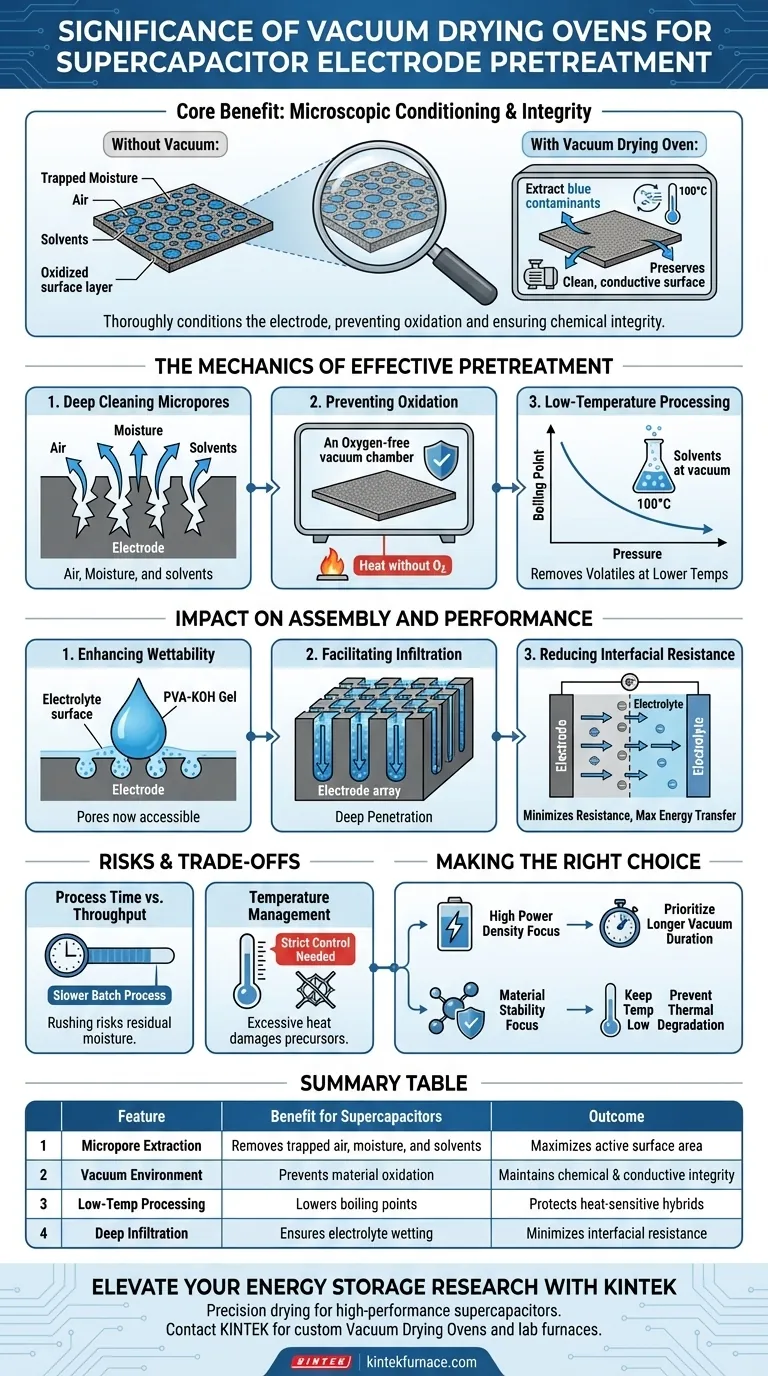
The significance of using a vacuum drying oven lies in its ability to thoroughly condition the electrode at a microscopic level. It functions by extracting air, residual solvents, and moisture deep within the micropores of the electrode sheets under controlled temperatures. Crucially, doing this in a vacuum prevents the oxidation of delicate materials that often occurs during conventional heating, ensuring the material retains its chemical integrity.
By eliminating microscopic barriers and preventing oxidation, vacuum drying ensures the electrolyte can fully penetrate the electrode structure. This deep infiltration is the critical factor in minimizing interfacial resistance and maximizing the energy transfer efficiency of the supercapacitor.

The Mechanics of Effective Pretreatment
Deep Cleaning Micropores
Electrode materials are porous by design to maximize surface area. However, these micropores often trap air, moisture, and solvents left over from manufacturing. A vacuum drying oven creates a pressure differential that physically pulls these contaminants out from the deepest parts of the material structure.
Preventing Oxidation
Standard drying methods rely on heat, which can react with oxygen in the air to degrade the electrode surface. The vacuum environment removes oxygen, allowing you to apply the necessary heat to dry the sheets without triggering oxidation. This preserves the pristine conductive surface required for high performance.
Low-Temperature Processing
The vacuum lowers the boiling point of solvents and water. This means you can remove volatile components at lower temperatures (e.g., 100°C). This is vital for organic-inorganic hybrid materials that might deteriorate or lose their structural integrity under higher heat.
Impact on Assembly and Performance
Enhancing Wettability
For a supercapacitor to function, the electrolyte must touch the active material. If pores are blocked by air or moisture, the electrolyte cannot enter. Vacuum drying ensures the active surfaces are fully accessible, allowing viscous electrolytes—such as PVA-KOH gels—to effectively wet the surface.
Facilitating Infiltration
Beyond simple surface contact, the electrolyte needs to penetrate the electrode arrays. A thoroughly dried and evacuated electrode allows the gel electrolyte to infiltrate the porous structure completely. This maximizes the "double-layer" capacitance effect.
Reducing Interfacial Resistance
The primary enemy of supercapacitor efficiency is resistance at the interface between the electrode and the electrolyte. By ensuring deep infiltration and a clean surface, vacuum drying significantly reduces interfacial resistance. This leads to better power density and more efficient charge/discharge cycles.
Understanding the Risks and Trade-offs
Process Time vs. Throughput
Vacuum drying is inherently slower than continuous air drying because it requires a sealed batch environment to achieve low pressure. Rushing this stage is a common error. If the vacuum duration is too short, residual moisture remains deep in the pores, negating the benefits of the process.
Temperature Management
While vacuum allows for lower temperatures, excessive heat can still damage sensitive precursors. Even in a vacuum, you must strictly control the temperature profile to maintain the desired loose powder structure or sheet integrity. Overheating can collapse the pores you are trying to clean.
Making the Right Choice for Your Project
To maximize the utility of vacuum drying for your specific application, consider the following:
- If your primary focus is High Power Density: Prioritize the duration of the vacuum cycle to ensure absolute dryness, which creates the lowest possible interfacial resistance.
- If your primary focus is Material Stability: Focus on keeping the drying temperature as low as possible (leveraging the vacuum) to prevent the thermal degradation of organic components.
The precision of your drying process directly dictates the accessible surface area and efficiency of your final energy storage device.
Summary Table:
| Feature | Benefit for Supercapacitors | Outcome |
|---|---|---|
| Micropore Extraction | Removes trapped air, moisture, and solvents | Maximizes active surface area |
| Vacuum Environment | Prevents material oxidation at high temperatures | Maintains chemical & conductive integrity |
| Low-Temp Processing | Lowers boiling points of volatile solvents | Protects heat-sensitive organic-inorganic hybrids |
| Deep Infiltration | Ensures electrolytes (e.g., PVA-KOH) wet the structure | Minimizes interfacial resistance |
Elevate Your Energy Storage Research with KINTEK
Precision drying is the foundation of high-performance supercapacitors. At KINTEK, we understand that even microscopic moisture can compromise your energy density. Our advanced Vacuum Drying Ovens are engineered to provide the uniform heating and deep-vacuum environments necessary to preserve delicate electrode materials while ensuring complete electrolyte infiltration.
Backed by expert R&D and manufacturing, KINTEK offers Muffle, Tube, Rotary, Vacuum, CVD systems, and other lab high-temp furnaces, all customizable for your unique material science needs.
Ready to reduce interfacial resistance and maximize your lab's efficiency? Contact us today to find your custom solution!
Visual Guide
References
- Zhiqiang Cui, Rui Tong. Rationally Designed PPy-Coated Fe2O3 Nanoneedles Anchored on N-C Nanoflakes as a High-Performance Anode for Aqueous Supercapacitors. DOI: 10.3390/cryst15040346
This article is also based on technical information from Kintek Furnace Knowledge Base .
Related Products
- Vacuum Heat Treat Sintering and Brazing Furnace
- Vacuum Heat Treat Sintering Furnace Molybdenum Wire Vacuum Sintering Furnace
- Dental Porcelain Zirconia Sintering Ceramic Vacuum Press Furnace
- Molybdenum Vacuum Heat Treat Furnace
- Vacuum Hot Press Furnace Machine Heated Vacuum Press
People Also Ask
- What are the benefits of using vacuum heat treating furnaces for metal alloys? Achieve Superior Metal Properties and Performance
- What is one of the most important uses of vacuum heat treating furnaces in aerospace? Achieve Superior Strength in Aircraft Alloys
- How does vacuum heat treating affect the grain structure of metal alloys? Achieve Precise Microstructure Control
- What is the temperature of a vacuum furnace brazing? Optimize Your Joint Strength and Cleanliness
- What are the steps involved in a typical vacuum brazing treatment? Master the Process for Strong, Clean Joints












