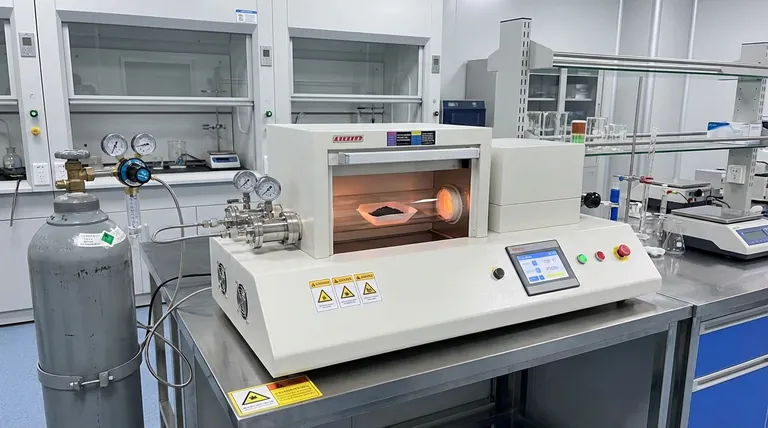
High-purity argon gas acts as a critical protective barrier during the calcination process, primarily serving to create an inert, oxygen-free environment. Its immediate purpose is to prevent the oxidation of Molybdenum Diselenide (MoSe2), a material that is highly susceptible to chemical degradation when exposed to oxygen at elevated temperatures. By maintaining this inert atmosphere, you ensure the chemical integrity of the TiO2/MoSe2 composite is preserved, protecting the specific adsorption capacity required for the sensor to detect gases like SO2.
The use of high-purity argon is the fundamental enabler of the calcination process. It resolves the conflict between the need for high-temperature structural repair and the material's inherent vulnerability to oxidation, ensuring the final sensor retains its sensitivity and effectiveness.
The Vulnerability of MoSe2
To understand the necessity of argon, one must first understand the chemical limitations of the materials involved.
High-Temperature Susceptibility
While MoSe2 offers excellent sensing properties, it becomes chemically unstable in the presence of oxygen during thermal processing. The calcination phase requires high heat, which significantly accelerates the rate of oxidation.
Preventing Material Degradation
If oxygen is present, the MoSe2 component will degrade, losing its semiconductor properties. High-purity argon acts as a blanket, physically displacing oxygen and preventing this chemical breakdown from occurring.
Preserving Adsorption Capacity
The ultimate goal of the material is to function as a heterojunction sensor for gases like SO2. Oxidation destroys the specific adsorption sites on the material surface, rendering the sensor ineffective; argon preserves these sites to ensure the sensor functions as designed.
The Role of High-Temperature Calcination
While argon protects the material, the high-temperature environment itself plays a distinct and vital role in defining the material's performance.
Structural Stabilization and Repair
The calcination furnace provides a 700 °C environment. This specific temperature is necessary to stabilize the structure of the MoSe2 and repair internal defects within the material lattice.
Enhancing Crystallinity
Exposure to this heat treatment significantly improves the crystallinity of the material. Higher crystallinity leads to fewer impediments for electron flow, directly improving the charge transfer efficiency across the material.
Forming the Heterojunction
Precise thermal control ensures the formation of tight n-n heterojunction contacts between the TiO2 and MoSe2 components. These tight contacts are the physical mechanism that increases the response speed and sensitivity of the resulting sensor.
Common Pitfalls to Avoid
The relationship between temperature and atmosphere is delicate; failing to balance them leads to compromised results.
The Risk of Impure Gas
Using standard-grade argon rather than high-purity argon can introduce trace amounts of oxygen. Even minimal oxygen exposure at 700 °C is sufficient to initiate partial oxidation and degrade sensor performance.
The Thermal Paradox
You cannot achieve high sensitivity without high heat (to improve crystallinity), but you cannot apply high heat without risking oxidation. Failing to maintain a strictly inert atmosphere renders the thermal treatment destructive rather than constructive.
Making the Right Choice for Your Goal
To maximize the efficacy of your TiO2/MoSe2 sensors, you must view the argon atmosphere and thermal profile as interdependent variables.
- If your primary focus is material longevity: Prioritize the purity of the argon gas flow to completely eliminate oxygen exposure, preserving the chemical composition of the MoSe2.
- If your primary focus is sensor response speed: Ensure the calcination temperature reaches and maintains 700 °C under the argon shield to maximize the formation of tight n-n heterojunctions.
Ultimately, high-purity argon provides the essential safety window that allows you to apply the high thermal energy needed to activate the material's full sensing potential.
Summary Table:
| Feature | Function in TiO2/MoSe2 Calcination |
|---|---|
| Argon Purity | Creates an inert atmosphere to prevent MoSe2 oxidation and chemical degradation. |
| 700°C Heat | Facilitates structural repair, improves crystallinity, and enhances charge transfer. |
| Heterojunction | Forms tight n-n contacts between TiO2 and MoSe2 for faster sensor response speed. |
| Oxygen Exclusion | Preserves specific adsorption sites essential for detecting gases like SO2. |
Elevate Your Materials Research with KINTEK
Achieving the perfect calcination environment requires absolute thermal precision and atmosphere control. At KINTEK, we understand that even trace oxygen can compromise your TiO2/MoSe2 sensors. Backed by expert R&D and world-class manufacturing, we provide high-performance Tube, Vacuum, and CVD systems tailored for sensitive materials research.
Whether you need customizable lab high-temperature furnaces or specialized gas-handling solutions, our equipment ensures your materials achieve peak crystallinity without the risk of oxidation.
Ready to optimize your thermal processing? Contact our experts today to find the perfect system for your unique laboratory needs!
References
- Lanjuan Zhou, Dongzhi Zhang. TiO2 Nanosphere/MoSe2 Nanosheet-Based Heterojunction Gas Sensor for High-Sensitivity Sulfur Dioxide Detection. DOI: 10.3390/nano15010025
This article is also based on technical information from Kintek Furnace Knowledge Base .
Related Products
- Molybdenum Disilicide MoSi2 Thermal Heating Elements for Electric Furnace
- Molybdenum Vacuum Heat Treat Furnace
- Vacuum Heat Treat Sintering Furnace Molybdenum Wire Vacuum Sintering Furnace
- Electric Rotary Kiln Pyrolysis Furnace Plant Machine Small Rotary Kiln Calciner
- 1700℃ Controlled Inert Nitrogen Atmosphere Furnace
People Also Ask
- What are the typical application temperatures for molybdenum disilicide (MoSi2) heating elements? Master High-Temp Performance
- What is the primary use of molybdenum disilicide? Ideal for High-Temp Heating Elements
- What are the characteristics of molybdenum disilicide heating elements? Unlock High-Temp Performance
- What are the properties of molybdenum disilicide (MoSi2) that make it suitable for high-temperature applications? Discover Its High-Temp Resilience
- What are the applications of molybdenum disilicide heating elements? Achieve Extreme Heat Stability for Industrial Processes