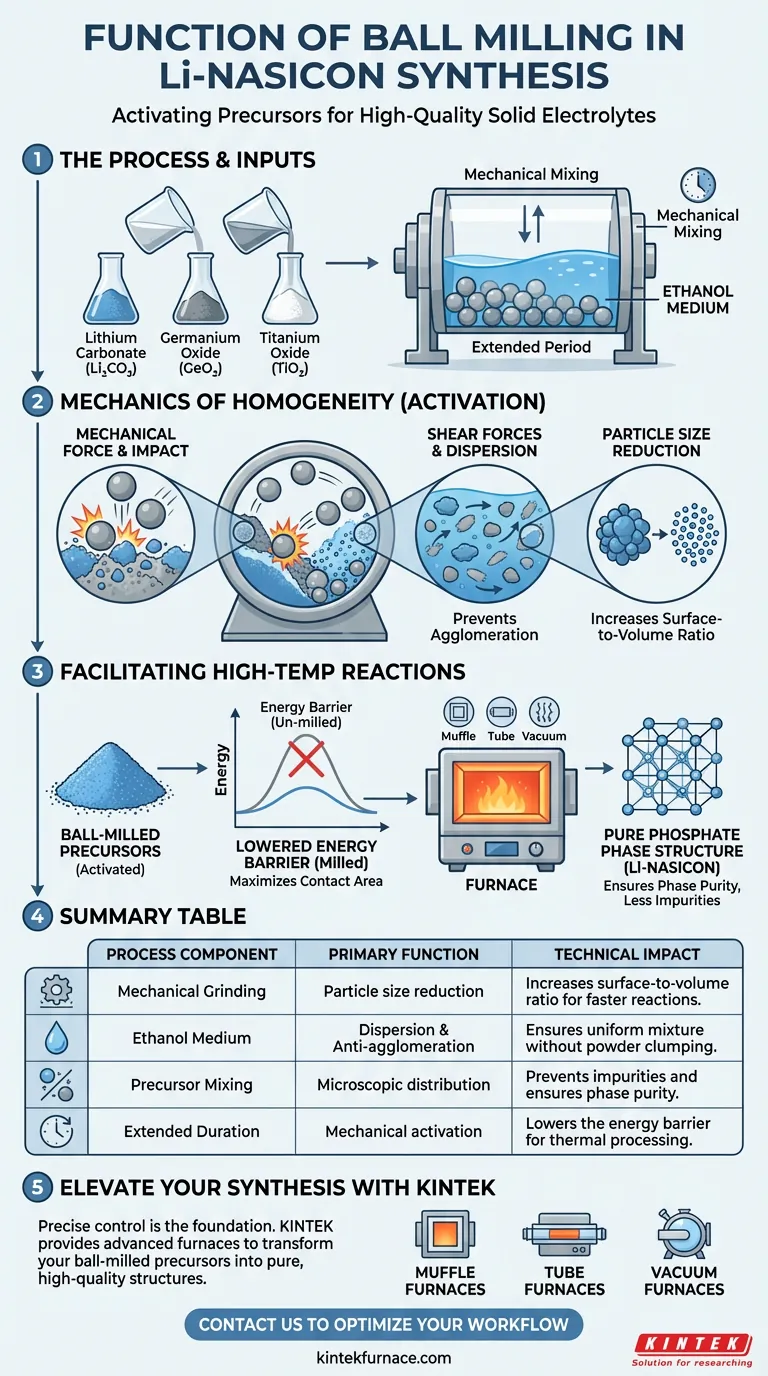
The primary function of the ball milling process in the synthesis of Li-NASICON solid electrolytes is to mechanically mix precursor powders—specifically lithium carbonate, germanium oxide, and titanium oxide—to achieve a uniform microscopic distribution. By conducting this grinding in an ethanol medium for an extended period, the process significantly reduces particle size and maximizes the contact area between chemical components.
Core Takeaway Ball milling is an activation step, not just a mixing method. By reducing particle size and increasing surface area, it lowers the energy barrier for subsequent reactions, ensuring the formation of a pure, high-quality phosphate phase structure during thermal treatment.
The Mechanics of Microscopic Homogeneity
Utilizing Mechanical Force
The process relies on the application of intense mechanical force to the precursor materials. As the milling media impacts the powders, it generates significant energy that physically breaks down the raw materials.
Shear and Impact Dynamics
While the primary goal is mixing, the mechanism involves high-energy impact and shear forces. This facilitates a "deep mixing" process that goes beyond simple blending, integrating the components at a microscopic level.
The Role of the Medium
The milling is performed in an ethanol medium rather than dry air. This liquid environment aids in dispersing the powders, preventing re-agglomeration, and ensuring the mixture remains uniform throughout the extended processing time.
Facilitating High-Temperature Reactions
Increasing Contact Area
The most critical physical change driven by ball milling is the reduction of particle size. Smaller particles possess a much higher surface-to-volume ratio, which dramatically increases the contact area between the lithium, germanium, and titanium precursors.
Lowering the Energy Barrier
High-temperature solid-state reactions require energy to initiate. By maximizing the contact area between reactants, ball milling lowers the activation energy barrier required for these chemical changes to occur.
Ensuring Phase Purity
The ultimate goal of this pre-treatment is to dictate the quality of the final product. A microscopically uniform mixture ensures that during the subsequent high-temperature reaction, a pure phosphate phase structure is formed, rather than a material ridden with impurities or incomplete reactions.
Critical Process Considerations
Requirement for Extended Processing
This is not a rapid procedure; it requires an "extended period" of milling to be effective. Short-cutting this step will result in insufficient mixing and larger particle sizes, compromising the final material.
Energy Intensity
The process utilizes high-speed rotation and mechanical impact to achieve the necessary shear forces. It is an energy-intensive prerequisite that must be maintained consistently to guarantee the reactants are sufficiently "activated" for the thermal treatment.
Optimizing the Synthesis Workflow
To ensure the highest quality Li-NASICON electrolyte, consider your specific processing goals:
- If your primary focus is Phase Purity: Ensure the milling duration is sufficient to achieve a truly microscopic uniform distribution, preventing the formation of secondary phases.
- If your primary focus is Reaction Efficiency: Prioritize the reduction of particle size to maximize contact area, which will facilitate easier and more complete reactions during the heating stage.
The success of your final solid electrolyte is directly proportional to the uniformity and particle size achieved during this initial milling stage.
Summary Table:
| Process Component | Primary Function | Technical Impact |
|---|---|---|
| Mechanical Grinding | Particle size reduction | Increases surface-to-volume ratio for faster reactions |
| Ethanol Medium | Dispersion & Anti-agglomeration | Ensures uniform mixture without powder clumping |
| Precursor Mixing | Microscopic distribution | Prevents impurities and ensures phase purity |
| Extended Duration | Mechanical activation | Lowers the energy barrier for thermal processing |
Elevate Your Materials Synthesis with KINTEK
Precise control over particle size and homogeneity is the foundation of high-performance Li-NASICON solid electrolytes. Backed by expert R&D and world-class manufacturing, KINTEK provides the advanced Muffle, Tube, and Vacuum furnaces required to transform your ball-milled precursors into pure, high-quality phosphate phase structures.
Whether you need customized systems for specialized lab research or high-temp production, our equipment is designed to meet your unique thermal processing needs. Contact us today to optimize your laboratory workflow!
Visual Guide
References
- Benjamin X. Lam, Gerbrand Ceder. Degradation Mechanism of Phosphate‐Based Li‐NASICON Conductors in Alkaline Environment. DOI: 10.1002/aenm.202403596
This article is also based on technical information from Kintek Furnace Knowledge Base .
Related Products
- Electric Rotary Kiln Continuous Working Small Rotary Furnace Kiln for Pyrolysis Plant Heating
- Electric Rotary Kiln Pyrolysis Furnace Plant Machine Small Rotary Kiln Calciner
- High Temperature Muffle Oven Furnace for Laboratory Debinding and Pre Sintering
- Electric Rotary Kiln Small Rotary Furnace Biomass Pyrolysis Plant Rotating Furnace
- Vacuum Sealed Continuous Working Rotary Tube Furnace Rotating Tube Furnace
People Also Ask
- What are the advantages of electric rotary kilns compared to fuel-fired ones? Boost Precision and Efficiency in Your Process
- What materials can be processed in an electric rotary kiln? Versatile Solutions for Advanced Materials
- What advantages do electric rotary kilns offer over fuel-based kilns? Boost Efficiency and Purity in Your Process
- What are the primary applications of electric rotary kilns? Precision Thermal Processing for High-Value Materials
- In what ways are electric rotary kilns more environmentally friendly? Achieve Zero On-Site Emissions