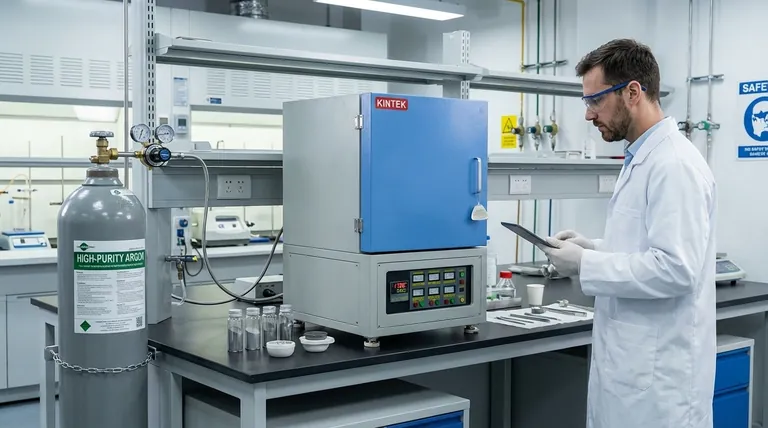
The primary purpose of using high-purity argon is to establish a chemically inert environment that isolates the alloy from atmospheric contamination. During the preparation of Fe60Co10-xNi15Cr15Six high-entropy alloy powders, this shielding medium effectively prevents the molten metal from coming into contact with oxygen and nitrogen in the air.
By eliminating the formation of oxide inclusions, high-purity argon ensures the alloy powder maintains superior purity and high surface activity. This is the foundational step required to achieve high-quality metallurgical bonding in subsequent laser cladding applications.
The Mechanism of Protection
Chemical Isolation
The core function of argon in this process is to serve as a chemically inert shield. It creates a physical barrier around the melt.
Because argon does not react with the metallic elements, it completely isolates the active ingredients in the Fe60Co10-xNi15Cr15Six alloy.
Preventing Atmospheric Contamination
Without this shield, the active metallic elements within the high-entropy alloy would react immediately with the surrounding air.
Argon specifically targets the exclusion of oxygen and nitrogen, which are the primary sources of contamination during the heating phases.
Impact on Powder Quality
Eliminating Oxide Inclusions
The direct result of excluding oxygen is the prevention of oxide inclusions.
These inclusions are impurities that can degrade the mechanical properties of the final material. By using high-purity argon, the resulting powders remain free of these defects.
Preserving Surface Activity
Beyond simple purity, the inert atmosphere preserves the surface activity of the powder particles.
High surface activity is a critical characteristic that dictates how well the powder will behave during future processing steps.
Downstream Benefits for Laser Cladding
Enhancing Metallurgical Bonding
The ultimate goal of using argon shielding extends beyond the powder production phase to the final application.
Clean, oxide-free powder allows for superior metallurgical bonding.
Improving the Cladding Layer
When the powder is used in laser cladding, the high purity ensures a stronger, more cohesive layer.
This results in a cladding layer with fewer defects and better structural integrity.
Critical Considerations
The Necessity of High Purity
It is not enough to simply use argon; the reference specifically highlights high-purity argon.
Using industrial-grade argon with trace impurities could reintroduce the very oxygen or nitrogen you are trying to exclude, negating the benefits of the shielding process.
Process Continuity
The shielding must be maintained throughout two distinct phases: melting and atomization.
A lapse in shielding during either phase can lead to immediate oxidation, compromising the entire batch of Fe60Co10-xNi15Cr15Six powder.
Making the Right Choice for Your Goal
To ensure the best results when working with Fe60Co10-xNi15Cr15Six high-entropy alloys, consider the following regarding your atmosphere control:
- If your primary focus is powder purity: Ensure your argon source is certified high-purity to strictly prevent the formation of oxide inclusions.
- If your primary focus is laser cladding performance: Prioritize the preservation of surface activity during atomization, as this directly correlates to the quality of the final metallurgical bond.
The quality of your final coating is strictly limited by the purity of the atmosphere used to create the source powder.
Summary Table:
| Protection Mechanism | Impact on Powder Quality | Benefit for Laser Cladding |
|---|---|---|
| Chemical Isolation | Eliminates oxide inclusions | Enhances metallurgical bonding |
| Atmospheric Shielding | Maintains high surface activity | Improves cladding layer integrity |
| Inert Environment | Ensures superior alloy purity | Reduces structural defects |
Elevate Your Materials Research with KINTEK Precision Solutions
High-quality Fe60Co10-xNi15Cr15Six alloy production demands strict atmospheric control. KINTEK provides the specialized equipment necessary to achieve these rigorous standards. Backed by expert R&D and manufacturing, we offer high-performance Muffle, Tube, Rotary, Vacuum, and CVD systems, along with other lab high-temperature furnaces—all fully customizable to meet your unique metallurgical needs.
Don't let atmospheric contamination compromise your research. Contact KINTEK today to discover how our advanced furnace technology can enhance your alloy purity and cladding performance!
References
- Wenqiang Li, Fushan Li. Effect of Si Addition on Structure and Corrosion Resistance of FeCoNiCr High-Entropy Alloy Coating. DOI: 10.3390/ma18010072
This article is also based on technical information from Kintek Furnace Knowledge Base .
Related Products
- Spark Plasma Sintering SPS Furnace
- Controlled Inert Nitrogen Hydrogen Atmosphere Furnace
- 1400℃ High Temperature Laboratory Tube Furnace with Alumina Tube
- Silicon Carbide SiC Thermal Heating Elements for Electric Furnace
- 1200℃ Controlled Inert Nitrogen Atmosphere Furnace
People Also Ask
- Why is it necessary to maintain a high vacuum environment during the SPS of SiC? Key to High-Density Ceramics
- How does the heating mechanism of Spark Plasma Sintering (SPS) function? Enhance TiC/SiC Composite Fabrication
- What are the technical advantages of using an SPS sintering furnace? Elevate Al2O3-TiC Material Performance
- What are the steps in the discharge plasma sintering process? Master Fast, High-Density Material Consolidation
- What are the advantages of spark plasma sintering (SPS) over traditional forging? Precision Microstructural Control