
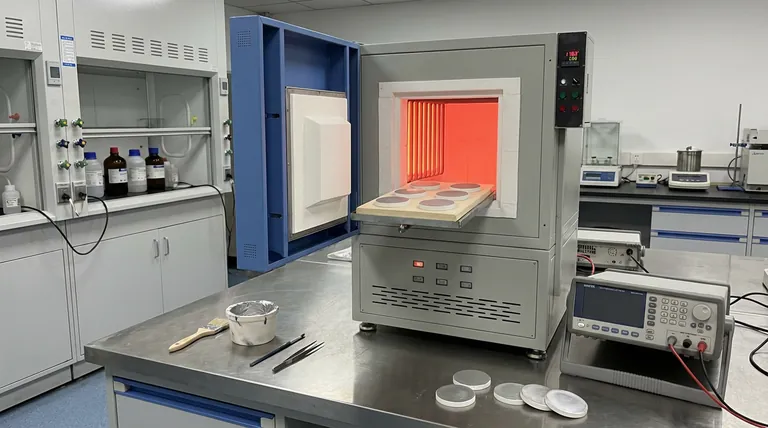
The high-temperature silver-firing process is critical for transforming a raw ceramic disc into a measurable electronic component. By baking conductive silver paste onto the surface, you create robust electrode layers with excellent ohmic contact. This metallization is a mandatory prerequisite for using an LCR bridge, ensuring that electrical test signals penetrate the ceramic medium uniformly to yield accurate dielectric data.
The firing process converts the ceramic sample into a functional parallel-plate capacitor. This step eliminates contact resistance errors, allowing the measuring instrument to distinguish the material's intrinsic properties—capacitance and dielectric loss—from surface artifacts.
The Physics of the Measurement Interface
To characterize $\text{Ba}_{1-x}\text{Ca}_x\text{TiO}_3$ ceramics, you must bridge the gap between the material and the measuring instrumentation.
Creating a Parallel Plate Capacitor
To measure dielectric properties, the ceramic sample must physically act as a capacitor.
The silver layers fired onto both sides of the disc function as the parallel plates of this capacitor.
Without these defined plates, the LCR meter cannot apply a consistent electric field across the dielectric material.
Ensuring Uniform Signal Propagation
The primary reference highlights the need for test signals to pass uniformly through the ceramic medium.
A fired silver electrode ensures the electrical potential is distributed evenly across the entire surface area of the sample.
This uniformity prevents "hot spots" or dead zones in the electric field, which would otherwise distort the capacitance reading.
The Role of Ohmic Contact
Simply touching probes to a ceramic surface creates an unstable, high-resistance connection.
Eliminating Contact Barriers
The firing process bonds the silver to the ceramic, creating a connection with good ohmic contact.
This means the junction between the metal and the ceramic follows Ohm's law, providing a linear and low-resistance path for the current.
Precision in LCR Measurements
High-precision LCR bridges are sensitive instruments designed to detect minute changes in electrical response.
If the contact is poor, the instrument measures the resistance of the contact point rather than the dielectric loss of the ceramic.
Solid ohmic contact ensures that the data reflects the true behavior of the $\text{Ba}_{1-x}\text{Ca}_x\text{TiO}_3$ material, not the limitations of the setup.
Understanding the Trade-offs
While silver firing is the standard for high-accuracy measurements, it introduces specific methodological constraints that must be managed.
Temperature Constraints
The firing process requires high temperatures to properly sinter the silver paste.
You must ensure that the firing temperature is high enough to bond the silver but not so high that it alters the microstructure of the underlying $\text{Ba}_{1-x}\text{Ca}_x\text{TiO}_3$ sample.
Irreversibility of the Process
Once the silver is fired onto the ceramic, it is effectively a permanent modification for the sake of measurement.
This makes the sample excellent for electrical testing but potentially unsuitable for other types of surface analysis (like SEM) without polishing the electrodes off later.
Making the Right Choice for Your Goal
The silver-firing process is not merely a preparation step; it is the mechanism that validates your data.
- If your primary focus is High-Precision Data: Ensure the firing profile creates a continuous, defect-free silver layer to maximize the accuracy of the LCR bridge.
- If your primary focus is Temperature-Dependent Studies: Rely on the fired electrodes to maintain stable contact as the sample expands or contracts during heating cycles.
By securing good ohmic contact through silver firing, you ensure that every fluctuation in your data represents a real physical change in the ceramic, not an error in your contact method.
Summary Table:
| Feature | Purpose in Dielectric Measurement | Impact on Data Quality |
|---|---|---|
| Silver Electrode Layer | Creates a parallel-plate capacitor structure | Enables uniform electric field distribution |
| High-Temp Firing | Bonds silver paste to the ceramic surface | Ensures stable, permanent metallization |
| Ohmic Contact | Eliminates high-resistance contact barriers | Prevents contact resistance from distorting loss data |
| Signal Uniformity | Allows test signals to penetrate the medium | Yields intrinsic material properties vs. surface artifacts |
Elevate Your Material Research with KINTEK
Precision in dielectric characterization starts with the right equipment. Backed by expert R&D and manufacturing, KINTEK offers a comprehensive range of Muffle, Tube, Rotary, Vacuum, and CVD systems, all fully customizable for your specific high-temperature silver-firing and ceramic sintering needs.
Whether you are developing Ba1-xCaxTiO3 ceramics or advanced electronic components, our high-temp furnaces provide the thermal stability required for perfect ohmic contact and reliable data. Contact us today to find your custom lab solution!
References
- Kamil Feliksik, M. Adamczyk. Dielectric, Electric, and Pyroelectric Properties of Ba1−xCaxTiO3 Ceramics. DOI: 10.3390/ma17246040
This article is also based on technical information from Kintek Furnace Knowledge Base .
Related Products
- 1400℃ High Temperature Laboratory Tube Furnace with Alumina Tube
- 1700℃ High Temperature Laboratory Tube Furnace with Alumina Tube
- High Temperature Muffle Oven Furnace for Laboratory Debinding and Pre Sintering
- 1200℃ Muffle Oven Furnace for Laboratory
- Laboratory Muffle Oven Furnace with Bottom Lifting
People Also Ask
- How does zone-melting in tube furnaces synthesize bismuth micro-wires? Master Single-Crystal Thermoelectric Growth
- How do high-temperature laboratory tube furnaces ensure environmental stability? Precision Thermal Reduction Tips
- How are high-temp tube furnaces used to measure diffusion coefficients per Fick's law? Master Precision Annealing
- How are high-temperature laboratory tube furnaces applied in long-term vacuum homogenization heat treatments for intermetallic samples?
- How are high-temperature tube furnaces applied in testing ceramic-supported alloy membranes? Insights


















