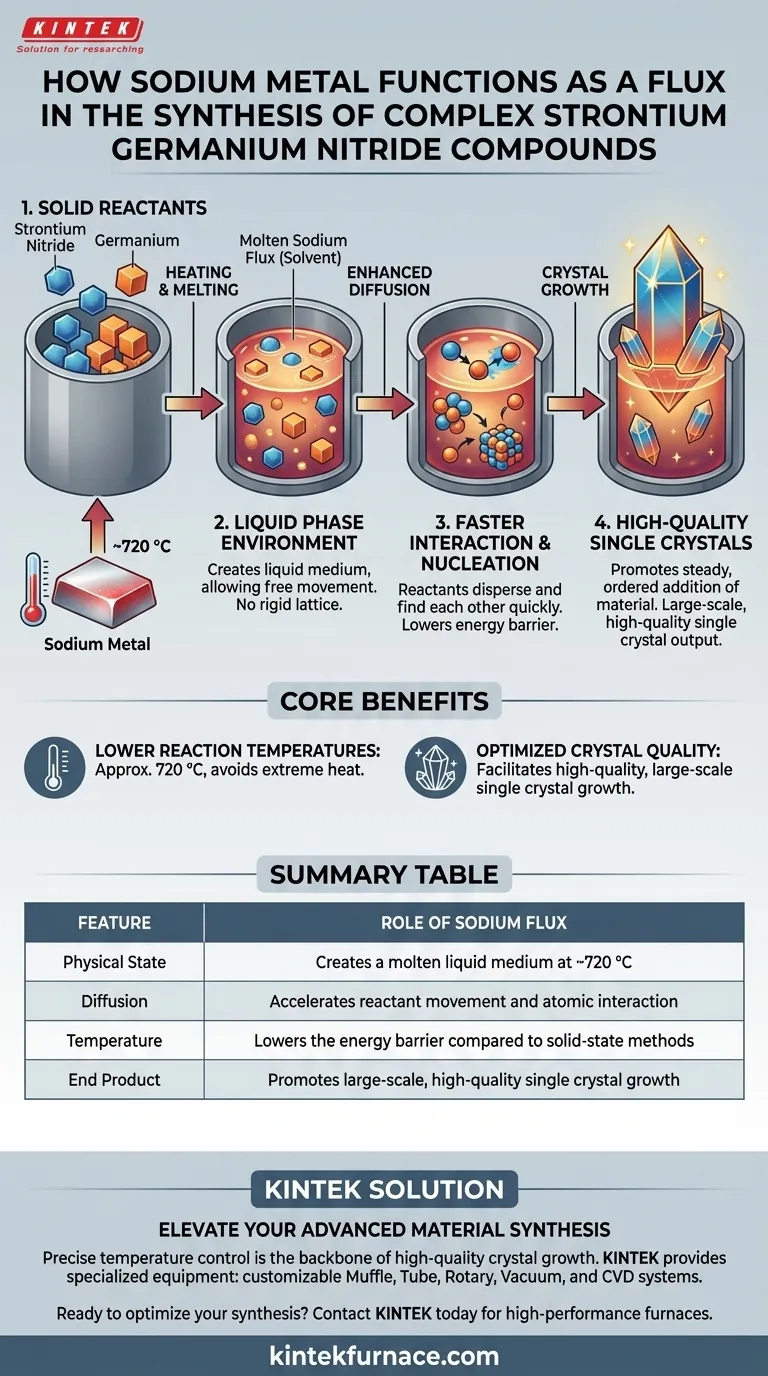
Sodium metal functions as a facilitator for liquid-phase synthesis. It acts as a solvent that melts to create a liquid environment, allowing solid reactants like strontium nitride and germanium to dissolve and interact more freely. This process significantly lowers the energy barrier required for the reaction, enabling the formation of complex compounds at approximately 720 °C.
Core Takeaway: By introducing a liquid phase, sodium flux enhances reactant diffusion and lowers the processing temperature, directly enabling the nucleation and growth of high-quality, large-scale single crystals.
The Mechanics of Sodium Flux
Creating a Liquid Phase Environment
In solid-state chemistry, reacting two solids is often difficult because atoms move slowly. Sodium metal solves this by acting as a liquid-phase flux.
When heated, the sodium melts and surrounds the solid reactants. This creates a medium where the components are no longer locked in a rigid lattice but are free to move.
Enhancing Reactivity and Diffusion
The primary benefit of this liquid environment is the drastic improvement in diffusion rates.
Reactants such as strontium nitride and germanium can disperse through the molten sodium. This increased mobility allows the distinct elements to find one another and react much faster than they would in a traditional solid-state mixture.
Crystal Growth and Thermal Benefits
Lowering Reaction Temperatures
Traditional synthesis often requires extreme heat. The sodium flux method allows synthesis to occur at a relatively low reaction temperature of approximately 720 °C.
Because the flux facilitates mixing at the atomic level, the system does not require excessive thermal energy to force the reactants together.
Facilitating Nucleation
The sodium flux provides an ideal environment for nucleation, the initial step in crystal formation.
Once the reaction begins, the flux supports the steady, ordered addition of material to the growing crystal structure. This results in the production of high-quality, large-scale single crystals rather than disordered powders.
Understanding Process Requirements
Specific Temperature Control
While the temperature is "low" relative to other methods, the process relies heavily on maintaining the specific environment around 720 °C.
Success depends on achieving and sustaining this temperature to ensure the flux remains effective and the diffusion rates are optimized for the specific reactants involved.
Making the Right Choice for Your Synthesis
If you are evaluating synthesis methods for strontium germanium nitride compounds, consider your specific end-goal requirements.
- If your primary focus is Crystal Quality: The sodium flux method is ideal as it facilitates the growth of high-quality, large-scale single crystals through controlled nucleation.
- If your primary focus is Thermal Budget: This method is superior because it enables reactivity at a relatively low temperature (approx. 720 °C), avoiding the need for extreme heat.
The sodium flux method effectively bridges the gap between solid reactants and high-quality crystal output by leveraging liquid-phase dynamics.
Summary Table:
| Feature | Role of Sodium Flux |
|---|---|
| Physical State | Creates a molten liquid medium at ~720 °C |
| Diffusion | Accelerates reactant movement and atomic interaction |
| Temperature | Lowers the energy barrier compared to solid-state methods |
| End Product | Promotes large-scale, high-quality single crystal growth |
Elevate Your Advanced Material Synthesis with KINTEK
Precise temperature control is the backbone of high-quality crystal growth. Whether you are utilizing sodium flux methods or traditional solid-state reactions, KINTEK provides the specialized equipment needed to succeed. Backed by expert R&D and manufacturing, we offer customizable Muffle, Tube, Rotary, Vacuum, and CVD systems designed to meet the rigorous demands of lab high-temp research.
Ready to optimize your synthesis process? Contact KINTEK today to discover how our high-performance furnaces can bring precision and efficiency to your unique research needs.
Visual Guide
References
- Lukas Link, Rainer Niewa. Nitridogermanates(IV): The Germanide Oxide Sr<sub>15</sub>Ge[GeN<sub>4</sub>]<sub>3</sub>O, the Carbodiimide Ba<sub>5</sub>[GeN<sub>4</sub>][CN<sub>2</sub>], and the Oxidonitridogermanate Sr<sub>6</sub>[Ge<sub>2</sub>N<sub>6</sub>O]. DOI: 10.1002/zaac.202500068
This article is also based on technical information from Kintek Furnace Knowledge Base .
Related Products
- 1200℃ Controlled Inert Nitrogen Atmosphere Furnace
- Small Vacuum Heat Treat and Tungsten Wire Sintering Furnace
- Multi Heating Zones CVD Tube Furnace Machine for Chemical Vapor Deposition Equipment
- Vertical Laboratory Quartz Tube Furnace Tubular Furnace
- Slide PECVD Tube Furnace with Liquid Gasifier PECVD Machine
People Also Ask
- What controlled-atmosphere furnace conditions are required for sintering powder metallurgy copper alloy compacts? Ideal Setup
- What factors should be considered when choosing a controlled atmosphere furnace? Ensure Optimal Performance for Your Materials
- Why is uniform atmosphere flow important in a controlled atmosphere furnace? Ensure Consistent Results and Avoid Costly Failures
- How does a vacuum or controlled atmosphere furnace facilitate sessile-drop experiments? Optimize Alloy Wetting Analysis
- What Roles Do a Controlled Atmosphere Furnace and Oil Quenching Tank Play in AISI 5140 Steel Heat Treatment?