
The primary function of compacting Polyvinyl Chloride (PVC) and metal oxide mixtures is to maximize the physical contact between solid reactants to improve chemical efficiency. By pressing PVC, iron oxide, and silica into cylindrical pellets, you increase the tightness of the particle arrangement, which is essential for promoting interface reactions and ensuring chlorine is fixed within the solid product rather than escaping as gas.
Compaction is not merely about shaping; it is a mechanism for densification. By forcing solid reactants closer together, you facilitate immediate interface reactions that significantly enhance the efficiency of chlorine fixation during high-temperature processing.
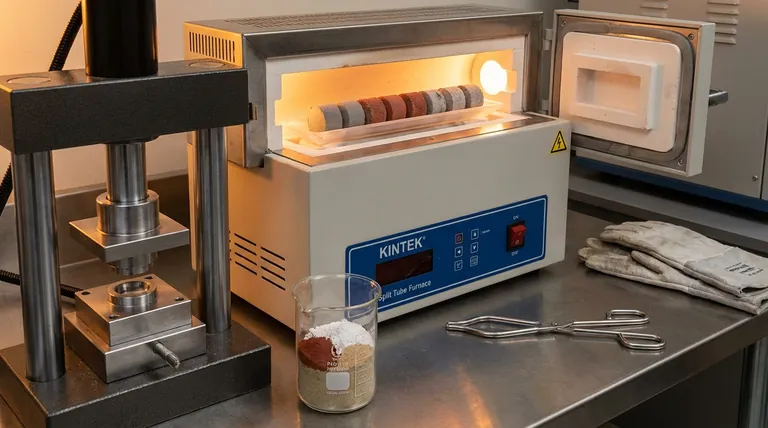
The Mechanics of Solid-State Reactions
Enhancing Particle Contact
In loose powder mixtures, gaps between particles can hinder chemical interactions. Compacting the mixture into cylindrical pellets eliminates these voids.
This process forces the PVC, iron oxide, and silica into a tight, cohesive structure. The increased tightness of solid particles ensures that the reactants are physically touching, which is a prerequisite for efficient solid-state chemistry.
Driving Interface Reactions
Chemical reactions in solids occur at the interfaces where particles meet. When you use precision molds to compact the material, you increase the surface area of these active interfaces.
This physical proximity lowers the barrier for interaction. It promotes interface reactions that might otherwise be slow or incomplete in a non-compacted mixture.
The Impact on Dechlorination Efficiency
Maximizing Chlorine Fixation
The ultimate goal of this process is to handle chlorine effectively. The reaction relies on the interaction between the decomposing PVC and the metal oxides.
By improving the contact conditions, compaction improves the fixation efficiency of chlorine. This means more chlorine is trapped within the solid products (residue) rather than being released into the atmosphere, leading to a cleaner and more effective dechlorination process.
Understanding the Trade-offs
Process Complexity vs. Chemical Efficiency
While compaction drastically improves reaction efficiency, it introduces a mechanical requirement to the workflow. You cannot simply heat a loose mixture; you must first process it through precision molds.
This adds a step to the manufacturing line, requiring equipment capable of applying sufficient pressure to form stable cylindrical pellets. However, skipping this step results in poor particle contact and reduced chlorine retention, making the added mechanical complexity a necessary trade-off for high-performance dechlorination.
Making the Right Choice for Your Goal
To optimize your dechlorination process, consider how compaction aligns with your specific objectives.
- If your primary focus is Maximum Chlorine Retention: Prioritize high-pressure compaction to ensure the tightest possible particle contact and highest fixation efficiency.
- If your primary focus is Process Simplicity: Recognize that while skipping compaction removes a mechanical step, it will significantly degrade the interface reactions and allow more chlorine to escape.
Effective dechlorination relies on the principle that tighter particle contact leads to superior chemical fixation.
Summary Table:
| Feature | Impact of Compaction (Cylindrical Pellets) | Resulting Benefit |
|---|---|---|
| Particle Contact | Eliminates voids and air gaps between solid reactants | Maximized chemical interaction efficiency |
| Interface Reaction | Increases surface area where particles meet | Lowered interaction barriers and faster reaction |
| Chlorine Fixation | Ensures chlorine is trapped within solid residue | Prevention of harmful gas release and cleaner processing |
| Material Density | Higher tightness of solid particle arrangement | Uniform heat transfer and consistent output |
Optimize Your Dechlorination Efficiency with KINTEK
High-performance solid-state reactions require more than just the right mixture—they require precision thermal processing. KINTEK provides industry-leading Muffle, Tube, Rotary, Vacuum, and CVD systems, all designed to support the rigorous demands of dechlorination and high-temperature material science.
Backed by expert R&D and world-class manufacturing, our lab furnaces offer the temperature uniformity and control necessary to maximize chlorine fixation in compacted materials. Whether you are scaling up cylindrical pellet processing or refining unique mixtures, we offer fully customizable solutions tailored to your laboratory's unique needs.
Ready to enhance your lab’s productivity and chemical efficiency? Contact KINTEK Today to Consult with Our Experts
References
- Lan Hong, Lin-hai Ye. De-chlorination of poly(vinyl) chloride using Fe <sub>2</sub> O <sub>3</sub> and the improvement of chlorine fixing ratio in FeCl <sub>2</sub> by SiO <sub>2</sub> addition. DOI: 10.1515/htmp-2022-0299
This article is also based on technical information from Kintek Furnace Knowledge Base .
Related Products
- 2200 ℃ Graphite Vacuum Heat Treat Furnace
- High Temperature Muffle Oven Furnace for Laboratory Debinding and Pre Sintering
- 2200 ℃ Tungsten Vacuum Heat Treat and Sintering Furnace
- 1200℃ Muffle Oven Furnace for Laboratory
- 1400℃ High Temperature Laboratory Tube Furnace with Alumina Tube
People Also Ask
- Why are vacuum heat treating furnaces essential for aerospace? Ensure Superior Material Integrity for High-Stakes Applications
- What is the primary application of vacuum heat treating furnaces in aerospace? Enhance Component Performance with Precision
- What is the process of vacuum heat treating? Achieve Superior Metallurgical Properties
- How does a vacuum heat treating furnace improve the condition of metal alloys? Achieve Superior Metal Performance
- How does vacuum heat treating work in terms of temperature and time control? Master Precise Material Transformations



















