
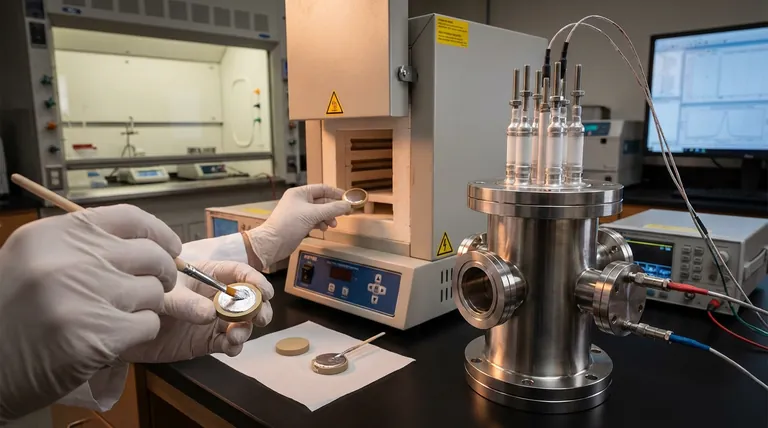
The application of high-purity silver paste followed by heat treatment is the critical step that transforms a BCZT ceramic from a raw material into a testable electronic component. This process establishes a conductive interface on the insulating ceramic, enabling the creation of specific electrode layers required for reliable electrical measurements.
The primary purpose of this process is to establish a high-quality ohmic contact on the ceramic surface. This ensures uniform electric field distribution and minimizes interface resistance, allowing for the accurate isolation of the material's intrinsic dielectric properties.
The Physics of the Electrode Interface
Establishing Ohmic Contact
The core objective of the silver paste coating is to create a good ohmic contact between the ceramic and the testing equipment.
Without this specialized layer, the interface between the metal probe and the ceramic would act as a barrier, introducing non-linear behaviors that distort measurement data.
The Role of Heat Treatment
Applying the paste is not enough; the subsequent heat treatment in a specialized electrode firing furnace is mandatory.
This firing process burns off the organic binders within the paste and sinters the silver particles. This bonds the metal physically and electrically to the BCZT surface, creating a robust, continuous conductive layer.
Ensuring Measurement Accuracy
Uniform Electric Field Distribution
For dielectric testing, the electric field must be applied evenly across the entire sample thickness.
The fired silver electrode ensures that when voltage is applied, the electric field is uniformly distributed across the geometry of the sample. This uniformity is a prerequisite for calculating accurate capacitance values.
Minimizing Contact Resistance
Any resistance found at the connection point acts as a parasitic error in your data.
By firing the silver to create a solid bond, you minimize contact resistance. This is particularly critical when measuring dielectric loss, as high contact resistance will artificially inflate loss values, masking the true performance of the BCZT material.
Understanding the Trade-offs
Thermal History Sensitivity
While heat treatment is necessary for the electrode, it subjects the ceramic to an additional thermal cycle.
You must ensure the firing temperature is high enough to sinter the silver but low enough to avoid altering the microstructure or oxygen vacancy concentration of the underlying BCZT. As noted in material synthesis principles, exposure to air at high temperatures can alter oxidation states, potentially hardening the material or reducing polarization intensity.
Electrode Quality vs. Diffusion
There is a delicate balance in the duration and temperature of the firing process.
Insufficient firing leads to poor adhesion and unstable signals. However, excessive heat can cause silver migration into the porous ceramic surface, which effectively reduces the insulating thickness and can lead to short circuits or inaccurate dielectric constant calculations.
Making the Right Choice for Your Goal
To ensure your electrical performance testing yields valid data, tailor your electrode preparation to your specific objectives:
- If your primary focus is Dielectric Loss precision: Prioritize a firing profile that ensures maximum density of the silver layer to reduce series resistance to absolute minimums.
- If your primary focus is Material Phase Stability: Select the lowest effective firing temperature for the silver paste to minimize the risk of re-oxidizing the sample or altering the oxygen vacancy concentration established during sintering.
Ultimately, the silver paste process is not merely a preparation step, but a definer of the measurement system's integrity.
Summary Table:
| Process Step | Primary Function | Impact on Measurement |
|---|---|---|
| Silver Paste Coating | Creates conductive interface | Establishes electrode geometry |
| Sintering/Firing | Removes binders & bonds silver | Minimizes contact resistance & parasites |
| Heat Treatment | Ensures ohmic contact | Uniform electric field distribution |
| Process Control | Balances adhesion vs. diffusion | Protects BCZT microstructure & phase stability |
Elevate Your Ceramic Testing Accuracy with KINTEK
Precise electrode firing is the difference between accurate data and parasitic error. KINTEK provides high-performance muffle and tube furnaces specifically engineered for the delicate thermal cycles required by BCZT and other advanced piezoelectrics.
Backed by expert R&D and manufacturing, KINTEK offers Muffle, Tube, Rotary, Vacuum, and CVD systems, all customizable to your unique research needs. Ensure your material phase stability and minimize silver migration with our superior temperature uniformity.
Ready to optimize your lab's thermal processing? Contact our specialists today to find the perfect furnace for your electrical performance testing.
Visual Guide

References
- Baoyun Wang, Yongjun Tian. High-temperature structural disorders stabilize hydrous aluminosilicates in the mantle transition zone. DOI: 10.1038/s41467-025-56312-z
This article is also based on technical information from Kintek Furnace Knowledge Base .
Related Products
- 1400℃ High Temperature Laboratory Tube Furnace with Alumina Tube
- 1800℃ High Temperature Muffle Oven Furnace for Laboratory
- 1700℃ High Temperature Laboratory Tube Furnace with Alumina Tube
- 1700℃ High Temperature Muffle Oven Furnace for Laboratory
- 1200℃ Muffle Oven Furnace for Laboratory
People Also Ask
- How does zone-melting in tube furnaces synthesize bismuth micro-wires? Master Single-Crystal Thermoelectric Growth
- How are high-temp tube furnaces used to measure diffusion coefficients per Fick's law? Master Precision Annealing
- How are high-temperature laboratory tube furnaces applied in long-term vacuum homogenization heat treatments for intermetallic samples?
- How do high-temperature laboratory tube furnaces ensure environmental stability? Precision Thermal Reduction Tips
- How are high-temperature tube furnaces applied in testing ceramic-supported alloy membranes? Insights



















