
At their core, laboratory furnaces are precision instruments for controlled thermal processing. Their functions range from simple moisture removal to complex material transformations, including drying, curing, annealing, sintering, and calcination. These processes are fundamental to materials science, chemistry, and engineering for altering a sample's physical or chemical properties in a predictable way.
The primary function of a laboratory furnace is not merely to generate heat, but to create a highly stable and uniform environment. This control allows you to precisely modify a material's internal structure, composition, or state to achieve a specific, desired outcome.
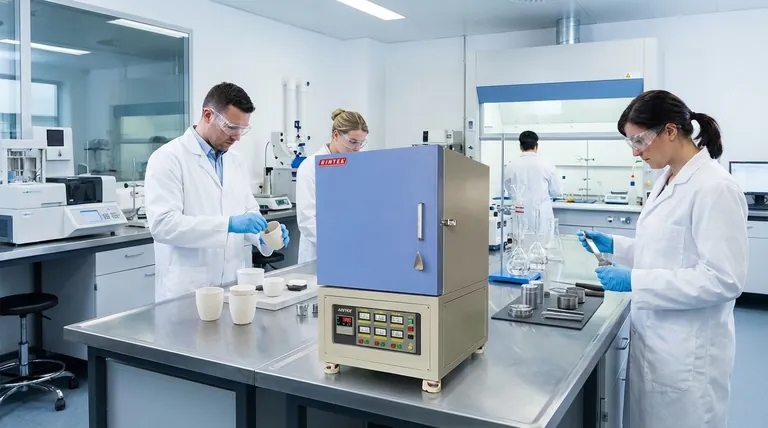
Foundational Thermal Processes
These functions represent the most common applications of a laboratory furnace, often serving as preparatory or finishing steps in a larger workflow.
Drying: Removing Moisture
Drying is the process of removing moisture or other volatile liquids from a sample at relatively low temperatures. The goal is to prepare a sample for further analysis or processing without fundamentally changing its chemical structure.
Baking: Simple Heat Treatment
Baking involves heating a sample to a specific temperature for a set duration, but without the primary goal of dehumidification. This can be used for initiating simple chemical reactions, testing thermal stability, or outgassing components.
Curing: Inducing a Chemical Change
Curing uses heat to trigger a chemical reaction, such as polymerization. This process hardens materials like epoxies, polymers, and other composites, transforming them from a liquid or pliable state into a solid, stable form with enhanced mechanical properties.
Advanced Material Transformation
For disciplines like metallurgy and ceramics, furnaces enable sophisticated processes that fundamentally change a material's crystalline structure and performance characteristics.
Annealing: Relieving Internal Stresses
Annealing involves heating a material (typically metal or glass) to a high temperature, holding it there, and then cooling it slowly. This process relieves internal stresses, increases ductility, reduces hardness, and refines the material's grain structure, making it less brittle and easier to work with.
Sintering: Fusing Powdered Materials
Sintering is the process of compacting and forming a solid mass of material from powder using heat and pressure—without melting it to the point of liquefaction. It is crucial for manufacturing ceramics, metallic components, and cermets where individual particles are fused together to create a dense, solid object.
Calcination: Thermal Decomposition
Calcination is a high-temperature process that heats a material to induce thermal decomposition. It is often used to remove volatile substances, drive off water of crystallization, or create a phase transition in the material. A common example is the production of cement clinker from limestone.
Understanding the Trade-offs and Critical Controls
The success of any furnace process depends less on the maximum temperature and more on the precision of its control systems.
Atmosphere Control: The Role of a Vacuum
Many materials, especially metals, will rapidly oxidize at high temperatures when exposed to air. Vacuum furnaces perform these processes in an oxygen-free environment. This prevents unwanted chemical reactions and contamination, which is critical for developing high-purity materials for industries like aerospace and electronics.
Temperature Uniformity: The Key to Consistency
A sample that is heated unevenly will have inconsistent properties. High-quality laboratory furnaces are engineered to provide exceptional temperature uniformity across the entire chamber, ensuring that every part of the sample undergoes the exact same thermal process.
Ramp and Soak: Controlling the Rate of Change
The speed at which a furnace heats up (ramp rate) and the duration it holds a temperature (soak time) are just as important as the target temperature itself. Precise control over these variables is essential for processes like annealing, where slow cooling is required to achieve the desired material properties.
Selecting the Right Process for Your Goal
Your choice of function depends entirely on the desired change in your material.
- If your primary focus is sample preparation: You likely need drying to remove moisture and solvents without altering the underlying material.
- If your primary focus is creating a solid object from powder: You need sintering, which requires precise temperature control just below the material's melting point.
- If your primary focus is enhancing a metal's workability: Annealing is the correct process to increase ductility and reduce hardness.
- If your primary focus is working with reactive materials: A vacuum or inert gas furnace is non-negotiable to prevent oxidation and ensure material purity.
Understanding these core functions transforms the furnace from a simple heat source into a powerful and precise tool for material innovation.
Summary Table:
| Function | Key Purpose | Common Applications |
|---|---|---|
| Drying | Remove moisture without chemical change | Sample preparation, analysis |
| Baking | Heat treatment for reactions or stability | Chemical testing, outgassing |
| Curing | Induce hardening via chemical reactions | Polymerization, composite forming |
| Annealing | Relieve stress, increase ductility | Metal and glass processing |
| Sintering | Fuse powders into solid objects | Ceramics, metal components |
| Calcination | Thermal decomposition for phase changes | Cement production, material purification |
Ready to elevate your lab's capabilities with precision thermal processing? KINTEK specializes in advanced high-temperature furnace solutions, including Muffle, Tube, Rotary, Vacuum & Atmosphere Furnaces, and CVD/PECVD Systems. Leveraging our exceptional R&D and in-house manufacturing, we offer deep customization to meet your unique experimental needs—ensuring superior temperature control, uniformity, and reliability for processes like sintering, annealing, and more. Contact us today to discuss how our tailored solutions can drive your material innovations forward!
Visual Guide

Related Products
- Laboratory Muffle Oven Furnace with Bottom Lifting
- Laboratory Vacuum Tilt Rotary Tube Furnace Rotating Tube Furnace
- Laboratory Quartz Tube Furnace RTP Heating Tubular Furnace
- 1200℃ Muffle Oven Furnace for Laboratory
- 1700℃ High Temperature Laboratory Tube Furnace with Alumina Tube
People Also Ask
- Why is a high-temperature laboratory muffle furnace essential for the alkali fusion process in zeolite synthesis?
- What is the importance of the calcination process? Master High-Purity Calcium Phosphate Nanopowder Production
- Why is a high-temperature muffle furnace required for FeOx-MOx/TiO2? Engineering High-Performance Nanocomposites
- What function does a muffle furnace perform in Ba0.75Ca0.25TiO3 calcination? Ensure Phase Purity & Synthesis
- What are the primary functions of a high-temperature laboratory muffle furnace in the preparation of biosorbent materials?



















