
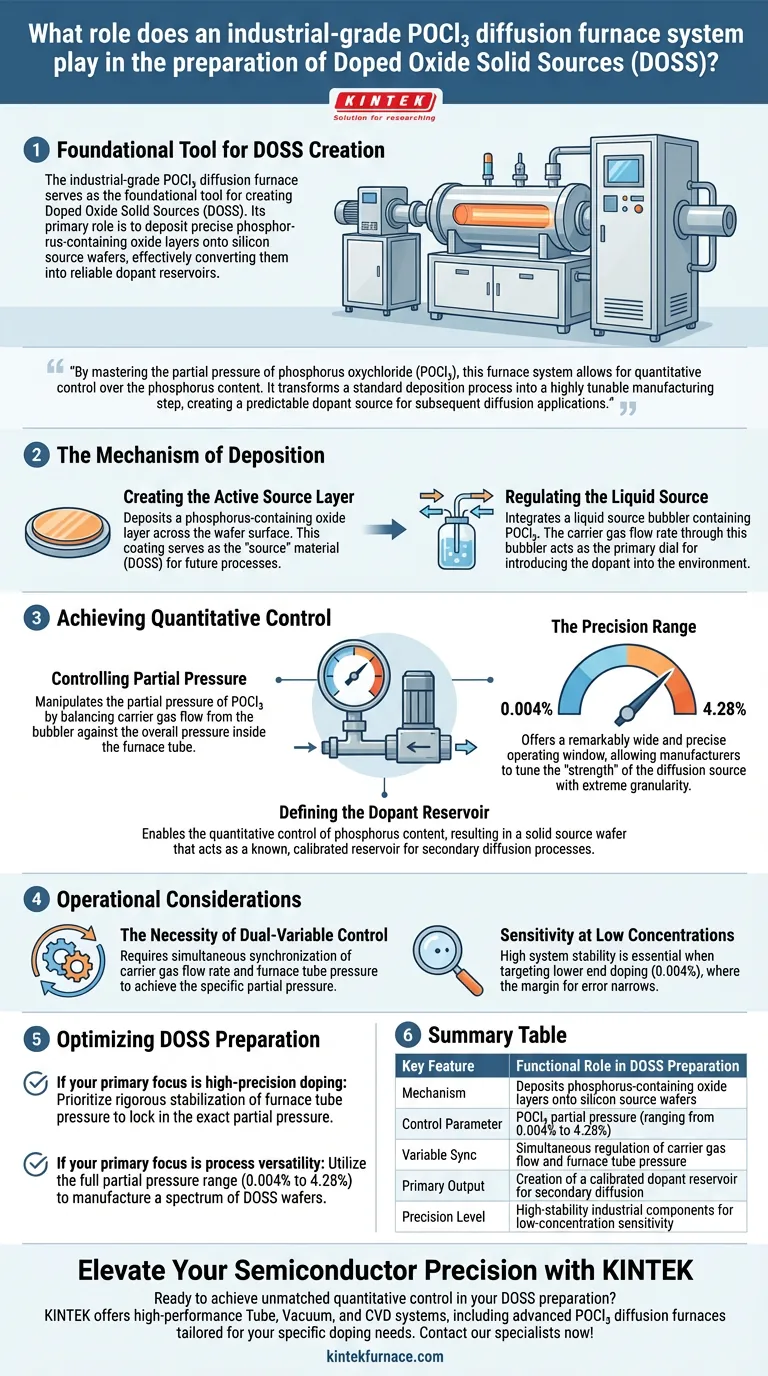
The industrial-grade POCl3 diffusion furnace serves as the foundational tool for creating Doped Oxide Solid Sources (DOSS). Its primary role is to deposit precise phosphorus-containing oxide layers onto silicon source wafers, effectively converting them into reliable dopant reservoirs. Through strict regulation of internal pressures and gas flows, the system determines the exact chemical composition of the solid source.
By mastering the partial pressure of phosphorus oxychloride (POCl3), this furnace system allows for quantitative control over the phosphorus content. It transforms a standard deposition process into a highly tunable manufacturing step, creating a predictable dopant source for subsequent diffusion applications.
The Mechanism of Deposition
Creating the Active Source Layer
The fundamental purpose of the furnace in this context is to coat silicon source wafers with a specific material.
The system deposits a phosphorus-containing oxide layer across the wafer surface. This coating is not the final product's active circuitry but rather serves as the "source" material (DOSS) for future processes.
Regulating the Liquid Source
The furnace system integrates a liquid source bubbler containing POCl3.
To control how much phosphorus enters the chamber, the system precisely manages the carrier gas flow rate through this bubbler. This flow rate acts as the primary dial for introducing the dopant into the environment.
Achieving Quantitative Control
Controlling Partial Pressure
The effectiveness of a DOSS depends entirely on the concentration of phosphorus it holds.
The furnace achieves this by manipulating the partial pressure of POCl3. This is done by balancing the carrier gas flow from the bubbler against the overall pressure maintained inside the furnace tube.
The Precision Range
The industrial-grade system offers a remarkably wide and precise operating window.
Operators can adjust the POCl3 partial pressure from as low as 0.004% up to 4.28%. This specific range allows manufacturers to tune the "strength" of the diffusion source with extreme granularity.
Defining the Dopant Reservoir
This precise control capability moves the process beyond simple coating.
It enables the quantitative control of phosphorus content within the diffusion source. The result is a solid source wafer that acts as a known, calibrated reservoir for secondary diffusion processes.
Operational Considerations
The Necessity of Dual-Variable Control
Achieving the specific partial pressure required for a high-quality DOSS is not a single-step setting.
It requires the simultaneous synchronization of the carrier gas flow rate and the furnace tube pressure. A deviation in either variable will shift the partial pressure, altering the phosphorus content of the final source.
Sensitivity at Low Concentrations
The ability to operate at a partial pressure of 0.004% implies a need for high system stability.
When targeting the lower end of the doping spectrum, the margin for error narrows significantly. The system's industrial-grade components are essential here to maintain steady states without fluctuation.
Optimizing DOSS Preparation
To leverage the full capability of a POCl3 diffusion furnace for solid source preparation, consider your specific targets:
- If your primary focus is high-precision doping: Prioritize the rigorous stabilization of furnace tube pressure to lock in the exact partial pressure required for your target resistivity.
- If your primary focus is process versatility: Utilize the full partial pressure range (0.004% to 4.28%) to manufacture a spectrum of DOSS wafers with varying phosphorus concentrations for different product lines.
By precisely modulating the chemical environment, the furnace ensures that your solid sources provide a consistent and quantifiable baseline for all subsequent diffusion steps.
Summary Table:
| Key Feature | Functional Role in DOSS Preparation |
|---|---|
| Mechanism | Deposits phosphorus-containing oxide layers onto silicon source wafers |
| Control Parameter | POCl3 partial pressure (ranging from 0.004% to 4.28%) |
| Variable Sync | Simultaneous regulation of carrier gas flow and furnace tube pressure |
| Primary Output | Creation of a calibrated dopant reservoir for secondary diffusion |
| Precision Level | High-stability industrial components for low-concentration sensitivity |
Elevate Your Semiconductor Precision with KINTEK
Ready to achieve unmatched quantitative control in your DOSS preparation? Backed by expert R&D and manufacturing, KINTEK offers high-performance Tube, Vacuum, and CVD systems, including advanced POCl3 diffusion furnaces tailored for your specific doping needs. Whether you require precise partial pressure stabilization or customizable high-temperature lab solutions, our experts are here to help you optimize your manufacturing efficiency.
Transform your production today — Contact our specialists now!
Visual Guide
References
- Rachid Chaoui, Brahim Mahmoudi. Phosphorus emitter profile control for silicon solar cell using the doss diffusion technique. DOI: 10.54966/jreen.v19i2.569
This article is also based on technical information from Kintek Furnace Knowledge Base .
Related Products
- Vacuum Dental Porcelain Sintering Furnace for Dental Laboratories
- Controlled Inert Nitrogen Hydrogen Atmosphere Furnace
- 1200℃ Controlled Inert Nitrogen Atmosphere Furnace
- Slide PECVD Tube Furnace with Liquid Gasifier PECVD Machine
- 1700℃ Controlled Inert Nitrogen Atmosphere Furnace
People Also Ask
- What is the purpose of dental sintering furnaces? Transform Zirconia into Durable, High-Quality Dental Restorations
- How does a dental vacuum porcelain furnace maintain restoration quality? Precision Sintering for Superior Esthetics
- What general precautions should be followed when using the Fast Slow Dental Sintering Furnace? Ensure Safe, High-Quality Dental Restorations
- What is a dental sintering furnace and what is its purpose? Achieve High-Strength Dental Restorations
- What is the role of dental sintering furnaces in dental restorations? Transform Zirconia into Durable, Aesthetic Teeth














