
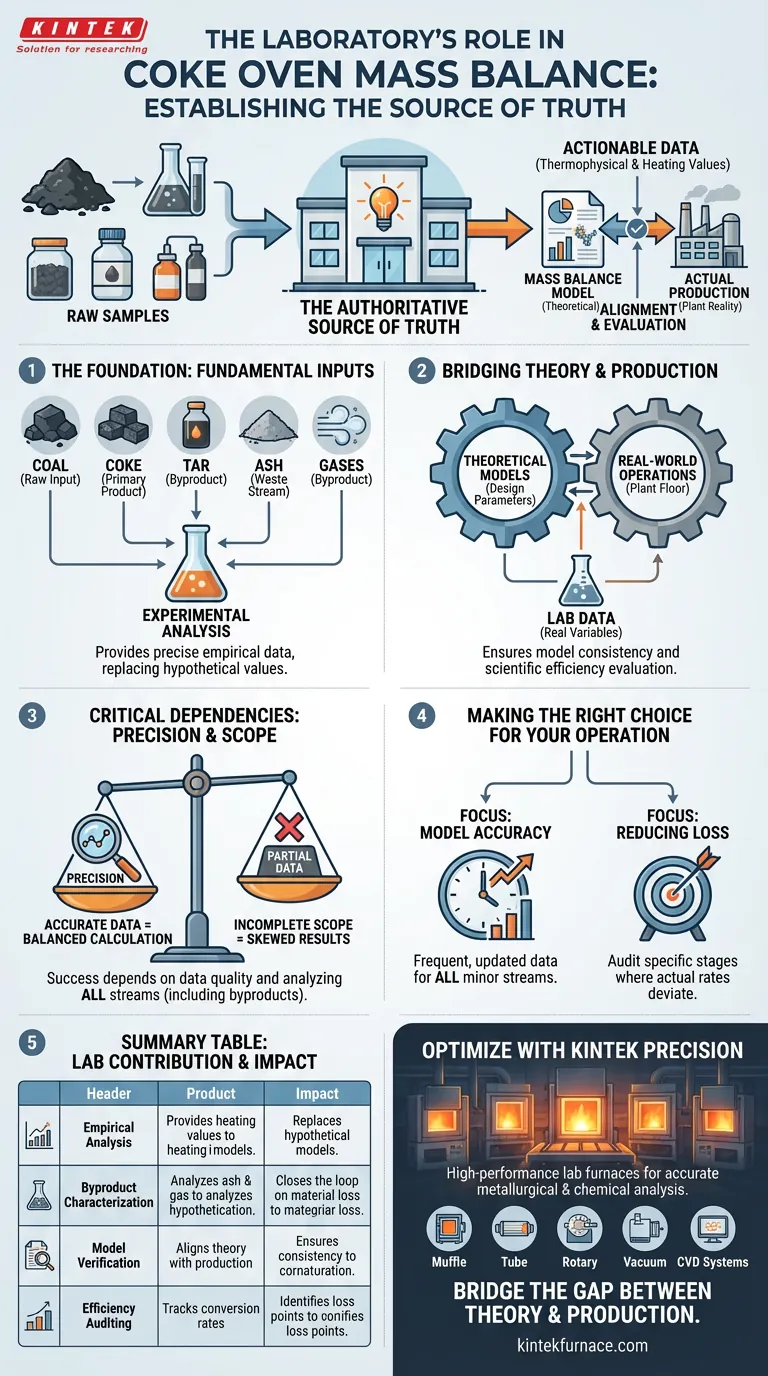
The laboratory serves as the authoritative source of truth for establishing an accurate mass balance in coke oven operations. It is responsible for generating the critical thermophysical data and heating values for all process materials—including coal, coke, tar, ash, and byproduct gases—which act as the fundamental variables for all balance calculations.
The laboratory transforms raw samples into actionable data, ensuring that theoretical mass balance models align with actual production conditions to allow for the scientific evaluation of material loss and efficiency.
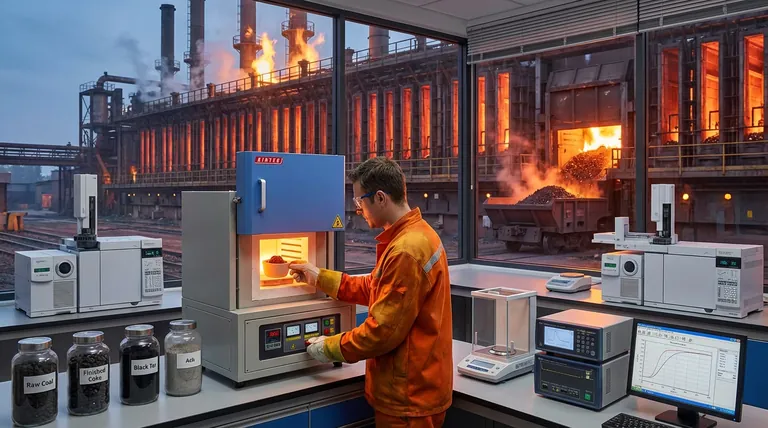
The Foundation of Mass Balance Calculations
Providing Fundamental Inputs
Theoretical models for coke ovens cannot function in a vacuum; they require precise empirical data.
The laboratory provides these fundamental inputs by conducting experimental analysis. Without this verified data, mass balance calculations would remain hypothetical rather than practical tools for plant management.
Analyzing Diverse Material Streams
A complete mass balance requires accounting for every input and output stream.
The laboratory analyzes the specific characteristics of the raw input (coal) and the resulting products. This includes determining the heating values and physical properties of coke, tar, ash, and various byproduct gases.
Bridging Theory and Production
Ensuring Model Consistency
One of the primary challenges in process engineering is the discrepancy between design parameters and real-world operations.
Laboratory data ensures that theoretical models remain consistent with actual production conditions. By feeding real-world variables into the equations, the facility bridges the gap between engineering theory and the reality of the plant floor.
Evaluating Conversion Efficiency
Understanding where material goes is essential for optimizing the coking process.
With accurate lab data, operators can perform a scientific evaluation of conversion efficiency. This allows the facility to track material flow precisely and identify specific stages where material loss occurs.
Understanding the Dependencies
The Criticality of Data Precision
The output of a mass balance calculation is highly sensitive to the quality of the input data.
If the laboratory fails to provide accurate thermophysical characteristics, the entire scientific evaluation becomes compromised. An error in measuring the heating value of a byproduct gas, for example, will skew the energy balance and mask potential inefficiencies.
The Scope of Analysis
Partial data leads to incomplete conclusions.
To establish a valid mass balance, the laboratory cannot focus solely on the primary product (coke). It must maintain equal rigor in analyzing byproducts and waste streams (tar, ash, gases) to fully close the loop on material loss.
Making the Right Choice for Your Operation
To maximize the value of your laboratory facility in mass balance efforts:
- If your primary focus is model accuracy: Ensure the laboratory provides frequent, updated thermophysical data for all minor byproduct streams, not just coal and coke.
- If your primary focus is reducing loss: Use the laboratory's experimental data to audit specific process stages where the "actual" conversion rates deviate significantly from theoretical expectations.
Accurate laboratory data is the difference between guessing your plant's efficiency and scientifically controlling it.
Summary Table:
| Lab Contribution | Functional Benefit | Impact on Mass Balance |
|---|---|---|
| Empirical Analysis | Provides heating values for coal, coke, & tar | Replaces hypothetical models with real-world data |
| Byproduct Characterization | Analyzes ash and gas streams | Closes the loop on material loss and waste tracking |
| Model Verification | Aligns theoretical design with actual production | Ensures consistency between engineering and operation |
| Efficiency Auditing | Tracks conversion rates across process stages | Identifies specific points of material loss |
Optimize Your Coking Process with KINTEK Precision
Accuracy in mass balance begins with high-performance laboratory equipment. Backed by expert R&D and manufacturing, KINTEK offers a comprehensive range of lab high-temp furnaces—including Muffle, Tube, Rotary, Vacuum, and CVD systems—all customizable to meet your unique metallurgical and chemical analysis needs. Whether you are analyzing coal samples or byproduct gas characteristics, our solutions provide the data precision required to maximize your plant's conversion efficiency.
Ready to bridge the gap between theory and production? Contact us today to find the perfect furnace for your laboratory!
Visual Guide
References
- Murat Ergul, Selçuk Selimli. An applied study on energy analysis of a coke oven. DOI: 10.2516/stet/2023042
This article is also based on technical information from Kintek Furnace Knowledge Base .
Related Products
- Laboratory Quartz Tube Furnace RTP Heating Tubular Furnace
- 1200℃ Muffle Oven Furnace for Laboratory
- Laboratory Muffle Oven Furnace with Bottom Lifting
- Laboratory Vacuum Tilt Rotary Tube Furnace Rotating Tube Furnace
- 1400℃ High Temperature Laboratory Tube Furnace with Alumina Tube
People Also Ask
- What physical conditions does a laboratory Tube Furnace provide for SOEC? Precision Heat for Solid Oxide Characterization
- What are the main features and functions of a laboratory tube furnace? Unlock Precise High-Temp Control for Your Lab
- Why is control of heating rate and gas flow in a lab tube furnace critical for EM wave absorption materials?
- What parameters must be controlled when calcining freeze-dried oxide precursors in a laboratory tube furnace? A Guide
- What conditions does a tube furnace provide for post-ion-implantation? Achieve Precise Microstructural Repair



















