
Post-processing Barium Titanate is mandatory because Spark Plasma Sintering (SPS) inherently alters the chemical balance of the ceramic. While SPS is an effective densification method, it typically operates in a vacuum or reducing atmosphere. This environment creates oxygen vacancies and introduces carbon impurities, which degrade the material's electrical properties. A high-temperature air annealing furnace is required to reverse these defects and restore the ceramic to its functional state.
Core Takeaway The vacuum environment of SPS creates chemical defects—specifically oxygen vacancies and carbon contamination—that compromise Barium Titanate. High-temperature air annealing is the necessary corrective step to restore stoichiometry, ensuring the material achieves high insulation resistance and a strong piezoelectric response.
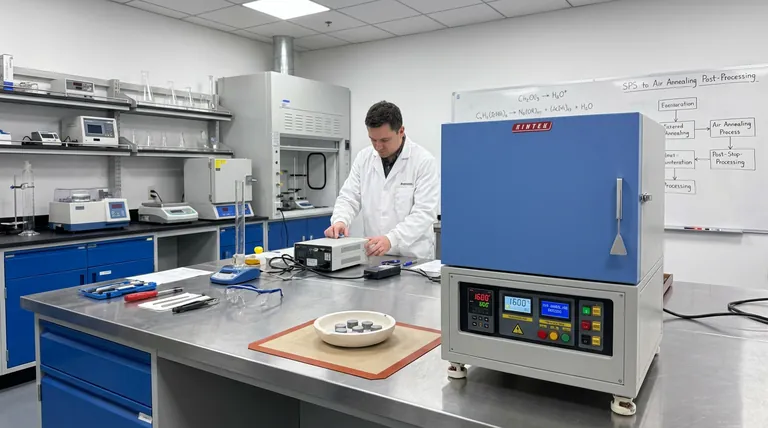
The Chemical Impact of SPS Processing
To understand the necessity of annealing, one must first understand the specific defects introduced during the sintering phase.
The Creation of Oxygen Vacancies
Spark Plasma Sintering is typically performed in a vacuum. While this aids in densification, it creates a reducing atmosphere.
In this oxygen-deprived environment, oxygen atoms are stripped from the Barium Titanate lattice. This leads to the formation of oxygen vacancies, effectively leaving "holes" in the chemical structure of the ceramic.
Residual Carbon Contamination
In addition to oxygen loss, the SPS process introduces foreign elements.
The process creates a risk of residual carbon contamination within the ceramic matrix. These impurities act as defects that interfere with the purity and performance of the final material.
How Air Annealing Restores Material Properties
The annealing furnace acts as a restorative chamber, utilizing an oxygen-rich environment to correct the defects caused by SPS.
Restoring Stoichiometry
The primary function of the high-temperature air furnace is to correct the chemical balance, known as stoichiometry.
By exposing the ceramic to high heat in air, oxygen is reintroduced into the lattice. This process fills the oxygen vacancies created during the vacuum sintering stage, returning the material to its intended oxide structure.
Removing Impurities
The annealing process actively cleans the material of contaminants.
The high-temperature oxygen environment causes the residual carbon to oxidize. This chemical reaction effectively burns off the carbon impurities, eliminating them from the ceramic structure.
Recovering Electrical Performance
Once the stoichiometry is restored and carbon is removed, the macroscopic properties of the ceramic improve drastically.
The treatment significantly enhances insulation resistance, which is often compromised in the oxygen-deficient state. Furthermore, the piezoelectric response—the material's ability to generate an electric charge under stress—is fully recovered.
Understanding the Process Trade-offs
The Cost of "As-Sintered" Material
It is a common pitfall to assume that the material is ready for use immediately after SPS densification.
However, "as-sintered" Barium Titanate is structurally dense but chemically defective. Skipping the annealing phase results in a ceramic with poor electrical insulation and weak piezoelectric performance.
Balancing Efficiency with Performance
SPS is chosen for its speed and efficiency, but it cannot produce a finished functional oxide on its own.
You must accept the additional processing time required for air annealing. This secondary heat treatment is the unavoidable trade-off required to convert a mechanically dense part into an electrically functional component.
Ensuring Material Success
To maximize the performance of your Barium Titanate ceramics, you must view annealing as an extension of the sintering process, not an optional step.
- If your primary focus is Insulation Resistance: You must anneal to eliminate oxygen vacancies, which are the primary drivers of leakage currents.
- If your primary focus is Piezoelectric Response: You must anneal to restore stoichiometry, ensuring the crystal lattice is chemically balanced to support the piezoelectric effect.
High-temperature air annealing is the bridge between a raw sintered shape and a high-performance electronic component.
Summary Table:
| Post-SPS Defect | Impact on Material | Annealing Solution | Resulting Benefit |
|---|---|---|---|
| Oxygen Vacancies | Poor insulation & leakage | Re-oxygenation in air | High insulation resistance |
| Carbon Contamination | Structural impurities | Thermal oxidation | High chemical purity |
| Reduced Stoichiometry | Weak piezoelectric response | Lattice restoration | Enhanced piezoelectricity |
Maximize Your Material Performance with KINTEK
Transitioning from a raw sintered shape to a high-performance electronic component requires precision heat treatment. Backed by expert R&D and manufacturing, KINTEK offers high-temperature air annealing furnaces, Muffle, Tube, and Vacuum systems—all customizable for your specific ceramic processing needs. Whether you are aiming to eliminate oxygen vacancies or restore stoichiometry in Barium Titanate, our systems deliver the uniform heating and atmospheric control your lab demands.
Ready to optimize your post-SPS workflow? Contact our technical experts today to find the perfect furnace for your application!
Visual Guide

References
- Effect of Beam Power on Intermetallic Compound Formation of Electron Beam-Welded Cu and Al6082-T6 Dissimilar Joints. DOI: 10.3390/eng6010006
This article is also based on technical information from Kintek Furnace Knowledge Base .
Related Products
- 1400℃ Controlled Inert Nitrogen Atmosphere Furnace
- 1700℃ Controlled Inert Nitrogen Atmosphere Furnace
- 1400℃ High Temperature Laboratory Tube Furnace with Alumina Tube
- High Temperature Muffle Oven Furnace for Laboratory Debinding and Pre Sintering
- 1700℃ High Temperature Muffle Oven Furnace for Laboratory
People Also Ask
- How does oxygen partial pressure control affect ceramic sintering? Master Defect Chemistry
- Why is controlled-atmosphere heating required for functional ceramics and sensors? Master Defect Engineering
- How do controlled-atmosphere furnaces support polymer pyrolysis? Master SiC & Si3N4 Ceramic Conversion
- Why is thorough binder burnout necessary before sintering advanced ceramics? Ensure Peak Density & Zero Defects
- How does real-time dilatometric analysis in a controlled-atmosphere furnace optimize PZT ceramic sintering?



















