
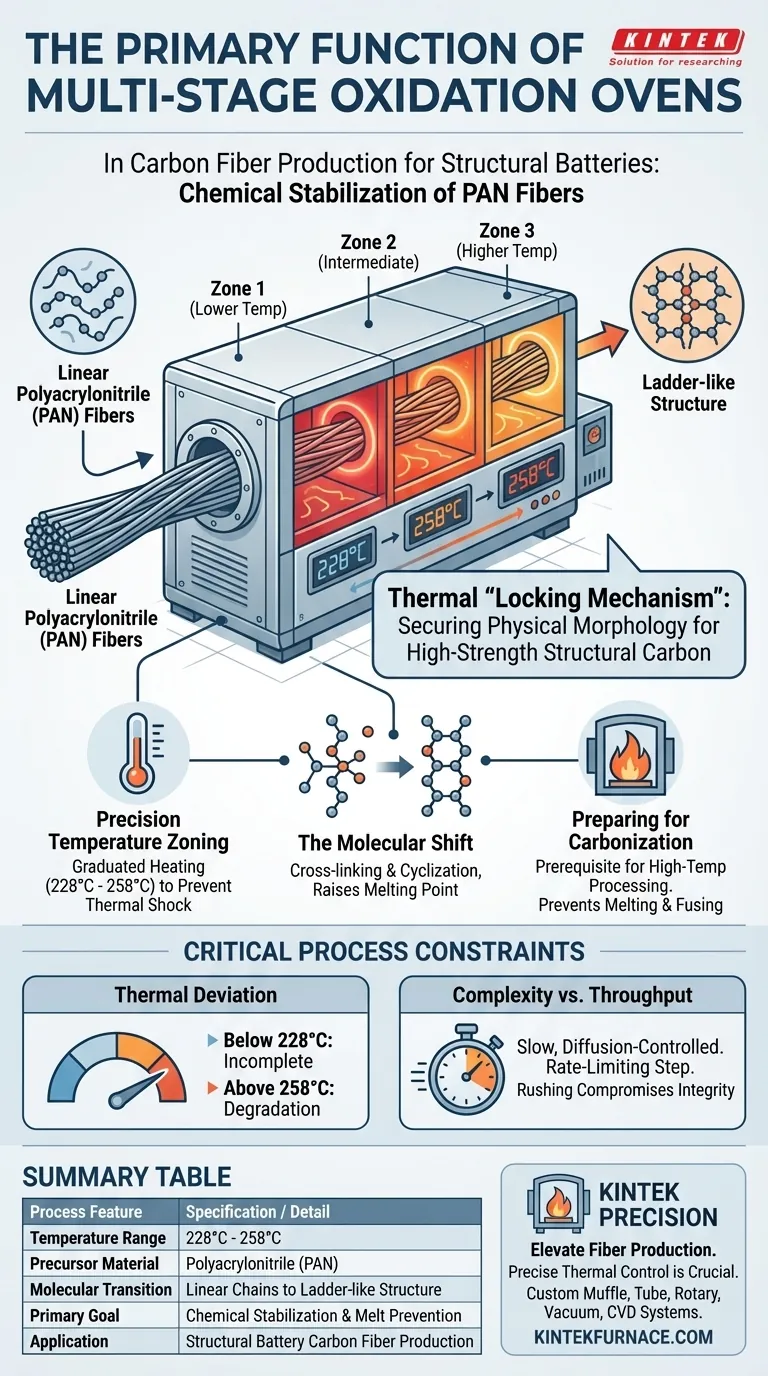
The primary function of multi-stage oxidation ovens is to chemically stabilize polyacrylonitrile (PAN) fibers prior to high-temperature processing. By utilizing precisely controlled temperature zones between 228°C and 258°C, these ovens facilitate a critical reaction that converts the fibers' linear molecular chains into a heat-resistant, ladder-like structure. This transformation is essential to prevent the fibers from melting and to ensure they maintain their physical shape during the subsequent carbonization stages required for structural battery components.
Multi-stage oxidation acts as the thermal "locking mechanism" of manufacturing, securing the physical morphology of the fiber so it can survive the transition from a plastic precursor to a high-strength structural carbon.
The Mechanics of Fiber Stabilization
Precision Temperature Zoning
The oxidation process does not rely on a single, static temperature. Instead, it employs multi-stage ovens that maintain specific thermal environments.
The operational window is strictly controlled, typically ranging from 228°C to 258°C. This graduated heating allows for a controlled reaction rate, preventing thermal shock or uneven stabilization across the fiber tow.
The Molecular Shift
The core purpose of this thermal exposure is to alter the atomic arrangement of the polyacrylonitrile (PAN) precursor.
Initially, the PAN molecules exist as linear chains. As they pass through the oxidation ovens, these chains cross-link and cyclize to form a stable, ladder-like structure. This molecular reconfiguration raises the melting point of the material significantly.
Preparing for Carbonization
Without this stabilization phase, the subsequent step—carbonization—would be impossible.
Carbonization involves extremely high temperatures intended to strip away non-carbon atoms. If the fibers were not first treated in the oxidation ovens to achieve a heat-resistant structure, they would simply melt or fuse together, destroying the fibrous morphology necessary for structural reinforcement.
Critical Process Constraints
The Consequence of Thermal Deviation
The tight temperature range (228°C to 258°C) highlighted in standard processing indicates a high sensitivity to thermal fluctuation.
If the temperature drops below the lower threshold, the chemical transformation may remain incomplete, leading to structural failure later. Conversely, exceeding the upper limit risks burning or degrading the fiber before the ladder structure is fully formed.
Complexity vs. Throughput
Achieving this "ladder-like" structure is a slow, diffusion-controlled process compared to other manufacturing steps.
The requirement for precisely controlled zones implies that this stage is often the rate-limiting step in production. Rushing this phase to increase output compromises the integrity of the ladder structure, resulting in fibers that cannot withstand the mechanical loads required in structural batteries.
Making the Right Choice for Your Goal
If your primary focus is process engineering: Ensure your thermal control systems can maintain strict variance limits within the 228°C–258°C window to guarantee uniform stabilization.
If your primary focus is material performance: Prioritize the completeness of the linear-to-ladder molecular conversion, as this directly dictates the fiber's ability to maintain morphology under load.
Mastering the oxidation phase is the only way to ensure the precursor material evolves into a viable structural component.
Summary Table:
| Process Feature | Specification / Detail |
|---|---|
| Temperature Range | 228°C to 258°C |
| Precursor Material | Polyacrylonitrile (PAN) |
| Molecular Transition | Linear chains to ladder-like structure |
| Primary Goal | Chemical stabilization & melt prevention |
| Application | Structural battery carbon fiber production |
Elevate Your Fiber Production with KINTEK Precision
Precise thermal control is the difference between a high-performance structural battery component and material failure. Backed by expert R&D and world-class manufacturing, KINTEK offers a comprehensive range of Muffle, Tube, Rotary, Vacuum, and CVD systems, along with specialized high-temperature lab furnaces.
Our equipment is fully customizable to meet your unique oxidation and carbonization requirements, ensuring your materials achieve the perfect molecular stabilization. Contact us today to optimize your thermal processing workflow.
Visual Guide
References
- Ruben Tavano, E. Leif. Influence of Carbonisation Temperatures on Multifunctional Properties of Carbon Fibres for Structural Battery Applications. DOI: 10.1002/batt.202400110
This article is also based on technical information from Kintek Furnace Knowledge Base .
Related Products
People Also Ask
- What thermal phenomena occur during polymer binder burnout in ceramic green bodies? Lab Furnace Guide
- What role does a high-temperature muffle furnace play in STFO synthesis? Achieve Pure Perovskite Results
- Why is controlled heat treatment in a muffle furnace necessary for calcined clay? Achieve Optimal Pozzolanic Activity
- How does a high-temperature muffle furnace facilitate the formation of LaNbxAl1−xO3+δ perovskite structures? Key Roles
- What role does a high-temperature muffle furnace play in the formation of biochar catalysts? Master Catalyst Synthesis
