
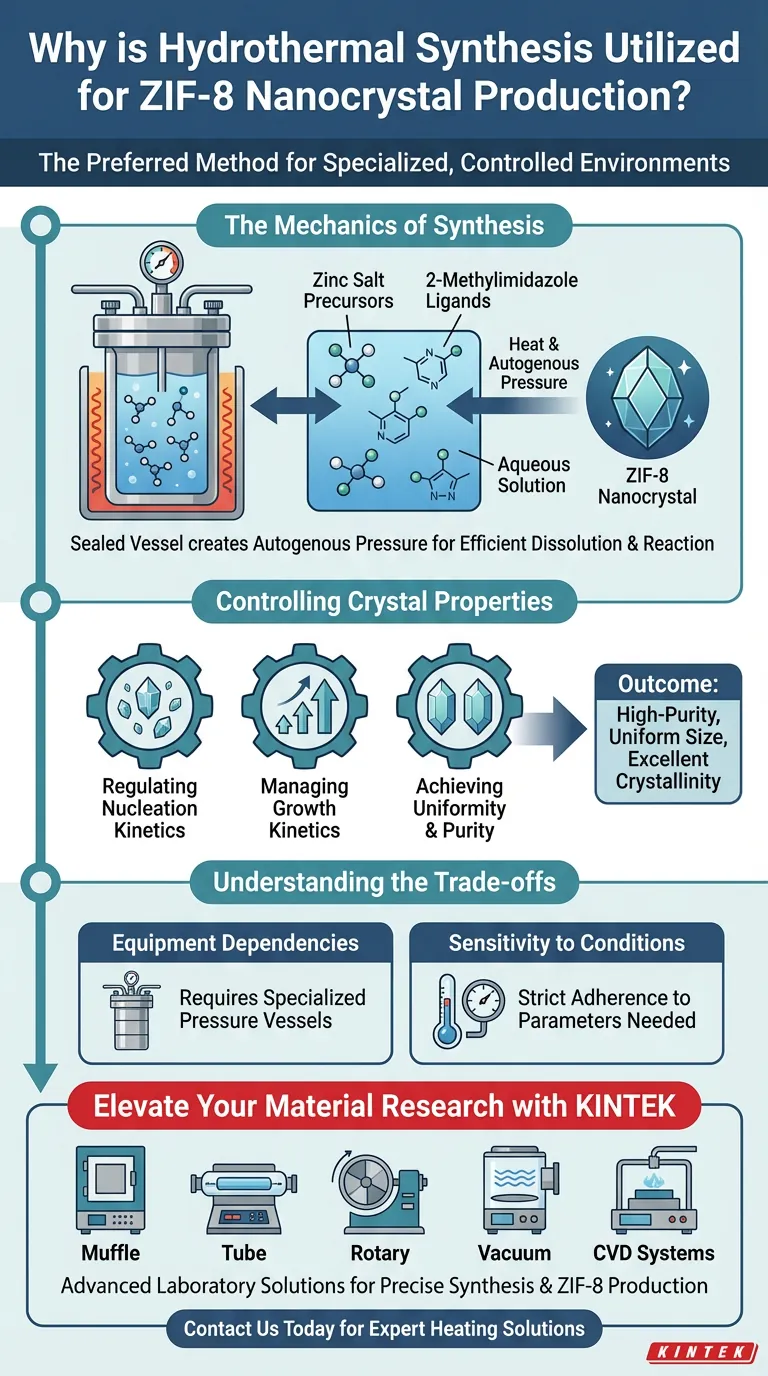
Hydrothermal synthesis is the preferred method for ZIF-8 production because it creates a specialized environment of controlled temperature and autogenous pressure within a sealed vessel. This setup allows for the efficient dissolution and reaction of zinc salt precursors and 2-methylimidazole ligands in aqueous solutions. By strictly regulating these conditions, the method dictates the kinetics of nucleation and growth to produce high-quality nanocrystals.
By leveraging the high-pressure environment of a closed system, hydrothermal synthesis offers superior control over crystal formation, resulting in high-purity ZIF-8 nanoparticles with uniform size and excellent crystallinity.
The Mechanics of Synthesis
Creating the Ideal Environment
The core advantage of this method lies in the use of a closed vessel. Unlike open-air reactions, this seals the chemical components inside.
Utilizing Autogenous Pressure
As the temperature rises within this sealed environment, autogenous pressure builds up naturally. This pressure is critical for driving the reaction forward.
Facilitating Efficient Reactions
The combination of heat and pressure allows the reagents—specifically zinc salt precursors and 2-methylimidazole ligands—to dissolve effectively. This ensures they react efficiently within the aqueous solution.
Controlling Crystal Properties
Regulating Nucleation Kinetics
Hydrothermal synthesis provides precise authority over nucleation, the initial step where the crystal begins to form.
Managing Growth Kinetics
Beyond the initial formation, the method allows for the control of growth kinetics. This determines how large the crystals become after nucleation.
Achieving Uniformity and Purity
Because the kinetics are so tightly controlled, the resulting ZIF-8 nanocrystals exhibit a uniform size distribution. Furthermore, the process yields nanoparticles that are both high-purity and highly crystalline.
Understanding the Trade-offs
Equipment Dependencies
The necessity of a closed vessel to generate autogenous pressure means this process cannot be performed in standard open glassware. Specialized equipment capable of withstanding pressure is required.
Sensitivity to Conditions
Since the outcome depends on precise control of the environment, deviations in temperature or seal integrity can disrupt the nucleation kinetics. This sensitivity requires strict adherence to process parameters to maintain uniformity.
Making the Right Choice for Your Goal
Hydrothermal synthesis is not just a mixing method; it is a tool for precision engineering at the nanoscale.
- If your primary focus is Crystal Quality: Hydrothermal synthesis provides the high purity and crystallinity necessary for advanced material applications.
- If your primary focus is Consistency: This method ensures a uniform size distribution by strictly managing nucleation and growth kinetics.
By controlling the pressure and temperature in a closed system, you transform simple precursors into highly ordered, uniform ZIF-8 structures.
Summary Table:
| Feature | Hydrothermal Synthesis Benefit |
|---|---|
| Environment | Sealed vessel with autogenous pressure |
| Reaction Efficiency | Enhanced dissolution of zinc salts & 2-methylimidazole |
| Nucleation Control | Precise regulation of initial crystal formation |
| Growth Kinetics | Managed development for uniform size distribution |
| Product Quality | High purity and excellent crystallinity |
Elevate Your Material Research with KINTEK
Precise control over nucleation and growth kinetics requires reliable high-temperature and high-pressure equipment. At KINTEK, we specialize in providing advanced laboratory solutions tailored for sophisticated material synthesis.
Backed by expert R&D and manufacturing, KINTEK offers a wide range of Muffle, Tube, Rotary, Vacuum, and CVD systems, along with other lab high-temp furnaces—all customizable to meet your unique ZIF-8 production needs.
Ready to achieve superior nanocrystal uniformity and purity? Contact us today to discover how our expert heating solutions can optimize your synthesis workflow!
Visual Guide
References
- Ashleigh M. Chester, Thomas D. Bennett. Loading and thermal behaviour of ZIF-8 metal–organic framework-inorganic glass composites. DOI: 10.1039/d4dt00894d
This article is also based on technical information from Kintek Furnace Knowledge Base .
Related Products
People Also Ask
- How does hydrogen furnace annealing assist in preparing mechanically alloyed powders for compaction?
- How does atmospheric annealing in a controlled hydrogen furnace affect the cold compaction behavior of metal powders?
- What are the characteristics and uses of hydrogen atmosphere in furnaces? Achieve Superior Surface Purity and Bonding
- What are the characteristics and uses of hydrogen atmospheres in furnaces? Unlock Clean Metal Processing
- What controlled-atmosphere furnace conditions are required for sintering powder metallurgy copper alloy compacts? Ideal Setup
