
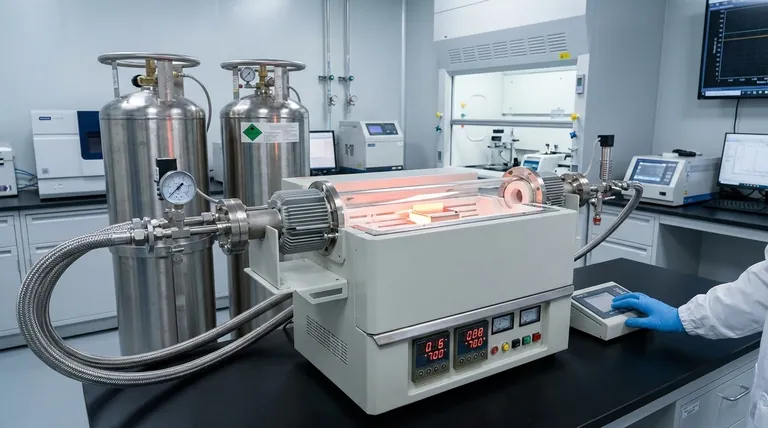
High-pressure oxygen annealing provides the thermodynamic force necessary to restore the stoichiometry of La1-xSrxMnO3 (LSMO) thin films. By subjecting the material to extreme environments—specifically oxygen pressures up to 100 bar at temperatures around 700 °C—this process actively drives oxygen into the crystal lattice to repair defects that standard annealing cannot reach.
Core Takeaway Thin films often suffer from degraded properties due to oxygen vacancies created by epitaxial strain. A high-pressure oxygen annealing furnace solves this by using massive pressure to force oxygen back into the lattice, correcting the manganese valence state and restoring the film's electromagnetic performance to match that of the bulk material.
The Mechanism: Overcoming Lattice Strain
Forcing Oxygen Infiltration
Standard annealing relies on passive diffusion, which is often insufficient for complex oxides. High-pressure annealing creates an environment of 100 bar of oxygen pressure.
Compensating for Epitaxial Strain
LSMO thin films experience significant strain when grown on substrates, leading to the formation of oxygen vacancies. The extreme pressure of this furnace provides the energy required to overcome this strain barrier, forcing oxygen atoms to occupy these vacant lattice sites.
Restoring Electronic and Magnetic Properties
Regulating the Manganese Valence State
The critical advantage of this process is the precise regulation of the Mn3+/Mn4+ ratio. Oxygen vacancies disrupt this balance, which is fundamental to the material's double-exchange mechanism.
Tuning Electromagnetic Performance
By refilling vacancies and correcting the valence ions, the furnace ensures the film's properties align with its theoretical potential. This causes the electromagnetic behavior of the thin film to closely resemble that of the bulk material, eliminating the performance degradation typically seen in strained films.
Understanding the Trade-offs
High Pressure vs. Standard Atmosphere
While a standard box-type atmosphere furnace offers good temperature uniformity and precise gas flow control, it operates near atmospheric pressure. For materials like LSMO where lattice strain is high, standard atmospheric pressure is often insufficient to drive the necessary chemical changes.
Specificity of Application
This process is specialized for defect compensation. In contrast, some laboratory annealing processes (such as those used for Gallium Oxide derivatives) are designed to induce lattice distortion or increase vacancies. You must ensure your goal is stoichiometry restoration, not defect engineering.
Making the Right Choice for Your Goal
This technology is not a one-size-fits-all solution; it is a precision tool for oxide electronics.
- If your primary focus is restoring bulk-like behavior: Use high-pressure oxygen annealing to correct the Mn3+/Mn4+ ratio and eliminate strain-induced vacancies.
- If your primary focus is basic stress relief or drying: A standard vacuum or box furnace is sufficient and more cost-effective for simple thermal treatments like removing organic residues.
By utilizing high-pressure oxygen annealing, you move beyond simple heating and apply a thermodynamic fix to the root cause of thin-film degradation.
Summary Table:
| Feature | Standard Annealing Furnace | High-Pressure Oxygen Furnace |
|---|---|---|
| Operating Pressure | Atmospheric (approx. 1 bar) | Up to 100 bar |
| Mechanism | Passive diffusion | Forced lattice infiltration |
| LSMO Impact | Limited vacancy repair | Restores Mn3+/Mn4+ valence state |
| Result | Residual epitaxial strain | Bulk-like electromagnetic properties |
| Best Use Case | Basic stress relief & drying | Stoichiometry restoration in oxides |
Elevate Your Thin-Film Research with KINTEK
Don't let oxygen vacancies compromise your material's performance. KINTEK provides industry-leading thermal solutions, including specialized high-pressure, vacuum, and CVD systems designed for the most demanding research environments.
Backed by expert R&D and manufacturing, our customizable laboratory furnaces empower you to achieve bulk-like properties in strained thin films through precise thermodynamic control.
Ready to restore your material's stoichiometric integrity? Contact our technical specialists today to find the perfect furnace for your unique needs.
References
- Meritxell Toda‐Casaban, B. Martı́nez. Tuning of Antiferromagnetic Phase in La<sub>1–<i>x</i></sub>Sr<sub><i>x</i></sub>MnO<sub>3</sub> Epitaxial Thin Films by Polymer-Assisted Deposition Synthesis. DOI: 10.1021/acs.cgd.4c00229
This article is also based on technical information from Kintek Furnace Knowledge Base .
Related Products
- 9MPa Air Pressure Vacuum Heat Treat and Sintering Furnace
- High Pressure Laboratory Vacuum Tube Furnace
- Controlled Inert Nitrogen Hydrogen Atmosphere Furnace
- 1400℃ Controlled Inert Nitrogen Atmosphere Furnace
- 1700℃ Controlled Inert Nitrogen Atmosphere Furnace
People Also Ask
- What are the key features of vacuum pressure sintering furnaces? Unlock High-Purity, Dense Materials
- What materials can be processed using vacuum pressure sintering furnaces? Unlock High-Performance Material Densification
- What safety features are integrated into vacuum pressure sintering furnaces? Ensure Operator and Equipment Protection
- What are the key components of a vacuum pressure sintering furnace? Essential Systems for High-Performance Materials
- What are the main technical parameters of vacuum pressure sintering furnaces? Key Specs for Advanced Materials



















