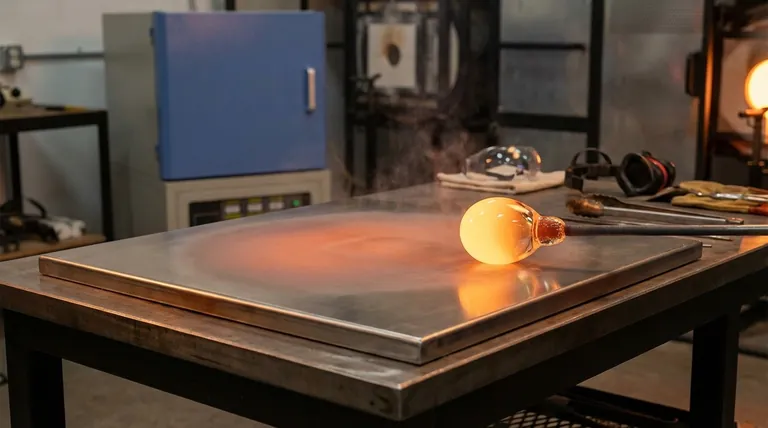
The primary purpose of a preheated stainless steel plate is to prevent catastrophic failure of molten glass through thermal stress management. By using a plate heated to approximately 480°C, technicians can facilitate the initial shaping of the material while strictly regulating its cooling rate. This temperature-controlled contact surface is essential for maintaining the structural integrity of the glass block before it enters the final annealing stage.
Preheating the contact surface minimizes the thermal gradient between the molten glass and the tool, preventing the material from shattering due to localized thermal shock. This process ensures the glass remains intact and structurally sound for subsequent processing.
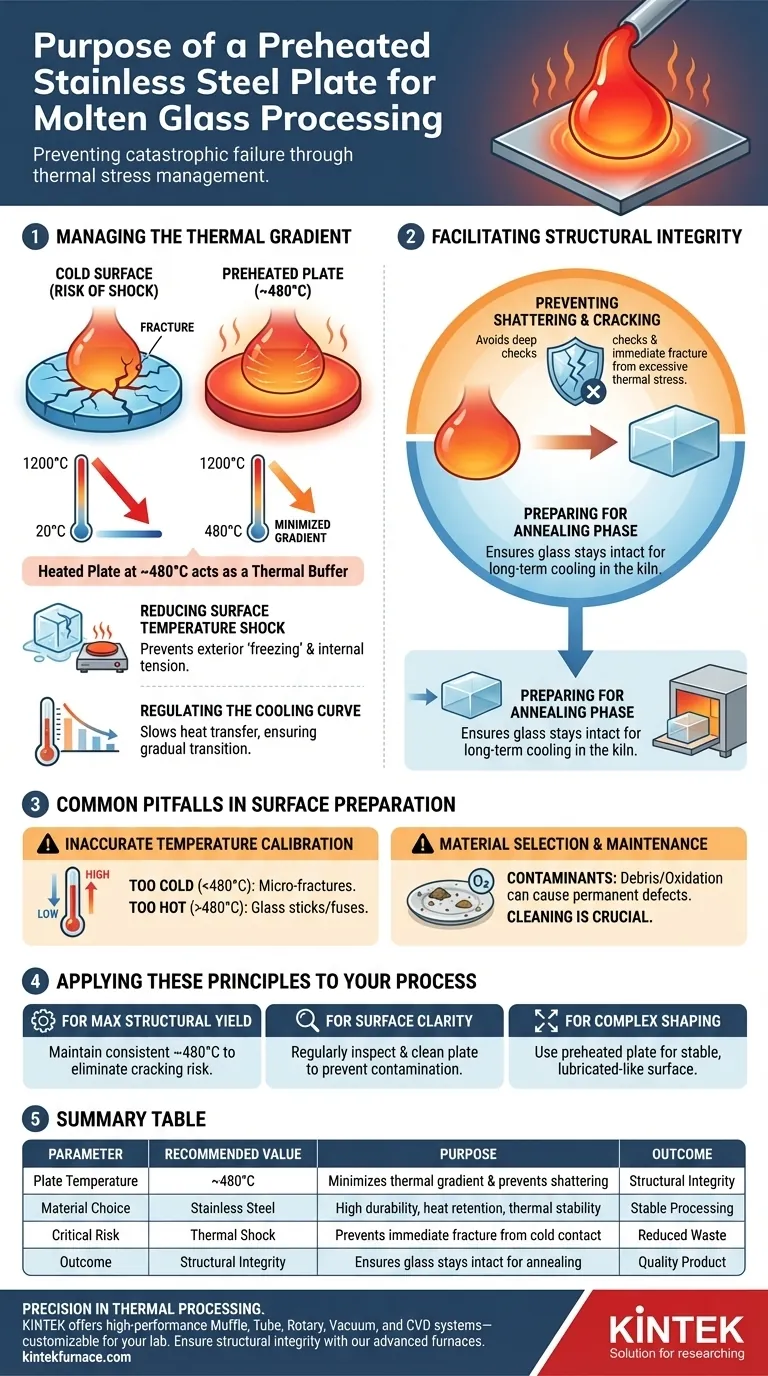
Managing the Thermal Gradient
Reducing Surface Temperature Shock
When molten glass contacts a cold surface, the exterior layer "freezes" and contracts much faster than the molten core. This massive temperature difference, known as a thermal gradient, creates internal tension that can lead to immediate fracture.
Regulating the Cooling Curve
A plate preheated to 480°C acts as a thermal buffer, slowing the transfer of heat away from the glass. By controlling this initial cooling phase, the glass transitions more gradually from a liquid to a solid state, reducing the risk of internal strain.
Facilitating Structural Integrity
Preventing Shattering and Cracking
The most critical risk in glass processing is excessive thermal stress. Without a preheated surface, the glass is likely to shatter or develop deep "checks" (surface cracks) that compromise the entire block.
Preparing for the Annealing Phase
Initial shaping on a heated plate ensures the glass block stays in one piece long enough to reach the annealing kiln. Proper preparation at this stage is the only way to ensure the material survives the long-term cooling process required for a finished product.
Common Pitfalls in Surface Preparation
Inaccurate Temperature Calibration
If the plate is heated significantly below 480°C, the glass may still experience enough shock to cause micro-fractures. Conversely, if the plate is too hot, the glass may stick or fuse to the stainless steel, ruining the surface finish.
Material Selection and Maintenance
Stainless steel is chosen for its durability and heat retention, but surface contaminants can affect the glass. Any debris or oxidation on the plate can be pressed into the molten glass, creating permanent visual or structural defects.
Applying These Principles to Your Process
When utilizing preheated surfaces in glasswork, your specific goals will dictate how you manage the environment.
- If your primary focus is maximizing structural yield: Ensure your plate is consistently maintained at 480°C to eliminate the risk of cracking during the critical shaping window.
- If your primary focus is surface clarity: Regularly inspect and clean the stainless steel plate to prevent the transfer of metallic oxides or debris to the molten glass.
- If your primary focus is complex shaping: Use the preheated plate to provide a stable, lubricated-like surface that allows the glass to be moved without sticking or premature hardening.
By precisely controlling the temperature of the contact surface, you transform a high-risk material transition into a predictable, stable manufacturing step.
Summary Table:
| Parameter | Recommended Value | Purpose in Glass Processing |
|---|---|---|
| Plate Temperature | ~480°C | Minimizes thermal gradient and prevents shattering |
| Material Choice | Stainless Steel | High durability, heat retention, and thermal stability |
| Critical Risk | Thermal Shock | Prevents immediate fracture from cold surface contact |
| Outcome | Structural Integrity | Ensures glass stays intact for the final annealing phase |
Precision is paramount when managing thermal gradients in glass and material science. Backed by expert R&D and manufacturing, KINTEK offers high-performance Muffle, Tube, Rotary, Vacuum, and CVD systems—all customizable to meet your unique lab requirements. Ensure the structural integrity of your materials with our advanced high-temperature furnaces. Contact KINTEK today to optimize your thermal processing!
Visual Guide
References
- I. M. Teixeira, J. W. Menezes. Transforming Rice Husk Ash into Road Safety: A Sustainable Approach to Glass Microsphere Production. DOI: 10.3390/ceramics8030093
This article is also based on technical information from Kintek Furnace Knowledge Base .
Related Products
People Also Ask
- What is the significance of using a high-temperature tube furnace with observation windows? Real-Time Wettability Analysis
- Why is an Ultra-High Vacuum (UHV) System Required for In2Se3? Achieving Atomic-Level Ferroelectric Clarity
- Why is an environmental laboratory chamber equipped with an optical window required for synthesizing Hafnium Carbide?
- What are the structural functions of the dual-chamber quartz glass container? Optimize Magnesium Alloy Vapor Analysis
- What is the purpose of utilizing a glassy carbon crucible and HCl gas treatment? Ensure Pure Molten Salt Systems