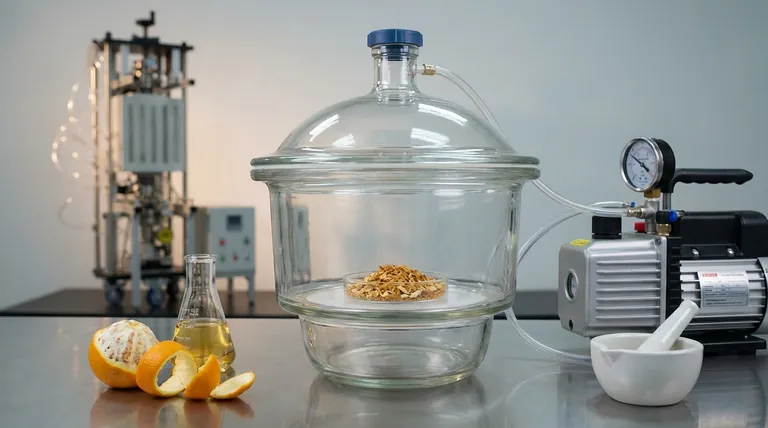
A vacuum desiccator is essential for preserving fruit peel extracts because it creates a low-pressure, moisture-free environment that facilitates the removal of residual solvents without the use of damaging heat. By lowering the environmental pressure, the device allows solvents to evaporate at ambient temperatures, preventing the thermal degradation of sensitive bioactive compounds while maintaining a contamination-free storage state.
By reducing atmospheric pressure, a vacuum desiccator lowers the boiling point of solvents, allowing extracts to dry completely without thermal stress. This process preserves the chemical integrity of oxidation-prone compounds like polyphenols, ensuring the sample remains stable for accurate phytochemical analysis.
The Principles of Preservation
Preventing Thermal Degradation
Fruit peel extracts often contain volatile and heat-sensitive compounds. Traditional drying methods that rely on heat can denature or destroy these valuable components.
A vacuum desiccator solves this by reducing the internal pressure. This physical change lowers the boiling point of residual solvents, allowing them to evaporate off the sample at safe, low temperatures.
Protecting Chemical Stability
Bioactive compounds found in fruit peels, such as polyphenols and flavonoids, are prone to oxidation and breakdown when exposed to environmental stressors.
The vacuum environment minimizes exposure to reactive air and moisture. This creates a stable stasis that preserves the original chemical profile of the extract.
Eliminating Moisture and Contamination
Beyond solvent removal, the desiccator maintains an actively dry environment. This prevents the re-absorption of atmospheric moisture, which acts as a catalyst for mold growth and chemical hydrolysis.
Furthermore, the sealed system provides a physical barrier against laboratory dust and cross-contamination. This ensures the extract remains pure for subsequent testing.
Ensuring Analytical Accuracy
The ultimate goal of extraction is often analysis. If the sample degrades during storage, the resulting data will be flawed.
By stabilizing the extract, the vacuum desiccator ensures that the phytochemicals detected in analysis accurately reflect the composition of the original source material.
Understanding the Trade-offs
Process Speed vs. Sample Integrity
While vacuum desiccation is gentler than oven drying, it is generally a slower process. You are trading rapid solvent removal for higher chemical fidelity.
Maintenance of the Seal
The effectiveness of the system relies entirely on the integrity of the vacuum seal. Poorly greased flanges or degraded gaskets can lead to pressure leaks, rendering the preservation ineffective.
Desiccant Saturation
The desiccant material inside the chamber has a finite capacity for moisture absorption. It requires regular monitoring and regeneration (drying) to maintain the low-humidity environment necessary for preservation.
Making the Right Choice for Your Goal
To ensure the highest quality results in your extraction workflow, match your storage method to your analytical needs:
- If your primary focus is preserving heat-sensitive compounds: Rely on vacuum desiccation to remove solvents without thermal damage to polyphenols and flavonoids.
- If your primary focus is long-term storage stability: Use the desiccator to eliminate moisture uptake and prevent oxidation or microbial spoilage.
- If your primary focus is analytical precision: Utilize this method to guarantee that your test samples are free from environmental contamination and degradation products.
Proper use of a vacuum desiccator converts a vulnerable raw extract into a stable, scientifically valid sample ready for rigorous analysis.
Summary Table:
| Feature | Vacuum Desiccation Benefit |
|---|---|
| Temperature Control | Facilitates low-temperature solvent evaporation to prevent thermal stress. |
| Chemical Stability | Protects polyphenols and flavonoids from oxidation and degradation. |
| Moisture Control | Eliminates atmospheric humidity to prevent mold and chemical hydrolysis. |
| Sample Purity | Provides a sealed, dust-free environment for contamination-free storage. |
| Analytical Goal | Ensures high-fidelity data by maintaining the extract's original profile. |
Secure the Integrity of Your Sensitive Extracts with KINTEK
Don't let thermal degradation or moisture compromise your phytochemical research. KINTEK provides high-performance vacuum systems and laboratory equipment designed to protect your most delicate samples. Backed by expert R&D and precision manufacturing, we offer a comprehensive range of Muffle, Tube, Rotary, Vacuum, and CVD systems, as well as customizable high-temperature furnaces tailored to your lab's unique requirements.
Ready to enhance your preservation workflow? Contact our specialists today to discover how our customizable solutions can ensure your analytical accuracy and sample stability.
References
- Valorization of fruit byproducts: Proximate analysis, functional characteristics and antioxidant activity of beetroot, chestnut peel and bael pulp. DOI: 10.22271/phyto.2025.v14.i4d.15473
This article is also based on technical information from Kintek Furnace Knowledge Base .
Related Products
- Vacuum Hot Press Furnace Machine for Lamination and Heating
- Vacuum Dental Porcelain Sintering Furnace for Dental Laboratories
- Stainless Steel Quick Release Vacuum Chain Three Section Clamp
- Vacuum Hot Press Furnace Machine Heated Vacuum Press
- Small Vacuum Heat Treat and Tungsten Wire Sintering Furnace
People Also Ask
- What are the primary components of a vacuum hot press furnace? Master the Core Systems for Precise Material Processing
- What safety features are incorporated in vacuum hot press furnaces? Ensure Operator and Equipment Protection
- What are the benefits of the vacuum environment system in a vacuum hot press furnace? Unlock High-Density Sintering
- What industries benefit from the use of vacuum hot press furnaces? Unlock High-Performance Materials for Your Industry
- How does the uniaxial pressure applied by a vacuum hot press furnace affect the microstructure of ZrC-SiC materials?