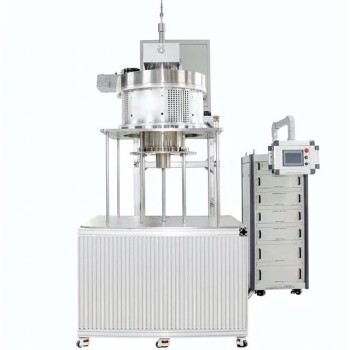
In an ex situ Catalytic Hydropyrolysis (CHP) process, the fixed-bed catalytic reactor functions as a dedicated, external upgrading unit that refines pyrolysis vapors. Situated downstream from the primary pyrolysis furnace, it facilitates critical chemical modifications—specifically hydrogenation, deoxygenation, and cracking—in a hydrogen-rich atmosphere to transform raw vapors into stable bio-oil.
Core Takeaway: By decoupling the initial biomass breakdown from the vapor upgrading, the fixed-bed reactor allows for precise, independent temperature control (typically 350–400 °C), which is essential for minimizing the oxygen content and maximizing the chemical stability of the final product.
The Mechanics of Vapor Upgrading
Decoupled Processing
In an ex situ configuration, the catalytic reactor is physically separated from the primary pyrolysis furnace.
This separation is crucial because it allows the upgrading stage to operate independently of the biomass decomposition stage. The vapors produced in the furnace are transferred to this secondary vessel for targeted treatment.
Chemical Transformation
Once inside the reactor, the pyrolysis vapors are exposed to specific catalysts within a hydrogen-rich environment.
This triggers a series of specific reactions: hydrogenation (adding hydrogen), deoxygenation (removing oxygen), and cracking (breaking down heavy molecules). These reactions directly address the high oxygen content often found in raw bio-oils.
Precise Environmental Control
Fixed-bed reactors are designed to maintain a constant temperature field and stable gas flow.
This stability allows for the precise simulation and control of reaction conditions, such as Weight Hourly Space Velocity (WHSV). By regulating the flow and contact time, operators can fine-tune the extent of the chemical upgrading.
Operational Advantages
Temperature Optimization
Because the reactor is external, it can operate at its own optimized temperature range, typically between 350 and 400 °C.
This range is distinct from the temperature required for the initial pyrolysis. This thermal independence ensures that the catalyst operates at its peak efficiency without being constrained by the thermal needs of the biomass feedstock.
Enhanced Bio-oil Stability
The primary output goal of this reactor is the enhancement of the bio-oil's quality.
By significantly reducing oxygen levels through the reactions described above, the reactor produces a bio-oil with superior chemical stability. This makes the final product less corrosive and more suitable for storage or further refining.
Understanding the Trade-offs
Complexity and Catalyst Life
While the fixed-bed design offers superior control, it introduces operational complexity compared to single-stage processes.
Furthermore, because the catalyst remains stationary (fixed) in the bed, it acts as a filter for impurities. Long-term thermal stability and resistance to poisoning are critical factors, as the catalyst bed may eventually degrade or foul, requiring regeneration or replacement.
Making the Right Choice for Your Goal
If you are evaluating the inclusion of a fixed-bed reactor in your CHP process design, consider your specific targets:
- If your primary focus is Bio-oil Quality: This reactor is essential for deep deoxygenation, yielding a more stable and energy-dense liquid fuel.
- If your primary focus is Process Control: The ex situ nature allows you to troubleshoot and optimize the pyrolysis and upgrading steps individually, rather than compromising on a "middle ground" temperature.
The fixed-bed catalytic reactor ultimately serves as the quality control center of the CHP process, converting raw potential into a stable, usable energy product.
Summary Table:
| Feature | Function in Ex Situ CHP |
|---|---|
| Primary Role | External upgrading and refining of pyrolysis vapors |
| Key Reactions | Hydrogenation, Deoxygenation, and Cracking |
| Operating Temp | Typically 350–400 °C (Independent of pyrolysis) |
| Atmosphere | Hydrogen-rich environment |
| Main Benefit | Enhanced bio-oil stability and significantly lower oxygen content |
| Process Design | Decoupled configuration for precise environmental control |
Elevate Your Bio-oil Research with KINTEK
Are you looking to achieve superior deoxygenation and chemical stability in your CHP process? Backed by expert R&D and manufacturing, KINTEK offers a comprehensive range of lab high-temp furnaces, including Muffle, Tube, Rotary, Vacuum, and CVD systems—all fully customizable to your unique catalytic reactor needs. Our equipment is designed to provide the precise thermal control and gas flow stability required for advanced vapor upgrading.
Ready to optimize your fuel production? Contact us today to discuss your custom furnace requirements and see how our expertise can drive your results!
References
- Hoda Shafaghat, Olov Öhrman. Customized Atmospheric Catalytic Hydropyrolysis of Biomass to High-Quality Bio-Oil Suitable for Coprocessing in Refining Units. DOI: 10.1021/acs.energyfuels.3c05078
This article is also based on technical information from Kintek Furnace Knowledge Base .
Related Products
- Custom Made Versatile CVD Tube Furnace Chemical Vapor Deposition CVD Equipment Machine
- Slide PECVD Tube Furnace with Liquid Gasifier PECVD Machine
- MPCVD Machine System Reactor Bell-jar Resonator for Lab and Diamond Growth
- 915MHz MPCVD Diamond Machine Microwave Plasma Chemical Vapor Deposition System Reactor
- Laboratory Quartz Tube Furnace RTP Heating Tubular Furnace
People Also Ask
- What is a CVD tube furnace and what is its primary function? Discover Precision Thin-Film Deposition
- Why are CVD tube furnace sintering systems indispensable for 2D material research and production? Unlock Atomic-Scale Precision
- Which industries and research fields benefit from CVD tube furnace sintering systems for 2D materials? Unlock Next-Gen Tech Innovations
- How does CVD tube furnace sintering enhance graphene growth? Achieve Superior Crystallinity and High Electron Mobility
- How can integrating CVD tube furnaces with other technologies benefit device fabrication? Unlock Advanced Hybrid Processes